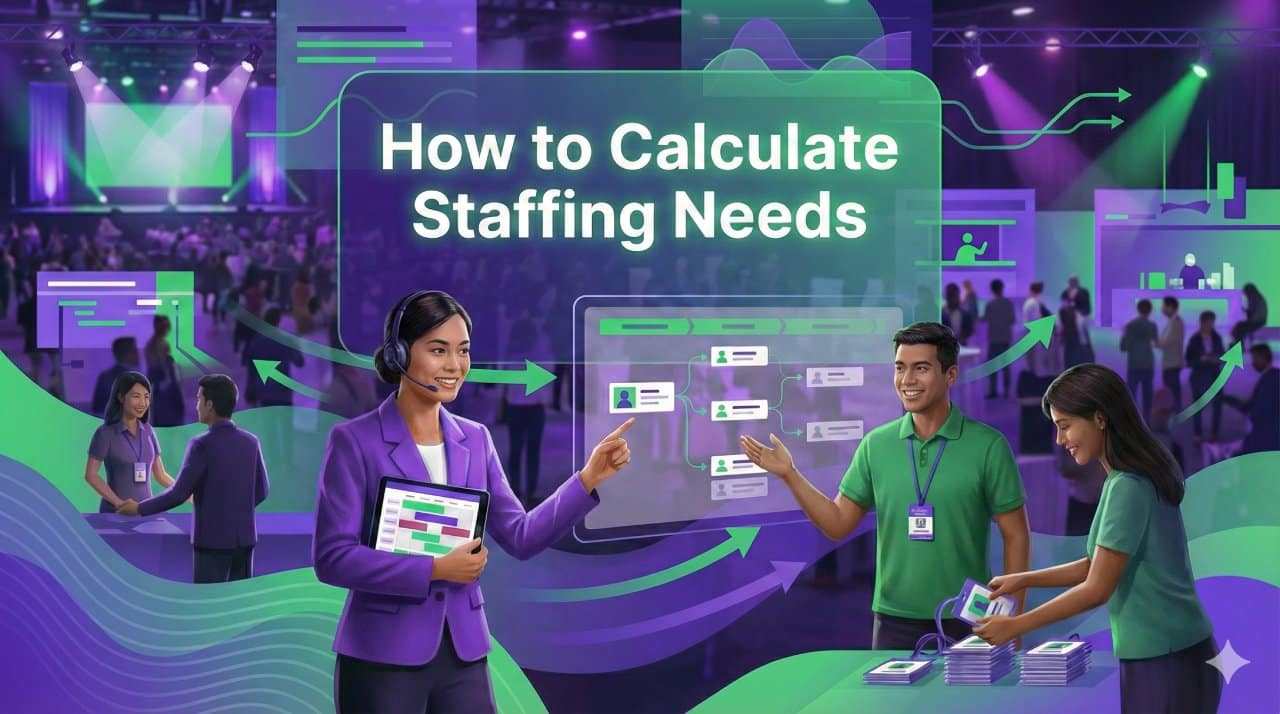
Knowing how to calculate staffing needs is one of the most important operational skills for any event staffing agency, supplier, or venue managing temporary teams. At its core, calculating staffing needs means determining how many people you require, in which roles, for how long, and with what level of contingency to deliver an event smoothly and profitably.
When staffing calculations are wrong, the consequences are immediate. Overstaffing inflates costs and erodes margins. Understaffing creates pressure on teams, compromises client delivery, and increases last minute changes. Poor planning often leads to reactive decision making when there is little time to fix it.
This article explains how to calculate staffing needs in a practical, structured way. It breaks the process down step by step, uses realistic numerical examples, and highlights where planning commonly goes wrong.
By the end, you should have a clear framework you can apply to real events, and a better understanding of when systems are required to support growing complexity.
5 Core Factors That Determine Staffing Needs
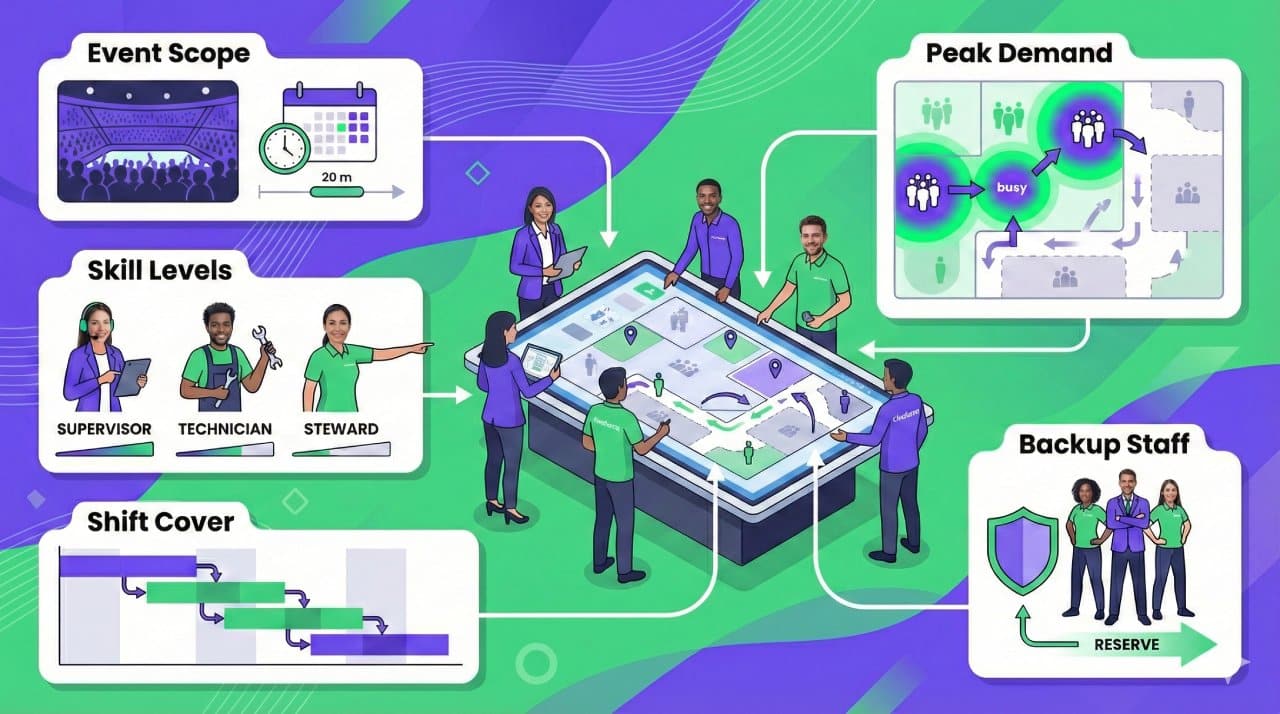
Calculating staffing needs is not about applying a single formula. It requires weighing several interconnected factors that change from event to event.
1. Event size and duration
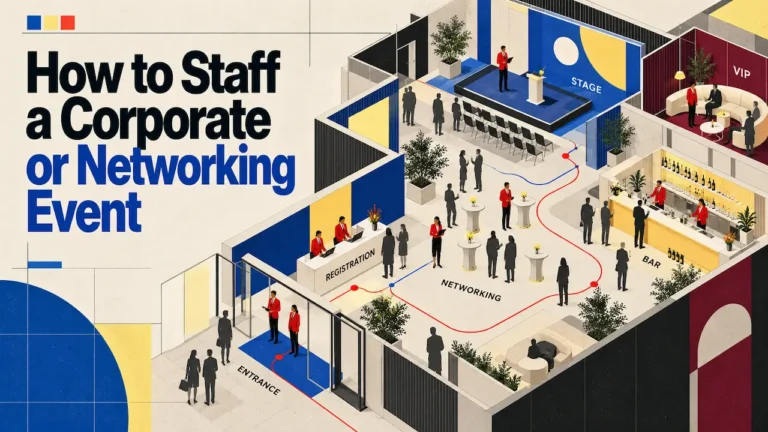
Event size is not just attendance numbers. It includes footprint, number of zones, operating hours, and complexity of movement. A 500 person conference across one hall requires fewer staff than a 500 person festival spread across multiple areas over several days.
Duration also matters. A one day event with long operating hours places different demands on staffing than a multi day event with shorter daily shifts.
2. Role complexity and skill level
Not all roles scale evenly. Low-skill, high volume roles such as general stewards or brand ambassadors often require higher headcounts but shorter training time. Specialist roles such as technicians, supervisors, or production managers usually require fewer people, but longer shifts and greater contingency.
When calculating staffing needs, experienced planners account for the mix of skills, not just total numbers.
3. Shift length and handovers
Shift length affects fatigue, compliance, and handover requirements. Shorter shifts increase headcount needs but can improve performance and reduce errors. Longer shifts reduce headcount but increase the need for breaks, supervision, and contingency.
Handovers also introduce risk. Each handover requires overlap or buffer time, which must be factored into staffing calculations.
4. Peak versus non peak periods
Most events have predictable peaks. Doors opening, session changeovers, headline acts, or meal service windows often require temporary increases in staffing. Planning solely on average demand almost always results in understaffing at critical moments.
Understanding how to calculate staffing needs means identifying these peaks and planning additional cover only where it is genuinely required.
5. Contingency planning
No plan survives contact with reality unchanged. Sickness, late arrivals, no-shows, weather disruption, or last-minute client requests are common in event environments. A realistic contingency buffer is essential, particularly for large or high-risk events.
Step by Step: How to Calculate Staffing Needs
This section outlines a practical approach to calculating staffing needs using realistic assumptions and examples.
Step 1: Define the operational requirements
Start by listing what must be delivered operationally. This includes:
- Areas or zones that must be covered
- Roles required in each area
- Operating hours per day
- Any legal or safety minimums
Avoid jumping straight to headcount. Focus first on what needs to be covered and when.
Step 2: Translate coverage into shifts
Once coverage is clear, convert it into shifts based on realistic working hours.
Example 1: One-day corporate event
- Attendance: 500 people
- Operating hours: 10 hours
- Roles required:
- 10 registration staff
- 15 floor staff
- 5 supervisors
- 10 registration staff
Assume an 8-hour maximum shift length.
To cover 10 hours of operation:
- Each role requires at least 1.25 shifts per position
Registration staff:
- 10 positions × 1.25 = 12.5 shifts
- Rounded up to 13 staff
Floor staff:
- 15 positions × 1.25 = 18.75 shifts
- Rounded up to 19 staff
Supervisors:
- 5 positions × 1.25 = 6.25 shifts
- Rounded up to 7 staff
Base staffing requirement: 39 staff
Step 3: Add contingency
A standard contingency for a mid risk event is typically between 10 and 20 per cent, depending on the event’s complexity.
Using a 15 percent contingency:
- 39 × 0.15 = 5.85
- Rounded up to 6 additional staff
Total staffing requirement: 45 people
This is a simple but realistic illustration of how to calculate staffing needs for a contained, single-day event.
Step 4: Adjust for complexity
Now consider a more complex scenario
Example 2: Multi day outdoor event
- Attendance: 3,000 people per day
- Duration: 3 days
- Operating hours: 12 hours per day
- Roles:
- 30 stewards
- 20 hospitality staff
- 6 supervisors
- 4 technical staff
- 30 stewards
Assume:
- Maximum shift length of 8 hours
- Two shift patterns per day
- Increased risk due to weather and scale
First, calculate daily shifts.
Stewards:
- 30 positions × 1.5 shifts = 45 shifts per day
Hospitality:
- 20 positions × 1.5 shifts = 30 shifts per day
Supervisors:
- 6 positions × 1.5 shifts = 9 shifts per day
Technical staff:
- Often work longer, assume 10-hour shifts
- 4 positions × 1.2 = 5 shifts per day
Total daily shifts:
- 45 + 30 + 9 + 5 = 89 shifts
Across 3 days:
- 89 × 3 = 267 shifts
If each worker averages 2 shifts across the event:
- 267 ÷ 2 = 134 people
Add a higher contingency of 20 per cent due to scale:
- 134 × 0.2 = 26.8
- Rounded to 27
Total staffing requirement: 161 people
This example shows how staffing needs increase rapidly with duration, shift patterns, and operational risk.
| Step | Planning input | Example numbers | What this tells you |
|---|---|---|---|
| 1. Define coverage | Roles required at all times | 10 registration, 15 floor staff, 5 supervisors | 30 positions must be covered continuously |
| 2. Set shift length | Maximum working hours | 8-hour shifts over a 10-hour event | Each position requires 1.25 shifts |
| 3. Convert to shifts | Shifts per role | 10 × 1.25 = 13 registration shifts | Coverage must be split across more people |
| 15 × 1.25 = 19 floor shifts | |||
| 5 × 1.25 = 7 supervisor shifts | |||
| 4. Base headcount | Total shifts needed | 13 + 19 + 7 = 39 staff | Minimum staffing before contingency |
| 5. Apply contingency | 15% buffer | 39 × 0.15 = 6 staff | Covers sickness and late changes |
| 6. Final staffing need | Total people required | 45 staff | Realistic operational requirement |
Common Mistakes Agencies Make
Even experienced agencies struggle with staffing calculations. The issues are rarely theoretical and usually come from operational pressure.
One common mistake is planning to averages. Staffing to an average demand rather than peak demand almost guarantees service gaps at critical moments.
Another issue is ignoring handovers and breaks. On paper, shift coverage looks complete, but in practice, gaps appear when staff are on rest periods or transitioning.
Agencies also underestimate contingency. Optimistic assumptions around attendance, punctuality, or weather often lead to understaffing when reality intervenes.
Finally, many teams rely on historic numbers without adjusting for changes in format, client expectations, or regulations. Understanding how to calculate staffing needs means treating each event as a fresh planning exercise, not a copy-and-paste job.
Tools, Data, and External Resources That Help
Reliable staffing calculations are supported by data, not instinct alone. Several external resources can help ground planning decisions.
- UK labour data from the Office for National Statistics provides insight into workforce availability and sector trends, which is particularly useful when planning large volumes of temporary staff.
- Industry bodies such as UK Hospitality and Event Industry News regularly publish guidance and benchmarks around staffing ratios and operational best practice.
- Professional organisations like the CIPD offer workforce planning frameworks that, while not event-specific, help structure thinking around capacity, skills, and risk.
Used selectively, these sources strengthen confidence in staffing decisions without overcomplicating the process.
When Manual Calculations Stop Working
Manual calculations and spreadsheets work well at small scale. As operations grow, cracks appear.
Complexity increases when:
- Multiple events run concurrently
- Staff work across several clients
- Roles overlap or change mid-event
- Availability changes in real time
At this point, spreadsheets become fragile. Version control issues, outdated availability, and communication delays introduce risk. Managers spend more time reconciling data than planning effectively.
Recognising when manual methods no longer support accurate calculations is a sign of operational maturity. It is often the point where teams need better visibility and coordination to continue calculating staffing needs reliably.
How Liveforce Supports Accurate Staffing Planning
As staffing operations become more complex, Liveforce supports teams by providing a single operational view of their workforce. Rather than replacing planning judgement, it reinforces it with clarity and structure.
Liveforce helps agencies maintain visibility over availability, roles, and assignments across multiple projects. This makes it easier to model staffing needs accurately and adjust plans when conditions change.
By centralising schedules, communication, and workforce data, teams gain confidence that staffing calculations reflect reality, not outdated assumptions. As scale increases, Liveforce supports consistent planning without increasing administrative burden.
Used in this way, Liveforce acts as the operational system that underpins confident staffing decisions as complexity grows.
If you want greater confidence in your staffing plans as complexity increases, Liveforce can support you in building a more controlled, scalable approach.
Frequently asked questions
What does it mean to calculate staffing needs for an event?
Calculating staffing needs means working out how many people you need, in which roles, and for how long to deliver an event safely, efficiently, and within budget. It accounts for event size, operating hours, role complexity, peak periods, and contingency.
How do you calculate staffing needs for different event sizes?
Staffing needs are calculated by defining coverage requirements first, then translating them into shifts based on working hours and skill levels. Larger or multi-day events require more detailed planning due to handovers, fatigue management, and higher contingency requirements.
How much contingency should be included when calculating staffing needs?
Most event staffing plans include between 10 and 20 percent contingency, depending on risk, scale, and environment. Outdoor events, complex schedules, or high-volume temporary teams usually require a higher buffer to manage no-shows or last-minute changes.
What are the most common mistakes when calculating staffing needs?
Common mistakes include planning to average demand instead of peak moments, underestimating handovers and breaks, and relying on past events without adjusting for changes. These issues often lead to understaffing, increased costs, and delivery pressure.
How can workforce management software help with staffing calculations?
Workforce management software helps maintain real-time visibility over availability, roles, and schedules across multiple events. Platforms like Liveforce support more accurate planning as operations scale, reducing guesswork and improving control.