Industry-standard staffing ratios give event organisers a defensible starting point for headcount.
They translate licensing requirements, service expectations, and crowd risk into numbers teams can spec, defend, and adjust.
The skill in how to calculate staffing ratios is knowing when to apply the benchmark cleanly. Risk, layout, and service standards determine where the benchmark needs to flex.
This guide covers the ratios used across UK events. It draws on the Purple Guide, UK Hospitality, the SIA, and HSE.
- It sits alongside the broader planning framework that uses ratios as inputs to a full staffing calculation.
For regional event teams managing seasonal calendars, the ratio question matters most when attendance patterns shift week to week.
What is a staffing ratio and where does it come from?
A staffing ratio is a numerical guide that ties one staff member to a defined unit of activity.
The unit might be guests served, attendees stewarded, or square metres covered. Most event ratios come from industry codes of practice that have evolved through licensing, insurance, and operational experience.
Three sources carry the most weight in UK events.
- The Purple Guide, published by the Event Industry Forum, sets the reference for outdoor music and major events.
- UK Hospitality publishes service-side benchmarks for bars, catering, and venues.
- The SIA governs door supervision and event security under regulated licensing conditions.
Knowing how to calculate staffing ratios begins with identifying which source applies to the event in front of you. A festival applies the Purple Guide. A banquet applies UK Hospitality. A licensed venue applies SIA cover rules.
None of these substitutes for local authority requirements written into the event’s licence.
Each source carries operational weight, and each one has limits.
| Sector | Indicative ratio | Adjustment factors | Source |
|---|---|---|---|
| Bar service (standing event) | 1 bartender : 75-100 guests | Drink complexity, peak length | UK Hospitality |
| Stewarding (low-risk outdoor) | 1 steward : 250 attendees | Crowd density, alcohol, layout | Purple Guide Ch.18 |
| Security cover (regulated) | 1 SIA : 100-500 attendees | Risk category, alcohol | SIA + local licensing |
| Medical cover (outdoor music) | Varies by attendance and risk | Crowd profile, duration, weather | Purple Guide Ch.19 |
| F&B service (seated banquet) | 1 server : 8-10 covers | Service style, course count | UK Hospitality |
What is the right bar-to-guest ratio for events?
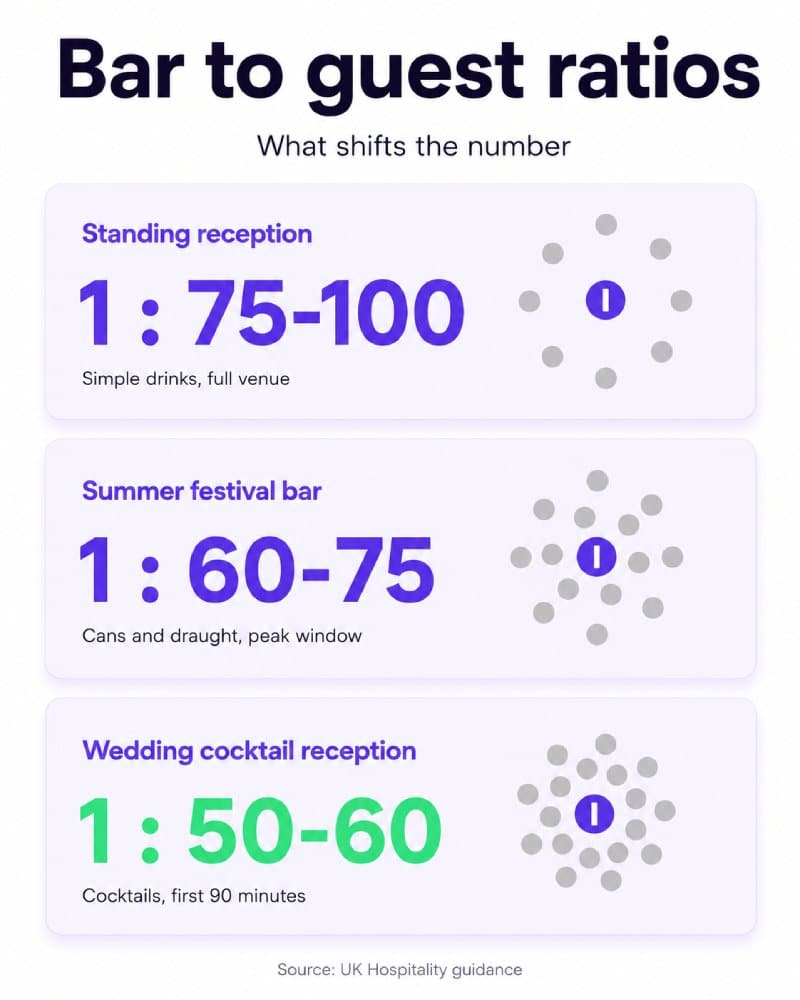
UK Hospitality guidance sets a typical bar service ratio at 1 bartender per 75 to 100 guests.
That figure applies to standing receptions with simple drinks. The ratio tightens when the menu involves cocktails, mixed drinks, or pour-control. It loosens when drinks are batched, pre-poured, or served via ticketing systems.
High-velocity events often plan tighter. A summer festival selling pints from canned and draught taps may run at 1 bartender per 60 to 75 attendees. That density holds during peak service windows. A wedding reception with a cocktail station typically needs 1 bartender per 50 to 60 guests. That ratio holds for the first ninety minutes of service.
The variables that change the bar ratio are predictable. Drink complexity, peak length, glassware turnaround, and queueing tolerance all push the number around.
A licensed bar with bottlenecks costs more in lost service revenue than the additional bartender costs in wages.
How many stewards per attendee does a UK event need?
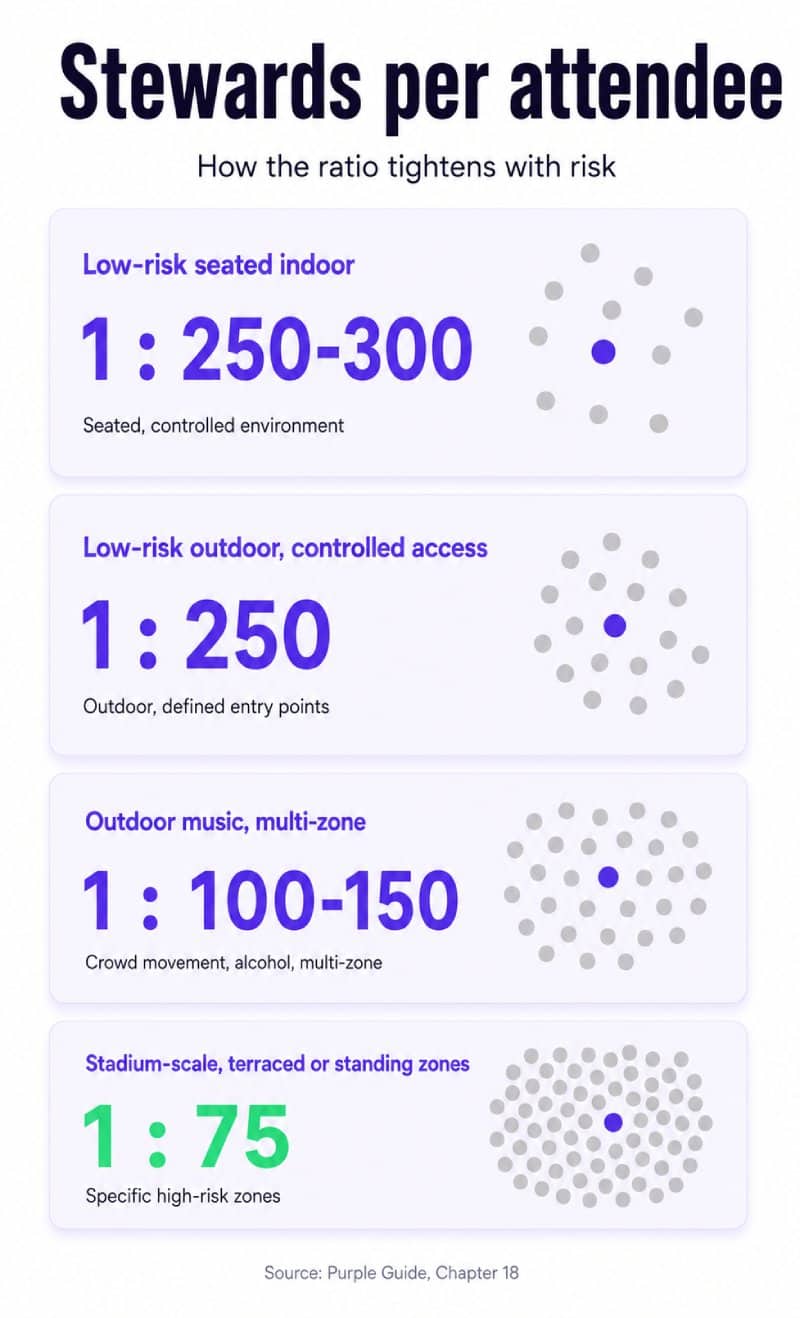
The Purple Guide, Chapter 18, provides the reference point for stewarding ratios in UK events.
For low-risk seated indoor events, a ratio of 1 steward per 250 to 300 attendees is typically defensible. For low-risk outdoor events with controlled access, 1 per 250 is a common starting figure.
Higher-risk events require tighter ratios. Outdoor music events with crowd movement, alcohol, and multi-zone layouts often plan 1 steward per 100 to 150 attendees. Stadium-scale events with terraced or standing areas may require ratios as tight as 1 per 75 in specific zones.
- Planning for major sporting event staffing typically operates at the tighter end of these benchmarks.
These figures cover stewarding only. They do not include security, medical, or specialist crowd-management roles. Local authority safety advisory groups will challenge any plan that conflates them.
What security ratios apply to events?
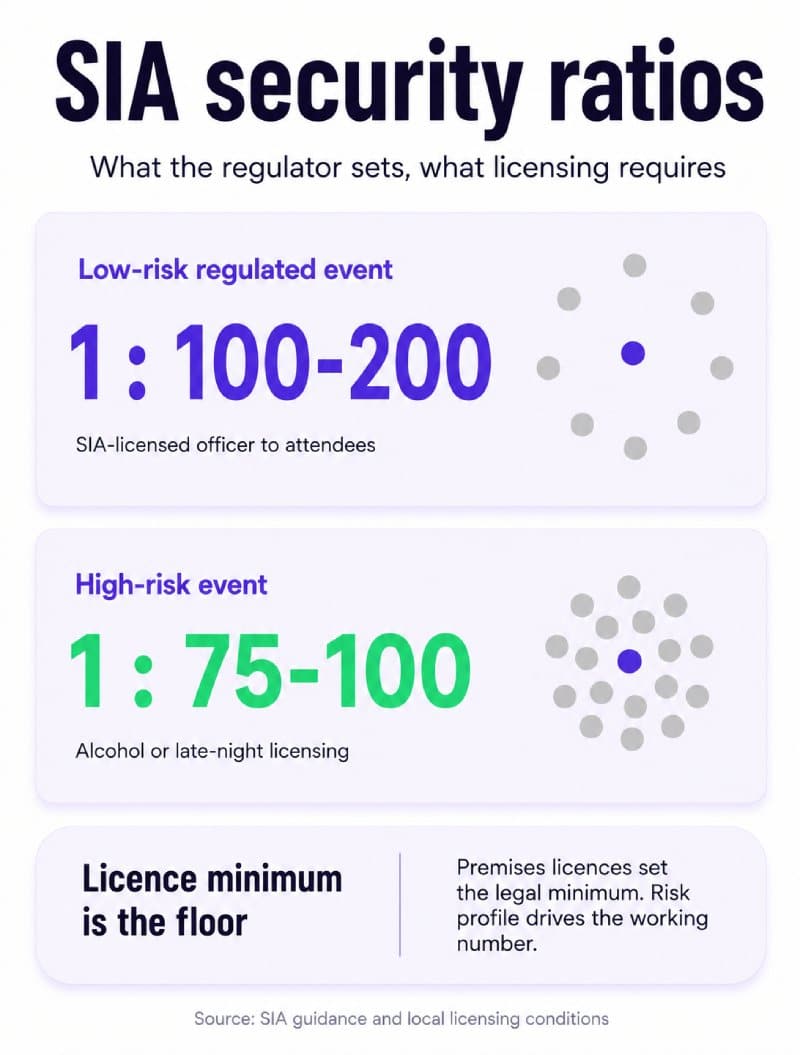
SIA-licensed security follows separate ratio logic.
For a low-risk regulated event, organisers typically plan 1 SIA-licensed officer per 100 to 200 attendees. For high-risk events involving alcohol or late-night licensing, ratios tighten to 1 per 75 to 100. Higher density at specific access points is normal.
The SIA does not publish a single universal ratio. Risk category, alcohol service, and the local authority’s licensing conditions drive the final number. Premises licences and Temporary Event Notices often state a minimum number of SIA staff required.
That minimum is the floor, not the target.
Door cover sits separately from internal stewarding. Mixing the two on a staffing plan is a common source of pushback from licensing officers.
What medical cover ratios apply to UK events?
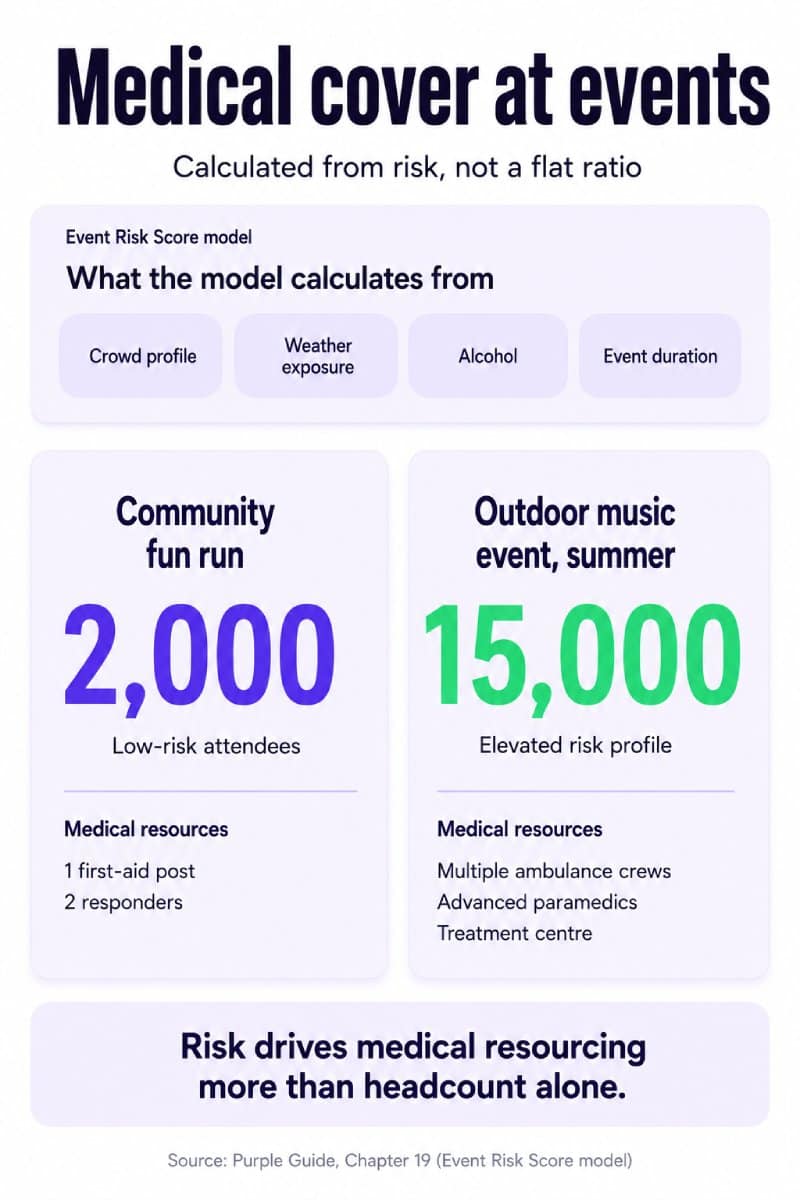
The Purple Guide, Chapter 19, sets medical cover based on attendance, duration, and risk profile. Rather than a flat ratio, the guidance uses the Event Risk Score model. That model calculates medical resourcing from crowd type, weather exposure, alcohol, and event duration.
A community fun run for 2,000 people might need a single first-aid post and two responders. A 15,000-attendee outdoor music event in summer may need multiple ambulance crews, advanced paramedics, and a treatment centre. Risk drives medical resourcing more than headcount alone.
Event organisers planning medical cover should work directly with NHS-affiliated providers or accredited medical event services. The Purple Guide’s calculator is the starting reference. Local commissioning rules still apply.
How do hospitality ratios change by service style?
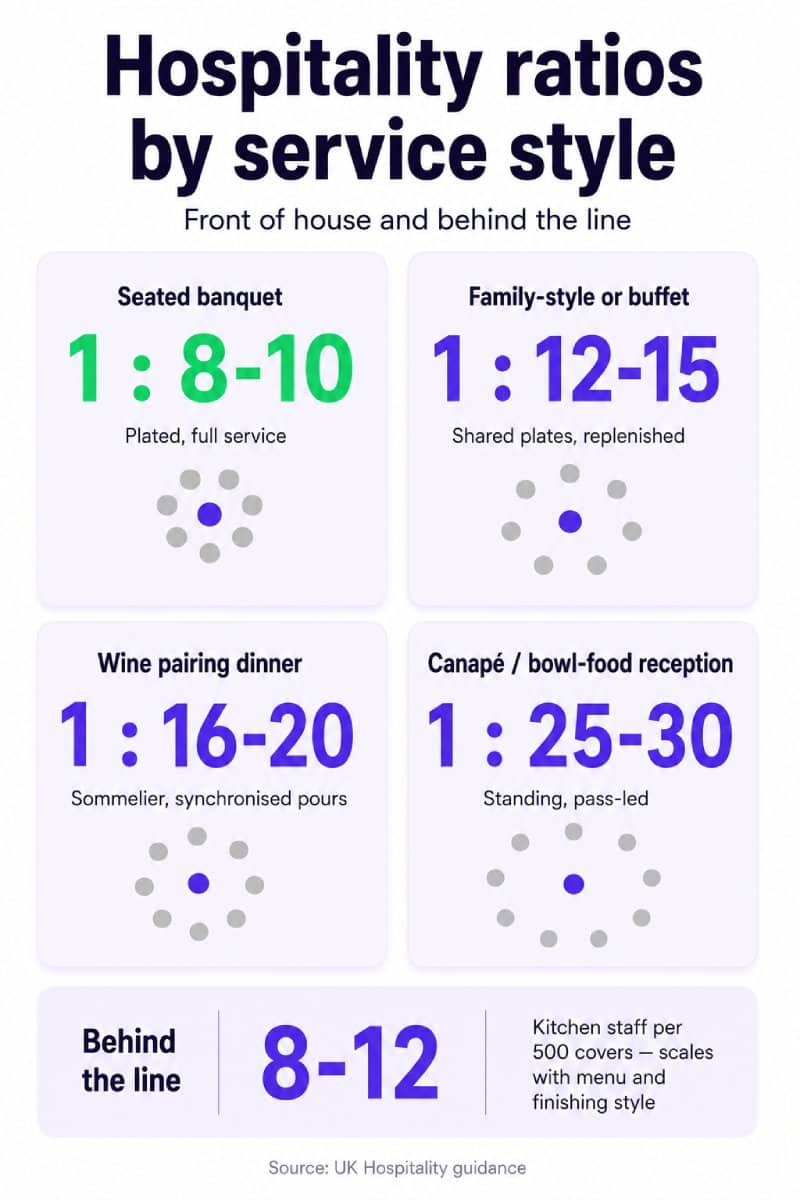
UK Hospitality publishes service ratios that vary by format. A formal seated banquet typically runs at 1 server per 8 to 10 covers for plated service. Family-style or buffet service runs at 1 per 12 to 15 covers. Canapé and bowl-food receptions run leaner, around 1 per 25 to 30 guests depending on pass complexity.
Sommelier and wine service introduces its own ratios. A premium wine pairing dinner often requires 1 wine server per 16 to 20 guests for synchronised service.
Catering ratios behind the line vary by output. A hot-food production kitchen for 500 covers typically needs 8 to 12 kitchen staff. That number scales with menu complexity and finishing style.
Why ratios shift across sectors and events
Ratios are starting points, not fixed rules. They flex with the operational reality of the event in front of you. Two outdoor events with the same headcount can need very different staff plans.
What changes the ratio:
- Crowd profile: family-friendly festivals carry different risk loads than alcohol-led events
- Layout and access: multi-zone outdoor sites need higher steward cover than single-room venues
- Alcohol licensing: events serving alcohol typically require additional bar and security cover
- Weather exposure: outdoor events need medical cover scaled to heat, cold, and duration
- Event duration: long events compound fatigue and require contingency on top of base ratios
This is where ratio-led planning meets operational reality. Three Counties applies planned ratios across multiple race days where attendance patterns vary by event, weather, and season. The same ratio that worked for a 3,000-attendee April fixture can break at the 8,000-attendee July weekend.
Independent event teams running regional series face this pattern repeatedly. The benchmark gives them the defensible number. The variables determine where the number needs adjustment.
Knowing how to calculate staffing ratios in practice means treating each event as a fresh exercise.
Once ratios are set, the practical challenge is identifying who can actually fill each role. Availability, certification, and shift patterns determine whether the plan holds on the day. A ratio of 1 SIA per 150 attendees means little if the SIA-certified people on the books are unavailable. Other clients may have already booked them that weekend.
This is where the planning ratios meet the workforce database.
- The Schedule and Book feature converts the ratio plan into confirmed shifts.
- The workforce database holds the certifications, skills, and availability that turn a ratio into a real headcount.
- Communication tools keep cover intact when changes hit on the day.
For festivals, races, and outdoor events specifically, festival staffing patterns vary by zone, weather window, and licensing condition.
Sector-specific solutions for festival operations sit at the point where ratios meet workforce planning across a multi-event calendar. The operational system underneath turns ratios into delivered cover.
What ratios do not cover:
- Briefing time before doors open
- Handover gaps between shifts
- Sickness and no-shows on the day
- Last-minute scope changes from clients or licensing
Ratios assume bodies in position at the right time. Real events lose people to traffic, illness, and shift overrun. Planning to the ratio without buffer is planning to fail at the first variance.
Plan ratios across the full season, weekend by weekend
Independent event teams running race days, festival weekends, or regional series benefit from a single operational view.
That view tracks who can fill each ratio-defined role across the calendar. Once teams know how to calculate staffing ratios, the next challenge is keeping cover intact across the season.
Liveforce gives event teams that view, so the ratio on the plan matches the cover on the day.
Book a demo to see how Liveforce supports ratio-led planning across multiple events.
Frequently asked questions
What is the difference between staffing ratios and staffing needs?
A staffing ratio is a numerical benchmark linking one staff member to a defined unit of activity. Staffing needs is the full calculation that uses ratios as one input. Knowing how to calculate staffing ratios gives the benchmark; calculating staffing needs gives the headcount plan.
What is a typical bar-to-guest ratio for UK events?
UK Hospitality benchmarks place a standing reception at 1 bartender per 75 to 100 guests for simple drinks service. Cocktail-led events tighten the ratio to around 1 per 50 to 60. Festival bars with high-velocity draught service often run at 1 per 60 to 75 during peak.
How do steward ratios change for outdoor versus indoor events?
Indoor seated events typically use 1 steward per 250 to 300 attendees as a Purple Guide benchmark. Outdoor low-risk events with controlled access sit at a similar ratio. Outdoor music events with alcohol, multi-zone layouts, and crowd movement often plan 1 per 100 to 150.
Where do industry-standard event staffing ratios come from?
UK staffing ratios are drawn from the Purple Guide, UK Hospitality, the Security Industry Authority, and HSE guidance. Local authority licensing conditions and event-specific safety advisory groups also set minimums. Always confirm which source applies to the event format you are planning.
Do staffing ratios apply to small events or only large ones?
Ratios apply to events of every size. A 200-person wedding still applies UK Hospitality service ratios. A 500-attendee fun run still applies stewarding and first-aid cover ratios. Smaller events benefit from ratio-led planning because they often have less margin for understaffing than larger budgets allow.