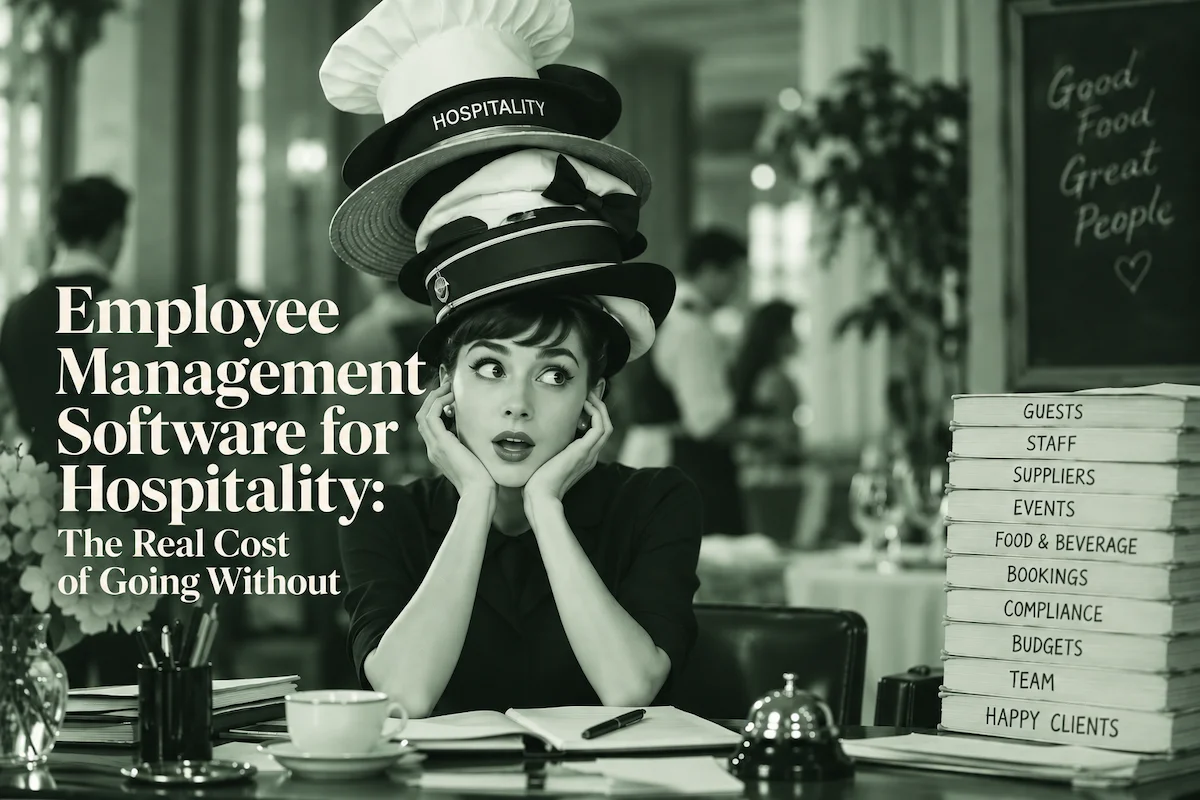
For a hospitality venue, wages are the visible cost of a flexible workforce. The expensive part sits around them.
Rota building, cover calls, no-shows, and pay corrections all take money out of the same week. None of it shows up as a line item. Employee management software for hospitality exists to remove that load at source.
Independent venues feel it hardest. A pub, bar, restaurant, or small music room manages its own staff directly, with no agency in the middle.
- The person building the rota is usually the same person running service that night. Every hour lost to admin is an hour taken off the floor, and it repeats every week.
- That is the gap hospitality staff scheduling software is built to close.
Where a hospitality staff rota quietly starts costing money
Start with churn. Accommodation and food services sits at the top of every UK turnover table, at roughly 52% a year. A venue with 20 casual staff replaces around ten people annually. CIPD puts the median cost of recruiting a non-senior employee at about £1,500.
That is £15,000 of replacement cost before anyone pours a drink.
Absence is the second driver. UK employees averaged 9.4 sick days in 2025, the highest level CIPD has recorded in over a decade. ONS counted 148.8 million working days lost to sickness across the UK that year. In an office, an absent person means delayed work. In a venue on a Saturday, it means service runs a body short.
Pay accuracy is the third. In a survey of 1,000 UK business leaders, 84% of SMEs reported payroll errors. Incorrect wage calculations were the most common problem, affecting 48% of those hit.
Around 31% still run payroll on spreadsheets or paper forms. A separate survey of 4,248 UK PAYE employees found that 25% had received an incorrect payslip.
Most of those errors start as a timesheet problem, not a payroll problem.
Employee management software for hospitality is judged against exactly these four numbers. Each cost driver looks minor inside a single trading week. Set them side by side across a year and the scale becomes obvious.
| Cost driver | Why it happens in hospitality | Typical operational impact |
|---|---|---|
| Last-minute drop-outs and no-shows | Casual staff hold shifts with more than one employer and confirm late. | UK employees averaged 9.4 sick days in 2025, the highest level in over a decade. |
| Double bookings across shifts | Two managers work from separate versions of the same rota file. | Cover is assumed rather than confirmed until the shift actually starts. |
| Manual rota building | Availability, holidays, and skills sit in different files or message threads. | Management hours every week that never reach the floor or the guest. |
| Chasing and correcting timesheets | Hours are written on paper or sent by message after service has finished. | 84% of UK SMEs report payroll errors, and 48% of those are wage miscalculations. |
| Under and overstaffing at peak | Headcount is set from last year's guess rather than live booking data. | Two surplus staff on a six-hour shift is over £150 at £12.71 an hour. |
| Right-to-work and compliance gaps | Documents and certificates are stored away from the shift record. | Civil penalty exposure per worker, plus time spent rebuilding the paper trail. |
| Turnover and replacement hiring | Unpredictable hours are a leading reason hospitality staff leave a venue. | Churn near 52% a year, at a median of about £1,500 per non-senior hire. |
Swipe to see the full table →
How the cost compounds across peaks and multiple shifts
One bad week is survivable. The damage comes from repeated exposure over a full trading year.
Managing casual staff when every week looks different
Casual staff work for more than one employer. Availability shifts weekly, and it often shifts after the rota has gone out. A spreadsheet cannot tell you that a bartender has accepted a competing shift. You find that out on the night.
- This is the point where employee scheduling software starts paying for itself.
Four things that break a manual rota under pressure:
- Availability drifts after publishing. The rota is accurate on Monday and wrong by Wednesday, with no version anyone trusts.
- Double bookings go unseen. Two managers assign the same person to a bar shift and a function, and nobody catches it.
- Shift swaps go untracked. Staff arrange cover between themselves by text, so the record never matches the floor.
- Compliance data sits in a drawer. Right-to-work documents and certificates live in a folder, away from the shift record.
That last one carries the sharpest tail risk. A missing right-to-work check is a civil penalty issue, not an admin issue. Venues running casual staff on paper records are the most exposed to it.
Managing seasonal hospitality staff through the December peak
Seasonal trading concentrates all those risks into a few weeks. Rotas are also leaner than they used to be. Average monthly shift hours per hospitality business fell from 112 in 2022 to 79 in 2025. That is a drop of around 30% in four years.
Leaner rotas leave almost no slack. A single drop-out on a function night becomes a service problem, not an inconvenience. Venues running heavy catering and function work carry the tightest margin for error.
Absence behaves differently at peak, too. A December sick call cannot be absorbed by the rest of the team. It has to be filled, usually at short notice and often at a premium rate. The manager then loses an hour to the phone in the middle of service.
Overstaffing costs real money in the other direction. The National Living Wage rose to £12.71 an hour in April 2026. Two surplus staff on a six-hour shift is over £150, before employer National Insurance. Repeat that across a December and the number stops being small.
Getting headcount wrong costs money in both directions, every week of the peak.
The hidden cost stack in a hospitality workforce
Wages are the line item you budget for. The rest is paid every week without ever being counted.
- Replacement hiring Hospitality churn around 52% a year, at roughly £1,500 per non-senior hire
- Absence and last-minute cover 9.4 sick days per UK employee in 2025, the highest in over a decade
- Rota building and cover calls Management hours every week, before a single shift is worked
- Pay corrections 84% of UK SMEs report payroll errors, 48% of them incorrect wage calculations
- Wrong headcount at peak Two surplus staff on a six-hour shift is over £150, before employer NI
- Compliance gaps Right-to-work exposure per worker when documents sit outside the shift record
Sources: CIPD, ONS, Employment Hero, GOV.UK. Figures are UK, 2025 to 2026.
What hospitality workforce management looks like once it is structured
Structure changes the shape of the week without changing the size of the team. That is the practical case for hospitality workforce management in an owner-run site.
CASE STUDY STORY:
Events by The Camberwell Arms is the catering arm of a South London restaurant. Every booking used to start with a round of calls to check who was free.
The admin was growing faster than the bookings. Once shifts were posted centrally and staff applied directly, the calls stopped. Head of Events Mathilde Seguin put the result plainly. Her team can now plan far ahead and hold a view of the whole year.
Planning moved from reactive to structured, without adding a single hour of headcount.
That is the practical outcome of employee management software for hospitality in an owner-run venue. Gaps become visible weeks out, well before the day itself. Briefings reach everyone at once. Hours are recorded against the shift they belong to, so pay runs stop generating corrections.
The four cost drivers do not disappear. They stop being invisible, which is what makes them manageable.
How employee management software for hospitality removes the cost
Liveforce is the system a venue runs to manage its own staff. The venue employs its people, onboards them, and pays them. Liveforce handles the management layer that sits around all of that work.
The platform replaces tools most venues have outgrown. Spreadsheets, group chats, paper timesheets, and a phone full of numbers collapse into one live record.
Employee management software for hospitality earns its place by reducing the number of systems a venue runs.
What changes in the first month of use:
- One workforce record. Availability, roles, certificates, and contact details sit in one place instead of four spreadsheets.
- Shifts posted rather than chased. Staff see open shifts and apply directly, which removes the round of calls before every function.
- Briefings in a single channel. Event details and late changes reach every named person, replacing scattered message threads.
- Timesheets tied to the shift. Hours are captured against the booking, so pay runs start from a clean record.
- The Crew App. Staff confirm shifts and read updates from their phone, which cuts confirmation chasing to almost nothing.
Where hospitality staff scheduling software changes the daily routine
The gain shows up on the busiest days, not the quiet ones. A manager filling a gap at short notice can see who is qualified and genuinely free. Nobody scrolls back through a chat history to work out who said yes.
Cost control follows visibility. A venue that can see planned hours against expected covers stops guessing at headcount.
- Retention improves alongside it, because predictable rotas are one of the strongest levers a venue has for reducing staff turnover.
Compliance gets easier for the same reason. Documents and certificates sit against each person in the same system. An expiring certificate becomes visible before the shift is assigned, not after it.
The cost you are already paying
None of these costs is new. They are distributed across enough weeks that they never get counted properly. Turnover sits in recruitment. Absence sits in overtime.
Pay corrections sit in the manager’s evening after service. Employee management software for hospitality makes that existing cost visible and then removes most of it.
Every venue already pays for one of two options. One arrives as a monthly subscription with a number attached to it. The other arrives in December, in a week nobody planned for.
Take the guesswork out of your next peak
An independent venue rarely gets a warning before a bad December. The rota holds until two people drop out on a function night. The cost then lands in a single week rather than spread across twelve.
Liveforce gives venue teams one view of who is booked, who is available, and where the gaps are.
Book a demo and go into the next peak with the rota already under control.
Frequently asked questions
What is employee management software for hospitality?
It is a platform for planning, scheduling, and managing staff whose hours change week to week. Hospitality versions handle casual and part-time workers, split shifts, and function work. General HR systems assume a fixed team on fixed hours.
How much does poor scheduling actually cost a venue?
The cost spreads across four places: replacement hiring, uncovered absence, surplus hours, and pay corrections. Hospitality churn sits near 52% and recruitment averages around £1,500 per non-senior hire. A 20-person venue can absorb five figures a year.
How do you manage casual and seasonal hospitality staff?
Keep availability, certificates, and contact details together in one live record. Post shifts centrally so staff claim them and the record updates itself. Confirm cover through one channel, not through several private message threads.
What should hospitality staff management software be able to do?
It should handle variable shift patterns, multiple roles, and staff working irregular hours. Look for live availability, shift posting, group briefings, and timesheets linked to each booking. Reporting on planned versus actual hours matters most for cost control.
Is it different from HR or payroll software?
Yes. HR software stores employment records and payroll software calculates and issues pay. Liveforce manages the workforce itself: who is booked, who is available, and what hours were worked. The venue remains the employer and pays its own staff.