Corporate event staffing means putting the right crew at the door and around the room. That crew covers registration staff, hosts, hospitality crew, and brand ambassadors.
The agency briefs, schedules, and checks them in, so the event runs smoothly for the client. Select roles by format and size the team to match the arrival peak. Build the rota to the timeline, brief everyone on the client, and check each person in before doors open.
This work sits with the agencies and suppliers who deliver the crew. It might be a promotional agency with brand ambassador and promo teams, a hospitality agency or a venue. Each is judged on two things: how they greeted guests and how the room felt.
When both go well, the client books again. That is why corporate event staffing starts weeks before the day, when you build the event-day rota.
What Staffing a Corporate or Networking Event Involves
Staffing a corporate or networking event covers every crew decision, from the first booking to the last check-out. Knowing how to staff a corporate event starts with its format.
Conferences, networking evenings, product launches, AGMs, awards dinners and client hospitality days all count as corporate events. Each has its own arrival pattern and its own mix of crew.
Whoever plans a corporate event owns the budget, the run of show, the AV and the menu. That is usually the organiser or the venue. Corporate event staffing is the part the agency owns. Clients booking event staff hire expect a team that arrives briefed and on time.
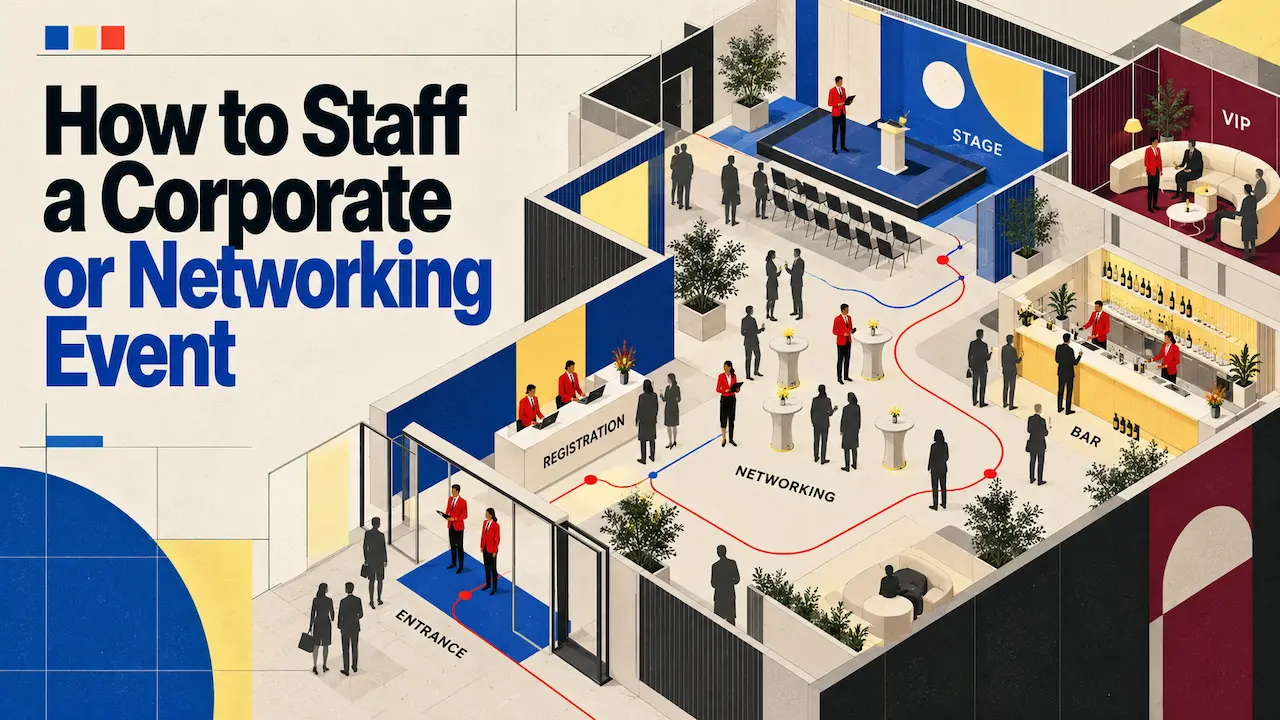
A networking event has no seating plan, so the crew does the job a seating plan would.
Networking events are the hardest of these formats to staff well. Guests arrive in a short window and spend the evening on their feet. Nobody tells them where to go.
Hosts greet people, make introductions, and keep the room circulating. Registration has to clear the queue quickly, because arrivals bunch into the first half hour. When the door is slow, the client’s first impression of their own event is a queue.
Presentation matters more at corporate events than at most. The client is often hosting its own customers, partners, or senior people. Dress, badges and manners reflect on the client first and your agency second.
The Crew Roles These Events Need
Most corporate events run on four crew groups:
- Registration staff,
- Hosts,
- Brand ambassadors and
- Hospitality crew.
Larger events add cloakroom staff, a supervisor and someone to liaise with the AV or stage team.
Getting corporate event staffing right starts with the mix for the format. A conference and a networking evening lean on different roles. Each role has its own duties and skills, set out in the full rundown of event staff positions.
| Event format | At the door | In the room | What the client notices |
|---|---|---|---|
| Conference | Registration staff, badge desk, wayfinding hosts | Session room hosts, AV and stage liaison, refreshment service | Short queues and sessions that start on time |
| Networking evening | Registration staff, cloakroom | Hosts making introductions, drinks and canapé service | Guests mixing, with nobody left standing alone |
| Awards dinner | Registration with the table plan, cloakroom | Waiting staff, bar team, stage and award runners | Service timed around the speeches |
| Product launch | Guest list check, registration staff | Brand ambassadors running demos, hosts | Every guest sees the product |
| Client hospitality day | Meet-and-greet hosts | Hospitality crew, a host for each suite or area | Guests looked after by name |
Choose the roles by format before you count a single head.
Event Hosts and Brand Ambassadors at Corporate Events
Hosts and brand ambassadors often share a dress code, so clients mix them up. Event hosts look after guests by greeting, directing, introducing, and answering questions. Brand ambassadors represent the client’s brand and run its demos, stands, and product conversations.
A product launch needs ambassadors who know the product inside out. A networking evening needs hosts who can start a conversation between two strangers.
In corporate event staffing, hospitality crew carries the dinners and receptions. A hospitality agency scheduling hospitality crews for an awards dinner needs staff who know the speech times. Plates should be cleared before the first award, and the bar should be ready for the break.
How Many Staff You Need
Headcount depends on guest numbers, format and how tightly arrivals bunch together. Size the team to the busiest moment of the event. For corporate event staffing, that moment is usually registration.
Take a 400-guest conference where most guests arrive in the 45 minutes before the opening session. Time one check-in at your own desk. If it takes about 30 seconds, one person clears about 90 guests in that window. Five people at the desk clear 450, which covers the peak with room for queries. Four would leave a queue just as the client walks in.
Size registration to the arrival peak.
Hosts follow the floor plan. Place one at each entrance and pinch point, such as the cloakroom or the lifts. Then add enough on the floor that every group of guests has a host in sight.
Hospitality numbers follow the service style. A plated dinner needs far more waiting staff than a standing drinks reception. Add a supervisor once the team passes a handful, and keep a reserve for every guest-facing role. For ratios by role and a step-by-step method, see how many staff an event needs.
Planning and Scheduling the Crew
Build the rota around the event timeline, then confirm availability early and line up cover before event week. A corporate event has distinct phases, and each needs a different shape of team.
Corporate event staffing works best when the rota follows those phases:
- Set-up: registration, cloakroom, and the supervisor arrive early enough to test the desk and rehearse a check-in.
- Arrival peak: every registration and host role is on, plus a floater to handle queries and missing badges.
- Main event: the desk scales down, hosts and hospitality crew carry the room, and the cloakroom stays staffed.
- Close and breakdown: cloakroom returns and guest exits come first, then a small team clears the space.
Every role on the rota needs a start time, a report point and a named reserve.
Staggered start times stop crew standing idle. The registration team starts first and finishes after the peak. Hosts and hospitality crew start later and stay to the close.
Send availability requests as soon as the client confirms the date. Confirm the team a week out, then again the day before. Keep a named reserve for each guest-facing role. A dropout the night before then means one call to one person.
An event agency running three corporate events in the same week books all three from one pool. That stops the same host appearing on two rotas at once.
Briefing the Team and Running the Day
Corporate clients expect crew who already know the event. So the brief goes out days before, and the crew check-in happens before doors.
On the day, corporate event staffing comes down to the first hour. A good corporate brief covers five things:
- The client and the purpose: who the client is, the event’s aim and what success looks like.
- Dress code and presentation: the uniform or dress standard, name badges and how to greet guests.
- Arrival and report point: the call time, the entrance to use and the person to report to.
- Run of show: doors, speeches, breaks and close, with where each role stands at each point.
- Names that matter: speakers, VIPs and the client contact, plus who to call when something goes wrong.
Send the brief by role and ask each person to confirm they have read it.
Attach it to the shift, so the brief travels with the booking. Hosts then get the floor plan and the bar team gets the drink timings. Messages kept in one place also leave a record if the client asks a question later. That is how you brief the team before doors without a group chat.
Getting Registration Staff Ready for the First Guest
Registration staff arrive first and rehearse a check-in before the doors open. They test the guest list, the badge printer and any scanners. Agree on who decides when a guest is missing from the list, and where that guest waits. Give the desk lead the client contact’s number before the first arrival.
Then check crew in on arrival, so you know the door is covered before guests appear. Crew check in from their phones, and the supervisor sees who has arrived against who was booked. If a host has not checked in by call time, you can move a reserve straight away. Corporate clients notice polish. Crew in the right dress who greet speakers by name make the agency look prepared.
Finish the crew check-in before the first guest reaches the desk.
After the Event: Hours, Pay and the Repeat Booking
After the event, approve the hours worked and use them for payroll and the client invoice. Then debrief while the details are still fresh.
Check-in and check-out times give you a record of when each person started and finished. Compare it with the booked shifts and resolve any gaps before the figures move on. Teams that approve hours after the event from that record avoid a week of chasing paper timesheets. The approved hours then feed your own payroll and the hours you bill the client.
Corporate events tend to repeat, from the annual conference to the quarterly networking evening. Ask the client what worked and where guests waited. Note the crew the client praised, so the same faces return next time.
A returning team that knows the venue and the client makes the next booking easier to win. Keep those notes on the client’s file, ready for the next corporate event staffing brief.
The repeat booking is decided in the week after the event.
How Liveforce Helps You Staff Corporate Events
A corporate event gives an agency one chance to look professional. It falls apart when the rota lives in a spreadsheet and the brief lives in an email. On the morning, nobody can say for sure who has turned up.
Liveforce is the workforce management platform event-led agencies use to run corporate event staffing in one place.
- The rota is built across the event timeline, with clashes flagged before anyone is double booked.
- Crew are picked from the agency’s own pool by skill, availability and past performance.
- Promotional teams can share a portfolio of their strongest crew with the client before the event.
- Briefs and updates go out by role, with reminders to confirm, in place of the group chat.
On the day, crew check in from their phones with location and photo. The supervisor sees the door is covered before guests arrive.
Check-in and check-out times become hours the agency approves and exports as payroll-ready reports. Payroll itself runs in the agency’s own system. For agencies running several corporate events at once, every event draws on the same pool without clashes.
CASE STUDY EXAMPLE:
WiseUp Team Building runs team-building events across the UK. On a busy day, it coordinates sixty staff across ten locations. After moving off spreadsheets, the team reports around 80% less staffing admin time and no double bookings.
Liveforce helps the agency run the crew it already has. It does not hire, source or place staff.
Liveforce is built for promotional, experiential, hospitality and event staffing agencies, and for venue teams. Crew sees their shifts, briefs, and check-in in the Crew App.
Corporate Event Staffing Starts at the Door
A corporate client judges the event by the door and the room. Both are staffing outcomes, settled weeks earlier in the rota and the brief.
Can you see who has confirmed, read the brief, and arrived, all in one place?
If the answer is no, that gap is where corporate event staffing goes wrong first. Put the rota, the brief and the check-in in Liveforce before the next corporate booking.
Ready to Run Your Next Corporate Event in One Place?
Corporate clients rebook the agency whose door ran smoothly last time. Liveforce gives agencies and venue teams one place for corporate event staffing, from the rota to the check-in.
Book a demo to see it set up for a conference or a networking evening.
FAQs: Staffing a Corporate or Networking Event
What staff do you need for a corporate or networking event?
Most corporate and networking events need registration staff, hosts and hospitality crew. Add brand ambassadors when the client is launching or demonstrating a product. Cloakroom staff and a supervisor join as the guest count grows.
How many staff does a corporate event need?
Corporate event headcount depends more on the arrival peak and floor plan than on total guests. Work out how many guests one registration desk clears in the busiest half hour. Then place hosts at every entrance and pinch point, and add one reserve per guest-facing role.
How do you run registration at a corporate or networking event?
Brief the desk team in advance and schedule enough people for the arrival peak. Have them rehearse a check-in with the guest list and badge printer before doors. Check the crew in first, so the desk is fully staffed before the first guest arrives.
What do event hosts do at a corporate event?
Event hosts welcome guests, direct them to registration, sessions or tables, and make introductions. They keep the room moving and answer guests’ questions throughout the event. Brand ambassadors represent the client’s brand and run its demos, stands and product conversations.
How do you staff a networking event?
Staff the door and the room first, with registration to clear arrivals and hosts to make introductions. Schedule the team to the event timeline and brief them on the client’s goals for the evening. Keep communication live on the day, so changes reach every role at once.