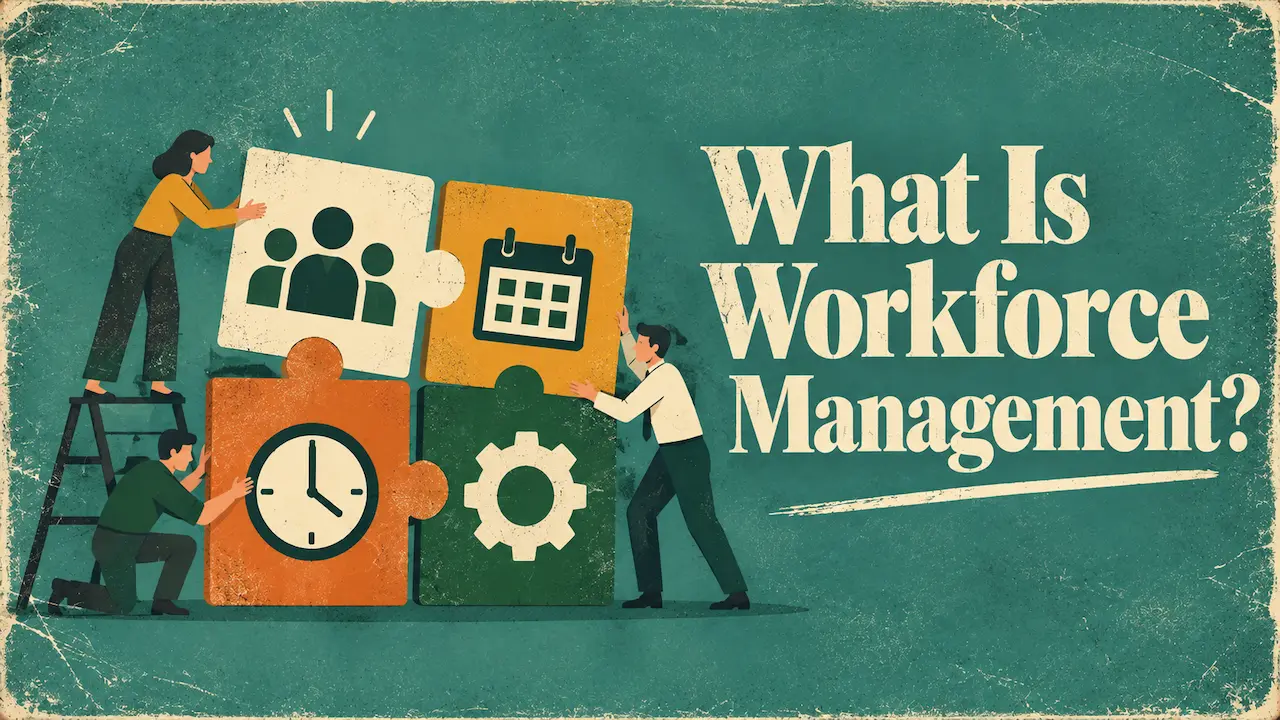
Workforce management is the day-to-day work of matching people to demand. It covers forecasting staff numbers, scheduling and briefing people, recording hours, and keeping pay and compliance records right. In events, it starts from a pool of freelance and casual crew who pick up shifts event by event.
At a stadium fixture or a festival weekend, the same work runs at a far larger scale. Hundreds of people arrive from in-house teams, agencies, contractors and volunteer groups. All of them work to a start time that cannot move.
Major event teams keep that whole picture in event workforce management software. They build workforce plans for stadium fixtures zone by zone, from the first forecast to the last approved timesheet.
Workforce Management Defined, in Plain Terms
Workforce management (WFM) is the operational side of managing staff:
- Who works
- Where
- When and
- For how many hours
It sits between the business plan and the pay run. The discipline grew up in contact centres and retail. There, demand is forecast against a fixed team on a fixed site. The rota (schedule) shifts a little each week, and forecasts lean on call volumes or footfall from the same building.
Event work changes almost every one of those conditions. The crew pool is shared with other employers, so availability moves daily. Many crew work for several employers in the same month. Some arrive on site for the first time on the day itself.
Headcount swings between a quiet midweek fixture and a sold-out final. Roles change with each client brief, from stewarding to hospitality to ticket scanning. The start time is printed on every ticket, so the plan has to be ready well before it.
That pairing of a fixed deadline and a changing crew is why events need their own approach. It also changes what failure costs. Loose bookings push labour spend over budget. Missed rest breaks or lapsed records create legal exposure. And a guest who reaches an unstaffed gate does not care whose spreadsheet was wrong.
For an operations lead, good workforce management makes each of those risks visible days before the event.
The Six Core Components of Workforce Management
Workforce management has six core components. They are forecasting demand, keeping the pool ready, scheduling and confirming, briefing, tracking attendance, and closing out pay and records.
Two jobs happen before the event, three run around it and one closes it out. Each job works differently with a casual event crew than with a fixed team.
Use the filter below to see the jobs by phase.
The six jobs depend on each other.
Say a steward drops out on Thursday night, which happens most weeks in a busy season. The forecast still needs that role covered, so cover comes from the pool. The new person needs the brief and a place on the check-in list.
Their hours then have to reach payroll and the client invoice. If each job lives in its own file, someone retypes that one change five times. A drop-out on the morning itself squeezes all of that into an hour.
That is why the pool comes first at major events. Every other job reads from it, so it needs one record for every worker: skills, availability, documents, and work history. Volunteers, contractors and agency crew belong in that record too, each with the fields that apply to them.
A stale record shows up fast. A steward whose first aid certificate lapsed last month still looks bookable on an old list. When the record is current, the rota, the briefing list and the timesheets all start from the same names.
Every booking, brief and timesheet then traces back to one person’s record.
How the Workforce Management Process Runs Around an Event
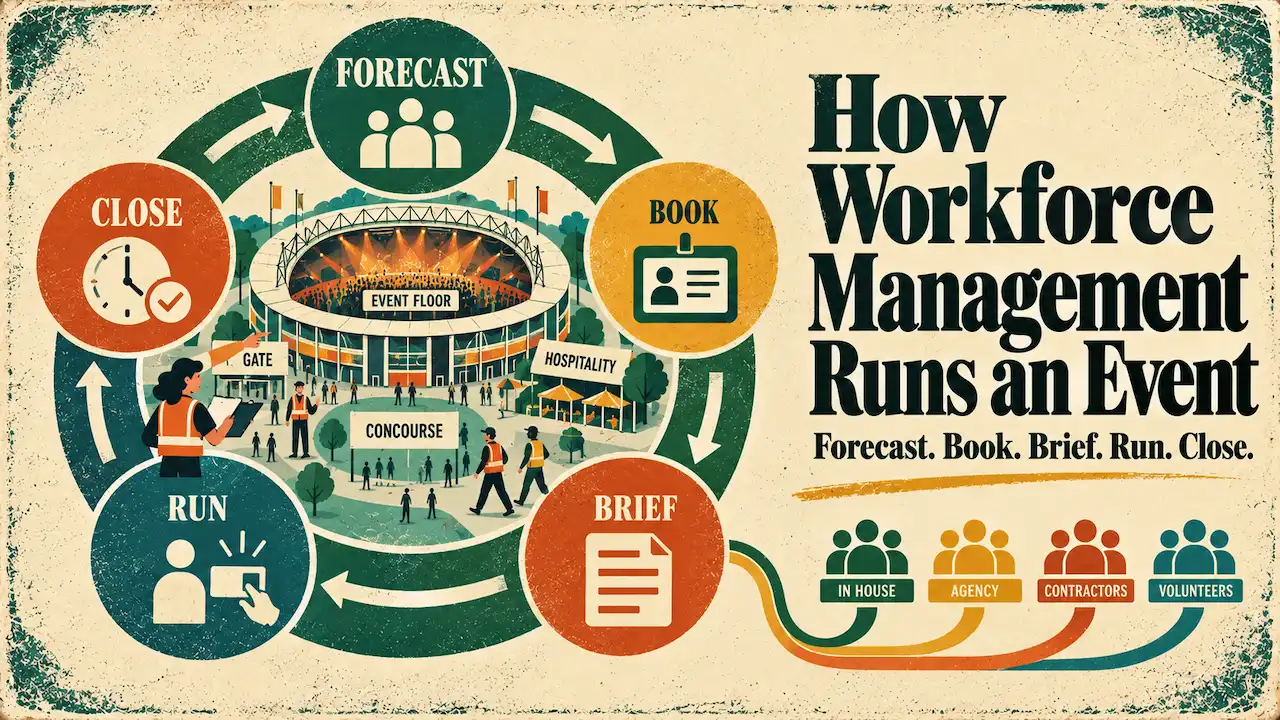
The workforce management process is a loop. It starts weeks before the event and closes after the last timesheet is approved. At a major event, it usually runs in five stages.
- Forecast. Set headcount for each zone and role. Base it on the client brief, ticket sales or attendance figures, and last year’s actuals. Split it by opening time, since gates often open before hospitality.
- Book and confirm. Offer shifts to your own pool and confirm who is coming. Hold a short standby list for each role, sized from last season’s no-shows.
- Brief. Send each role what it needs: arrival point, uniform, radio channel, and supervisor. Late changes go only to the people they affect.
- Run the day. Crew checks in on arrival, and the control room sees who is missing as the shift starts. Standby crew fill the gaps, so nobody has to ring round. Supervisors log late arrivals and early finishes as they happen.
- Close out. Approve hours, then export them for payroll and client billing. Query any hours that do not match check-in times before export. Compare the forecast with what happened on the day.
Most no-shows begin before the day itself. A confirmation a few days out and a reminder the night before catch people whose plans have changed. Anyone who still drops out is replaced from the standby list.
Track the reasons too: travel, clashes with other work, and late changes each need a different fix. Some teams also over-book a role slightly for fixtures with a poor no-show record.
Close-out is where workforce management admin piles up. Teams that turn check-ins into approved hours avoid the Monday spent chasing paper sign-in sheets. The forecast review matters just as much, because next season’s numbers start from this season’s actuals.
Workforce Management at a Major Event
At a major event, workforce management means one plan for hundreds or thousands of people from several sources. That plan has to hold across zones, roles and employers at the same time.
Who Runs Workforce Management on Match Day
A workforce or operations manager usually owns the plan. On match day (game day), they hold one picture across gates, stands, concourses and hospitality. Accreditation gets checked before anyone reaches a turnstile. Welfare and breaks are planned so stewards are fresh for egress.
The same manager agrees numbers with the client before the event and reports against them afterwards. When a gate runs short, theirs is the radio the safety officer calls.
Demand moves a long way between events. For example, a ground might plan 400 stewards for a league fixture and 650 for a cup final. Those figures are illustrative only. The final also brings extra hospitality, medical and ticketing roles.
The manager has to scale up without losing sight of who is where.
In-House Staff, Agency Crew and Volunteers in One Plan
Most major events draw on four sources at once.
- In-house staff come from the venue or organiser’s own team.
- Agency crew come from staffing agencies, which keep the records for their own people.
- Contractors such as security or medical providers bring their own teams and paperwork.
- Volunteers usually arrive through a club, a charity or a volunteer lead.
Each source keeps its own records, yet the event needs one view. It answers for every person on site, whoever employs them. When every source sends a separate spreadsheet, nobody sees a whole gate.
A steward listed twice looks like cover that does not exist. Event teams that coordinate volunteers on the day in the same plan as paid crew close that gap. One combined list also shows the client that every post is covered.
Stadium operators face their own version of the problem, set out in workforce management at stadiums.
What a Workforce Management System Does
A workforce management system holds the six jobs in one record, so a change in one updates the rest. Spreadsheets and group chats cope with a single event. They stop coping when several clients, venues or fixtures land on the same weekend. Then one person gets booked twice, and a briefing goes to last week’s list.
The system keeps the pool, the rota, messages and hours together. Supervisors on site see the same live list as the control room. It records approved hours and pay inputs, then feeds them to your existing payroll and client billing.
Payroll itself stays where it is. Crew confirm shifts, read briefs, and record a check-in with location and photo from a phone app.
Data protection matters too, because the records hold personal details and documents. Major venues and events usually run security reviews for large operations before they sign.
AI forecasting tools are appearing across workforce management. They are only as good as the records behind them. Clean check-in times and approved hours from past events are what make a forecast worth trusting.
A small agency or independent venue runs the same six jobs with fewer people. The tipping point tends to come with the second or third regular client, when memory stops being enough.
A shared calendar and a group chat often carry the work until then. The hardest part of switching is usually cleaning up the old crew list first.
Five KPIs show whether the plan held on the day:
- Fill rate, which shows whether the pool is deep enough for each role
- Time to confirm, an early warning that a shift may go unfilled
- No-show rate, measured against confirmed crew
- Hours variance between booked and worked hours, which exposes loose rotas
- Labour cost per event, the figure clients ask about first
Workforce Management vs HR, Scheduling and Workforce Planning
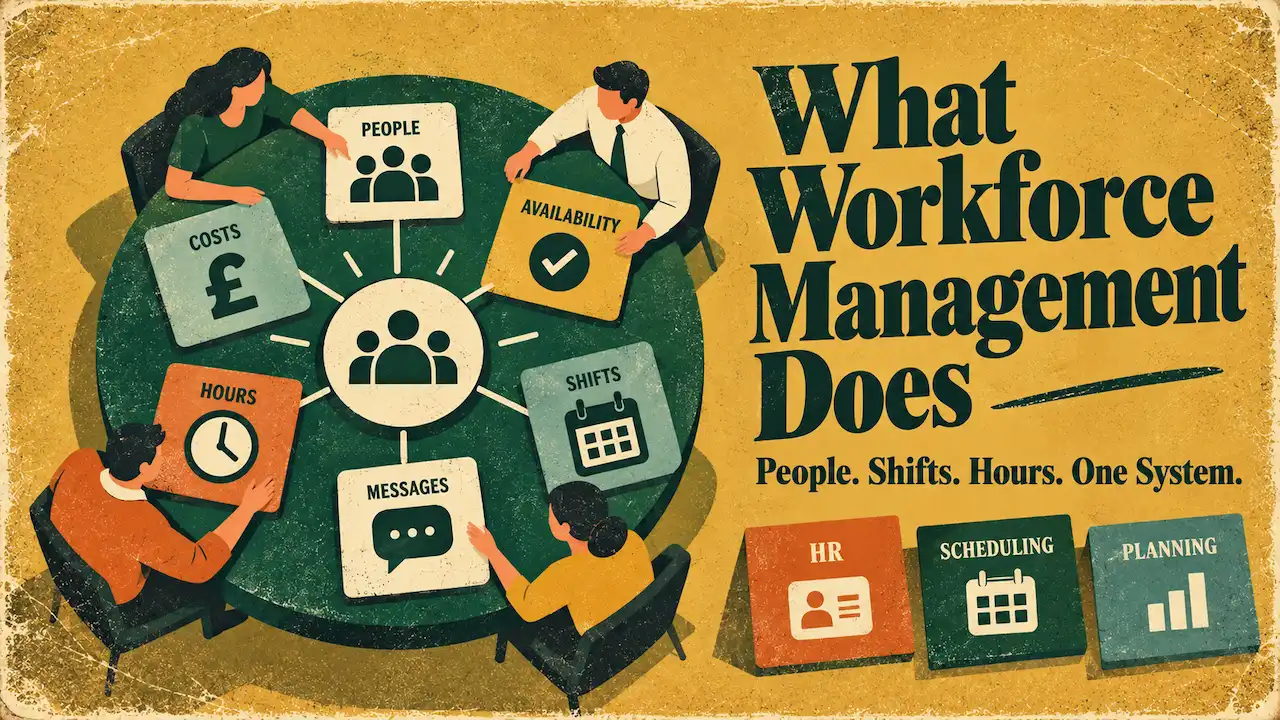
Workforce management overlaps with HR, scheduling and workforce planning, and each one covers a different part of the work.
Workforce optimisation is the analysis layer that uses workforce management records to cut costs and close gaps.
Workforce Management vs HR
HR looks after the employment relationship:
- Contracts
- Policy
- Development
Workforce management looks after the work:
- Who is on which shift
- Where
- Whether the hours were worked
The two hand over all the time. In events, HR also sets the conduct and welfare policies the rota has to follow. HR supplies the starting records, such as contracts and right-to-work documents.
For agency crew, those records usually sit with the agency. Workforce management sends approved hours back for pay.
Workforce Management vs Scheduling
Scheduling is one of the six jobs. A scheduling tool builds the rota, and it usually expects the same staff every week. Event crews change every time, so the pool has to feed the rota.
Workforce management also covers the forecast before the rota and the hours, pay inputs, and records after it. The difference shows after the event, when a rota alone cannot say whose hours are approved.
Workforce Management vs Workforce Planning
Workforce planning looks ahead to the season or year. It sets headcount, skills, and budget.
Workforce management runs this week’s shifts inside that plan, then feeds actuals back into the next one. The plan says how many supervisors the season needs. Workforce management books them for each date.
A festival might plan its season in winter and run workforce management every weekend from May.
The Labour Rules Workforce Management Has to Respect
Every rota has to respect working time, rest, holiday, minimum pay and right-to-work rules. The UK and US set those rules differently, so the plan follows the country it runs in.
In the UK
- Working time: a 48-hour average week over 17 weeks, unless the worker opts out. Rest rules add 11 hours off between working days and a 20-minute break in any day over six hours.
- Holiday: 5.6 weeks a year. Irregular-hours workers accrue it at 12.07% of hours worked, under rules in force since April 2024.
- Pay: the National Living Wage is £12.71 an hour for workers aged 21 and over from 1 April 2026.
- Right to work: checks must happen before someone starts work.
The checks themselves are the business’s job. A good system helps it track the documents each worker holds and keep them in date.
The Employment Rights Act 2025 adds zero hours reforms that are still being finalised. The proposals include guaranteed hours offers, reasonable notice of shifts and payment for shifts cancelled at short notice. They are expected to cover agency workers too.
The government consulted on the detail until 25 August 2026. No start date is confirmed yet. The government’s implementation timeline says timings will follow the consultation, and its 2025 roadmap pointed to 2027.
Guaranteed hours offers are expected to reflect hours worked over a reference period, so accurate hours records will matter.
In the US
Federal law requires overtime at one and a half times the regular rate for non-exempt employees. Overtime applies after 40 hours in a workweek.
The federal minimum wage is $7.25 an hour, and many states set a higher rate. California adds daily overtime after eight hours in a workday.
There is no federal predictive scheduling law, so those rules come from states and cities. Oregon’s statewide law requires 14 days’ notice from large retail, hospitality and food service employers.
New York City’s Fair Workweek Law covers fast food and retail. Worker classification decides which of these rules apply, and the business makes that call.
This is a summary, not legal advice, so check the current rules where you operate.
Running a Major Event Workforce From One Record
Six jobs kept in six places tend to break at the gate. The rota says one thing, the sign-in sheet another and the timesheet a third.
Liveforce is a workforce management platform built for event-led businesses. You can use it to manage large temporary or freelance teams across many projects, locations and clients. At a major event, three parts of it do most of the work.
- One Crew Database holds in-house staff, external crew, contractors and volunteers, in place of each source’s separate list.
- Scheduling puts every zone on one board in place of a spreadsheet each, with clash detection and automatic confirmations.
- A double booking is flagged the moment it is made, long before match day.
- On the day, check-in times become approved hours and payroll-ready exports, which ends the chase for paper timesheets.
You can schedule crew across every fixture from that board, and crew see their shifts in the Crew App. Hammerton Barca, below, shows what a central pool looks like across several countries.
A Simple Test for Your Next Big Fixture
Pick your next big fixture and ask four questions of your current setup.
- Who is booked?
- Who has confirmed?
- Who arrived?
- Whose hours are approved?
If one record answers all four, your workforce management is holding together. If the answers sit in three files and a group chat, that is where the next gap will open. If the next fixture is weeks away, ask the same questions of last weekend’s event.
Running stadium fixtures, festivals or tournaments? See your next fixture planned in one place in a short demo.
FAQs: What Is Workforce Management?
What is workforce management in simple terms?
Workforce management means getting the right people to the right place at the right time. It also means making sure they are paid for the hours they worked. For event-led businesses, that runs from forecasting each event to approving the last timesheet.
Is workforce management the same as workforce planning?
No, workforce planning sets the headcount and skills needed for the season or year ahead. Workforce management runs the shifts, briefings, attendance and hours for this week’s events.
Which KPIs show whether workforce management is working?
The main KPIs are fill rate, time to confirm, no-show rate, hours variance and labour cost per event. Hours variance compares booked hours with worked hours. Together they show whether the plan held on the day.
Who is responsible for workforce management at a large event?
A workforce or operations manager usually owns one plan across every zone and every source of staff. Agencies, contractors and volunteer leads feed into that plan for their own people.
What labour rules shape workforce management in the UK and US?
In the UK, working time limits, rest breaks, holiday accrual, the National Living Wage and right-to-work checks shape every rota. In the US, federal overtime rules apply alongside state laws and, in some places, predictive scheduling laws.