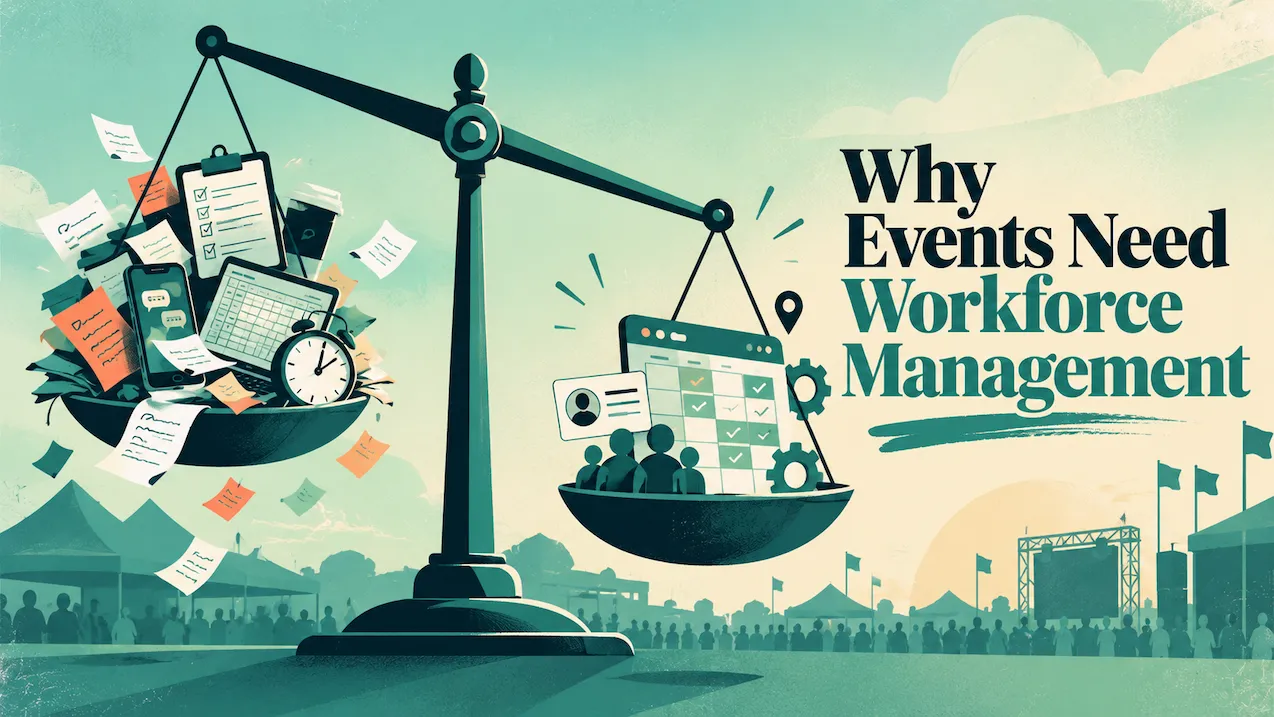
Events need workforce management because each event is a fixed deadline met by a workforce that changes every time. The doors open whether the right people arrived or not.
The crew running Saturday is rarely the crew from last week.
- Managing an event team by memory, a spreadsheet and a group chat works until the day it does not.
Event workforce management exists for the moment that improvised setup starts to cost you real money.
This bites hardest once an agency outgrows the point where one person holds the whole operation in their head. A growing event staffing business might run three clients across three venues in one weekend. It can scale from a handful of crew to a few hundred for one festival, then back.
- The UK Events Report 2024 valued the sector at £61.653bn and noted a clear shift toward more freelance roles.
- Coordinating staff across several sites at once is where that variability turns into a daily problem.
This piece looks at why the event format itself creates a workforce problem that office teams never face. It covers what tends to break when that problem is ignored.
It also shows how experienced operators run many events without losing the thread. The aim is practical: a clearer way to judge whether your current setup is holding, or quietly costing you.
What does event workforce management actually mean
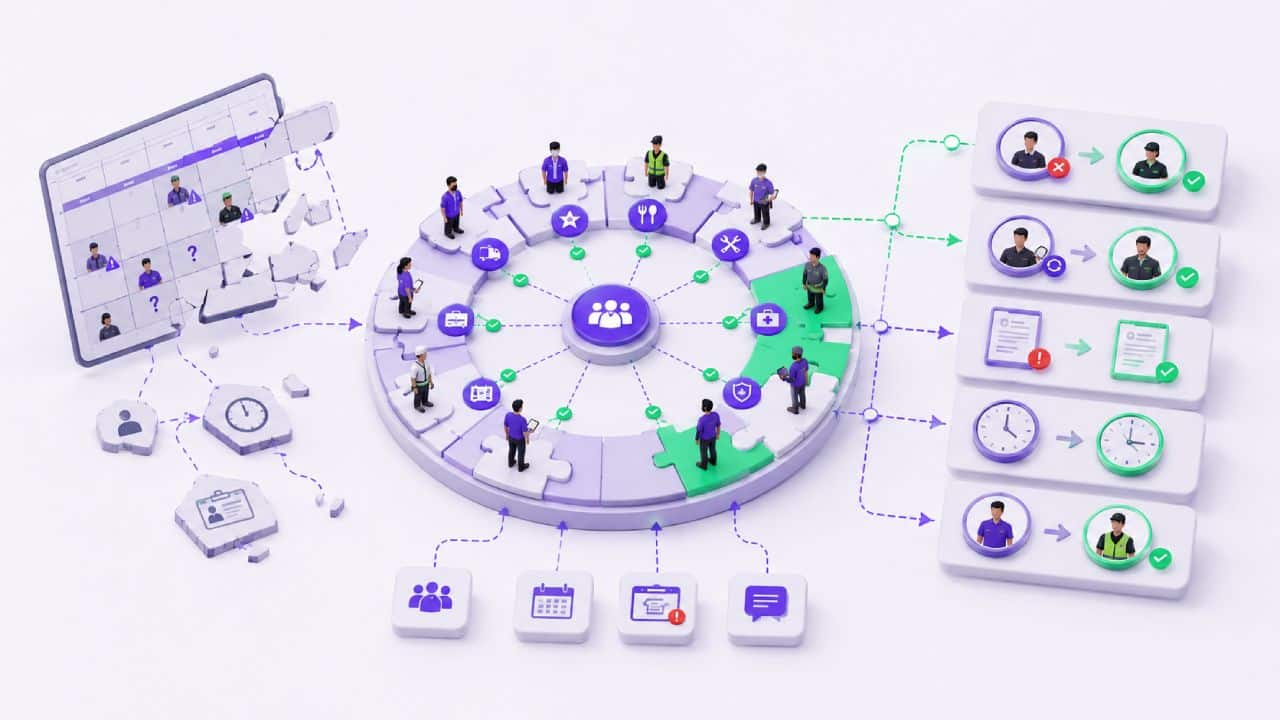
Event workforce management is the practice of planning, staffing, and coordinating the temporary teams that deliver events.
It covers who is available, who is booked, who is qualified, and how changes reach them in time. The work is operational, and it sits with the agency or supplier, never with the crew.
Generic workforce management was built for a different shape of work. Most tools assume a fixed team that clocks in at the same place each week, on predictable shifts. Event work breaks every one of those assumptions at once.
Event workforce management covers the moving parts a fixed-team tool ignores:
- Availability that changes daily across a shared freelance pool
- Skills and roles that vary from one crew member to the next
- Compliance and right-to-work documents that expire on their own schedule
- Live communication so every change reaches the right people before doors
A tool that assumes stability cannot manage work defined by change.
The opposite premise has to hold. Nothing about the next event is guaranteed to match the last. So the system has to begin from change and expect it every time.
Why events create a workforce problem that other industries do not
both at once. The deadline is fixed and public, and the workforce is assembled fresh each time. Retail rotas and office scheduling never face this from a standing start.
This is the gap event workforce management exists to close. The differences are clearest set side by side:
| Dimension | Office or retail workforce | Event workforce |
|---|---|---|
| Deadline | Flexible, work can move to another hour or day | Fixed and public, doors open on time or not at all |
| The team | Mostly permanent, the same faces each week | Freelance and casual crew, different for every event |
| Location | One fixed site | Several venues, often on the same day |
| Schedule | Repeats with small changes | Rebuilt from scratch for every booking |
| Headcount | Steady week to week | Swings from a handful to hundreds, then back |
The deadline that cannot be moved
An event has one start time, and it does not negotiate. A retailer short on staff can stagger tasks or extend opening hours. A festival gate set for 2pm opens at 2pm, ready or not. There is no second attempt, and no quiet Tuesday to recover on.
That single fact changes how staffing has to work. Every booking, confirmation, and replacement has to be settled before the deadline, not discovered at it. Accuracy in the days before an event matters far more than effort on the day.
A staffing gap shows up as a guest at an unstaffed door, with no chance to recover.
Managing temporary event staff who change for every event
The people delivering an event are rarely permanent employees. They are freelance and casual crew who work across several agencies and pick the shifts that suit them. The team that ran last weekend may share only a few names with the next.
- This is not a fringe pattern. In 2024 the live music sector employed more than 234,000 people (LIVE, Annual Report 2024).
Around four in five of those roles were casual or freelance. Managing temporary event staff at that churn is a tracking problem. Availability shifts daily, skills vary by person, and documents expire quietly in the background.
Scale makes it harder again. A supplier might need twelve crew on Thursday and three hundred on Saturday, then drop back to twelve. The pool is large, fluid, and shared, which is exactly what a fixed-team tool was never built to hold.
Headcount that swings by that much cannot live in one person’s memory.
What goes wrong when events run without workforce management
When the system includes memory, email and WhatsApp, the failures are predictable. They surface late, when there is no time left to fix them cleanly.
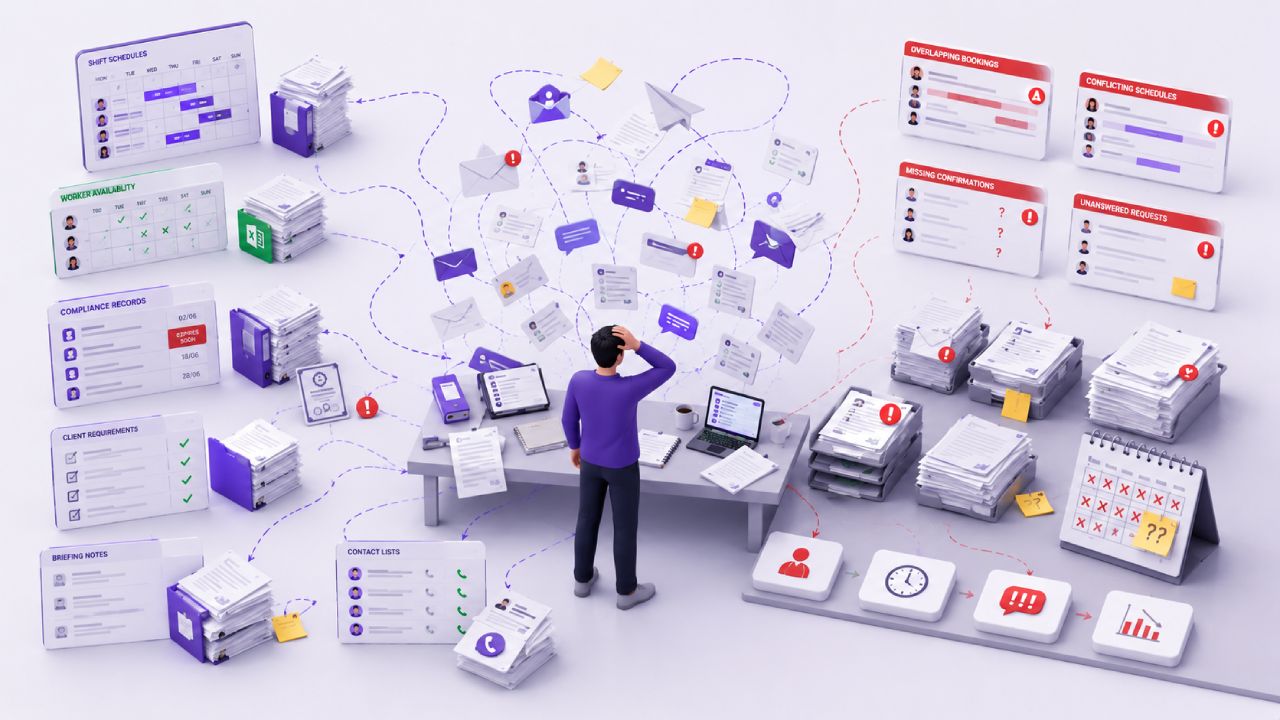
A worker cancels ninety minutes before the doors. The replacement hunt starts from a phone and a hunch about who is free. Two clients were promised the same person for the same Saturday. A briefing goes out by group chat, and half the team never reads it.
A right-to-work document lapsed weeks ago, and nobody noticed. Then the client phones for a confirmed name list that you cannot actually produce.
Most of these are visibility problems wearing the costume of people problems.
Without event workforce management, the information exists somewhere, just not where anyone can see it at once.
Where event staff scheduling clashes begin
The first thing to break is usually the schedule. Event staff scheduling across several clients puts the same names in several places at once. A spreadsheet cannot flag when one person is booked twice, so the clash stays invisible until both clients expect them.
Admin is the second casualty. As volume grows, the hours spent chasing confirmations and rebuilding rotas grow faster than the revenue behind them.
- One multi-client agency reached the point where manual systems could not keep pace.
That is the quiet threshold most growing suppliers cross without naming it. The same strain shows up across sectors.
- A hospitality supplier running repeat shifts feels it as sharply as a festival crew.
When admin outgrows revenue, the limit sits in the system rather than the effort.
What experienced event teams do differently
Operators who run many events well share one habit. They stop bending a fixed-team tool to fit event-shaped work, and they build around the event itself. Experienced teams treat it as one system.
They avoid a stack of apps, each knowing half the story.
Choosing event staffing software over a generic rota tool
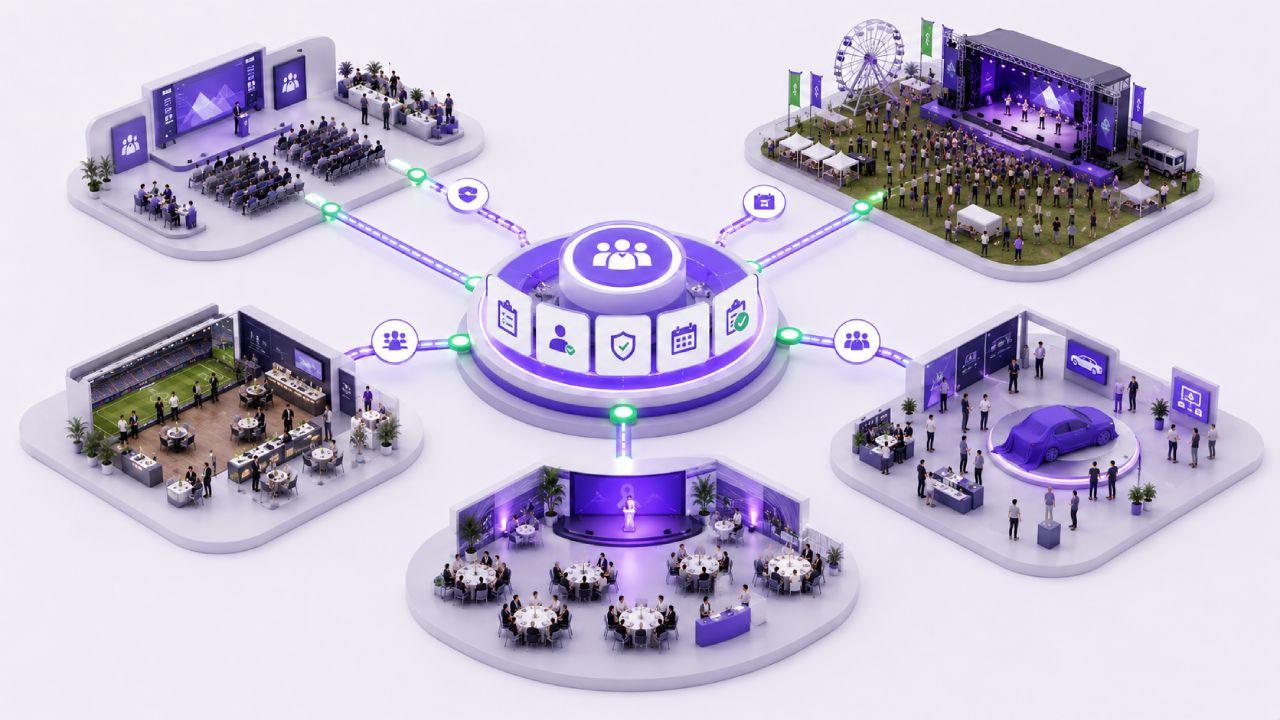
A generic rota tool can place names in time slots. It cannot hold a shared freelance pool, track who is qualified for what, or surface a free replacement in seconds. Event staffing software built for this work keeps the schedule, database, and messaging on one source of truth.
The practical test is simple. When a crew member drops out, can the system show who is free? It must also confirm they are qualified and not booked elsewhere. The same logic holds at the top of the scale.
- Large venue and stadium teams manage compliance and predictability across a long-term workforce. Purpose-built software answers in seconds.
A spreadsheet answers with a scramble.
Running multi-event operations from one source of truth
Running multi-event operations is mostly a problem of one truth in many places. Availability, bookings, documents, and changes all have to agree, or the gaps come straight back.
Experienced teams keep the lot in one system, so a change in one place updates everywhere at once.
One source of truth has to keep four things agreeing at all times:
- Who is available for each date and role
- Who is already booked, and where
- Which documents are valid, and which are about to expire
- What has changed since the version everyone last saw
That single source is what makes scale survivable.
The advantage shows up at peak, when the core team keeps the thread as the volume arrives.
How Liveforce supports event workforce management
By the time a supplier feels this, the problem is rarely one missing feature. It is coordination spread across too many disconnected tools. Liveforce is a workforce management platform built for event-led businesses.
It brings that scattered coordination into one system.
- Scheduling comes first, because the schedule is where clashes start. Schedule and book is used when staff are assigned across multiple events, locations, and roles at once. It replaces the spreadsheets and generic rota tools that cannot see a double booking coming.
- The workforce database sits underneath it. A central staff database tracks availability, skills, and compliance across a large freelance pool. It replaces the disconnected spreadsheets and contact lists that date the moment they are saved. It is a source of truth for people you already work with, rather than a place to source new ones.
- Communication closes the loop. Staff communication tools send briefings, shift updates, and last-minute changes. They replace the WhatsApp groups and text chains where half the messages never land. A rota change reaches every affected worker on their own device.
- Timesheets handle what comes after the work. They record hours worked accurately and speed up the admin behind payment, replacing manual sheets and disputed records. Liveforce supports payroll processes, and it does not run payroll.
- The Crew App supports all of this from the worker’s side. Crew can view shifts, confirm availability, and receive updates in one place. It sits last in the stack by design. The operator’s control room is where event workforce management actually happens.
The emphasis shifts by sector. Festivals lean on scale, access control, and communication at volume. Hospitality suppliers care about speed when repeat shifts stack up.
Venues and sports teams need predictability and compliance across a long-term workforce.
It is the same platform, framed around each one’s work.
What this means for a growing agency
None of this is about size. A growing agency reaches for event workforce management when the work outgrows what memory can hold. The pressure is structural. Fixed deadlines, a workforce that turns over, and clients who expect certainty you cannot fake.
So the better question has nothing to do with how big your events are. It is whether the work is forgiving enough to keep running on memory and a spreadsheet. For most growing event businesses, the honest answer lands the first weekend three things go wrong at once.
If that sounds familiar, it is worth seeing the alternative in practice.
Frequently asked questions
What is event workforce management?
Event workforce management is the practice of planning, staffing, and coordinating the temporary teams that deliver events. It covers availability, bookings, skills, compliance, and communication for a workforce that changes from one event to the next.
How is event workforce management different from general workforce management?
General workforce management assumes a fixed team, in a fixed place, on a predictable schedule. Event workforce management is built for the opposite. It handles temporary crew, changing locations, swinging headcount, and a schedule rebuilt every booking.
At what point does an event business need workforce management software?
The trigger is complexity rather than size. Once you run several clients and venues at once, a spreadsheet struggles to show who is booked or free. At that point the manual system has reached its limit.
Can workforce management work for short, one-off, or seasonal events?
Yes, because the value comes from repeatability and control rather than event length. It earns its place whenever staffing recurs or scales up and down, including seasonal peaks.
Does workforce management software replace recruitment?
No. It manages a workforce an agency already hires and pays, rather than sourcing or matching new people. The staff database is a source of truth for an existing pool, not a recruitment or marketplace tool.