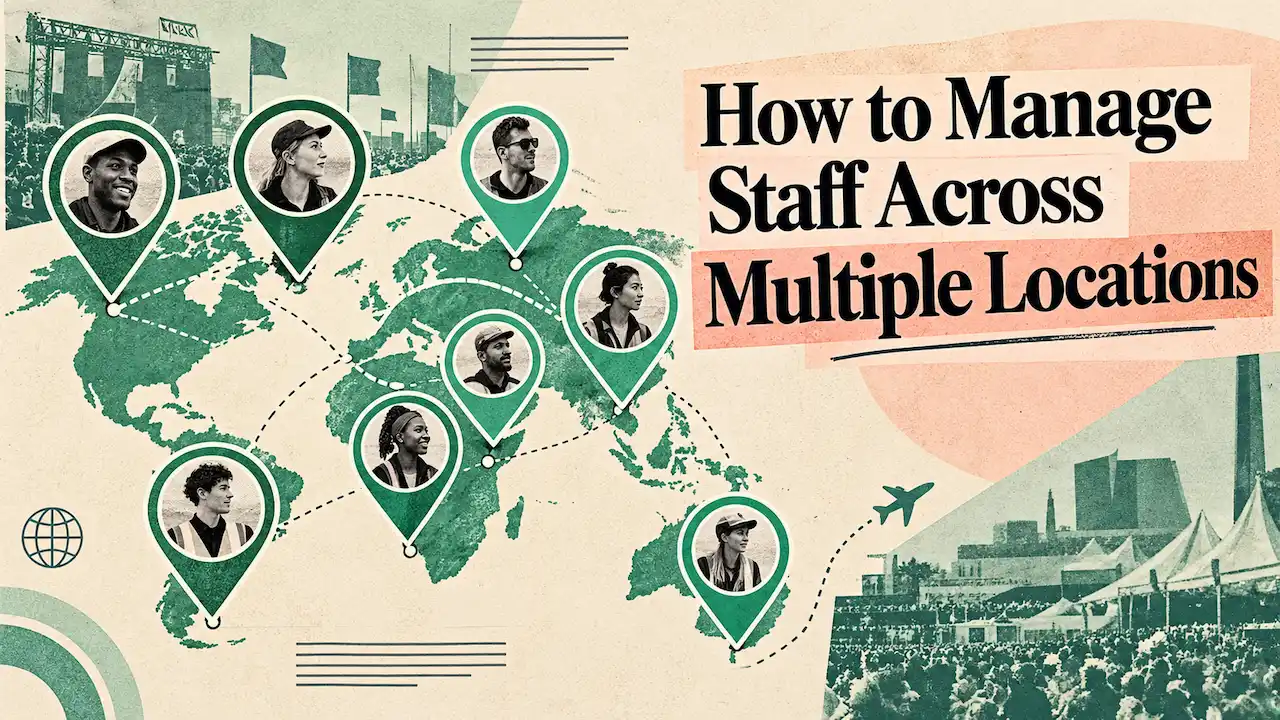
Managing staff across multiple locations is hard because no single person can hold the whole picture in their head.
Three clients at three venues on one weekend, and the tools that worked for a single event start producing gaps. The solution is not a better spreadsheet or a bigger team. It is one central source of truth for every schedule, every confirmation, and every briefing.
This problem hits a specific kind of agency. It is the hospitality supplier covering Wimbledon on Saturday, a festival in Manchester, and a corporate dinner in London. It is the experiential agency with three brand activations live at once. Each client has their own contact, their own brief, and their own standards. Each one expects their operation to feel like the only one.
Managing that through WhatsApp groups and spreadsheets is where control quietly breaks down.
This piece walks through what goes wrong, why the usual fixes fail, and what changes with one central view.
What goes wrong when managing staff across multiple locations
The symptoms are familiar to anyone who has coordinated more than two events at once.
- A confirmed staff member does not turn up because the shift update sat in the wrong group chat.
- A coordinator double-books a reliable hostess across two clients because availability was tracked in separate spreadsheets.
- A briefing goes out on Friday afternoon. Half the team have not read it by Saturday morning.
These are not staffing failures. They are coordination failures .
The signs usually show up in the same order. Confirmations start coming in late. Coordinators begin sending the same question twice because they cannot remember if they already asked. The operations WhatsApp group fills with messages that nobody has time to read. Someone on the team starts keeping a personal spreadsheet on the side. They no longer trust the shared one.
By the time the agency owner notices, the problem has already spread across multiple clients.
Where the breakdown actually happens
The breakdown is not in any one tool. It is in the handover between them. A coordinator confirms a shift in a spreadsheet. They send the briefing in WhatsApp. They track compliance in a folder. They answer a client query over email. Each tool works fine on its own.
The problem is that no single view shows what is true right now.
That missing view is where multi-location complexity gets lost. A coordinator running one event can keep it all in their head. A coordinator running four events across four clients cannot. When the mental model breaks, the operational model breaks with it.
Multi-location event staffing: why the usual fixes do not hold
Most agencies try the same three fixes. Each one feels sensible. None of them solve the root problem.
- The first is more spreadsheets. A master sheet is built, then a tab per client, then a tab per venue. Within a fortnight, half the tabs are out of date. The other half contradict each other. The sheet has become the problem it was meant to fix.
- The second is more group chats. A WhatsApp group per event, per client, or per venue. Coordinators end up jumping between fifteen conversations. Messages get missed. Staff end up in groups they should have left. Sensitive client information spreads across channels nobody can archive or audit.
- The third is more coordinators. Each location gets its own lead. On paper this looks like delegation. In practice it creates silos. Two coordinators confirm the same person for two events on the same day. Neither can see the other’s availability view. The agency owner now has to coordinate the coordinators.
Every one of these fixes adds complexity rather than removing it. They address the symptom, not the cause. The agency ends up doing more work to stay in the same place.
The real root cause: no visibility across locations
The root cause is always the same. No one system holds the truth about who is where.
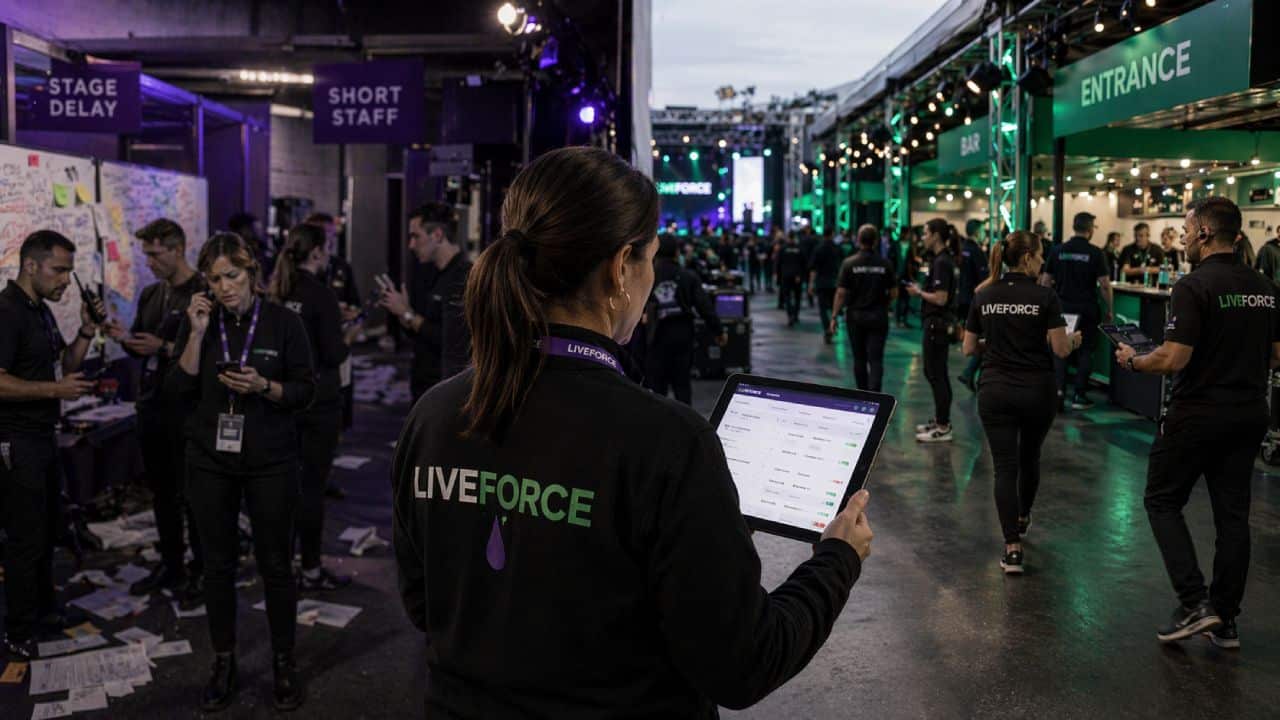
Each venue is being managed in a different spreadsheet, a different conversation, or a different person’s memory. There is no shared view of which staff are confirmed for which clients. There is no record of which briefings have been read. There is no list of which shifts still need filling. Every question has to be answered by someone digging through messages and asking around.
This is the visibility problem. It is not a staffing problem. The agency has the right people. It just cannot see them clearly enough, fast enough, across enough locations at once.
When visibility is the bottleneck, adding more staff does not help. Adding more coordinators does not help. The only thing that helps is collapsing the fragmented view into a single one. Managing staff across multiple locations at scale depends on that one change.
What managing multiple event clients looks like with one system
Agencies that handle multi-location complexity well do one thing differently. Every location sits inside the same operational view.
That single view holds four things at once:
- Scheduling for every client and every venue in one place, with visible conflicts and real-time availability
- Availability tracking across the whole workforce, so a coordinator can see who is free before they start asking
- Communication that routes shift updates and briefings to the right people, with a record of who has seen what
- Compliance and documents stored against each staff profile, so checks happen once and stay visible across every event
With this structure, a coordinator running four events on Saturday is looking at one screen, not four. They can see that the hostess confirmed for the Manchester festival is double-booked against a London dinner.
They catch it before either client notices. They can send the updated brief to all three hospitality teams at once. They can check who has not confirmed without opening three WhatsApp threads.
The day-to-day work does not disappear. But the work stops being about chasing information. It becomes about running the events.
Workforce visibility across locations: what it actually means in practice
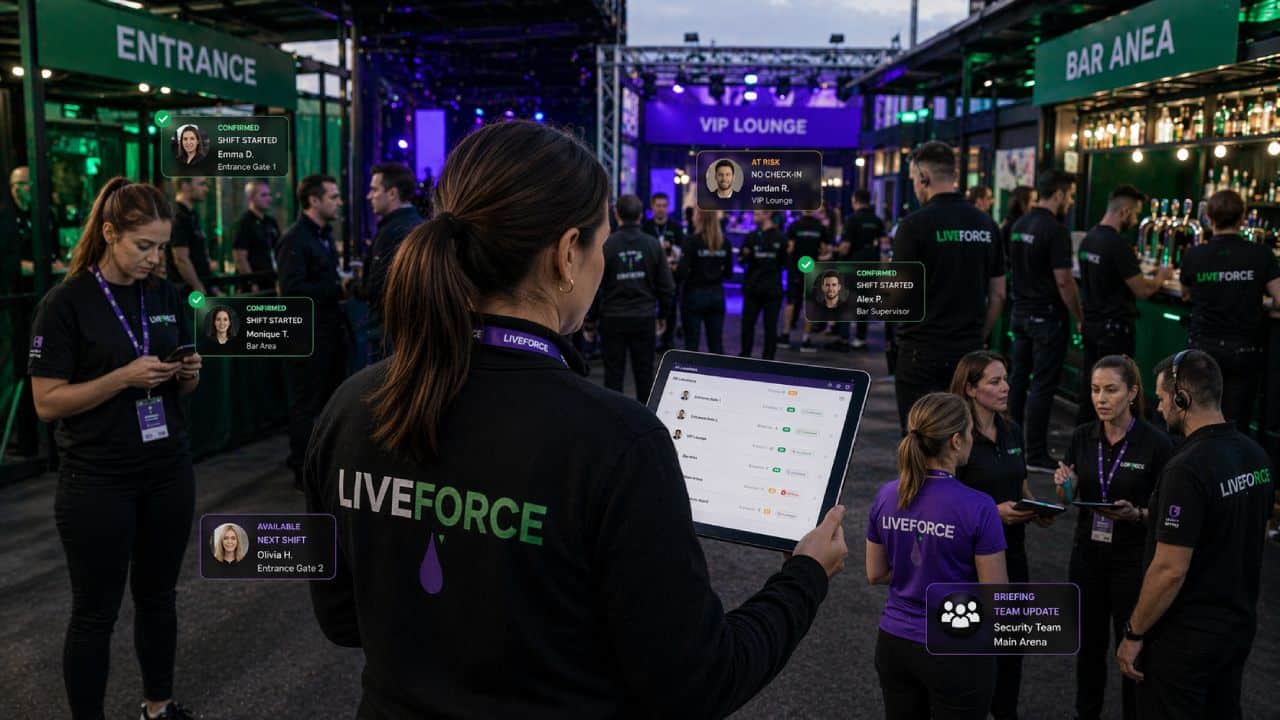
Workforce visibility across locations is not a dashboard. It is the ability to answer three questions at any moment.
- Who is confirmed.
- Who is available.
- Who is at risk.
A hospitality agency with 200 staff across a weekend needs all three answers at once. Who is confirmed for each venue. Who is still available if someone drops out. Who has gone quiet on confirmations and might not show up. When those three answers live in one place, the coordinator makes better decisions faster.
When they live in three separate tools, the coordinator is already behind.
How Liveforce handles multi-site workforce management
Liveforce is a workforce management platform built for exactly this scenario. Agencies running multiple clients at multiple venues at the same time are the core audience. Everything in the platform is shaped around giving a small operations team full visibility across every active location.
In practice, that looks like four capabilities working together.
Staff scheduling is used when an agency is assigning different staff pools to different clients and venues at once. It replaces the tangle of separate spreadsheets per client or per event. One coordinator can see every shift, every role, and every confirmation in one view. Double-bookings are flagged before they happen, not after.
The workforce database is used when the agency needs to know who is available and where they are confirmed. It also holds whether each person’s compliance is in order. It replaces scattered contact lists and last-minute availability calls. Every staff profile carries their skills, documents, and confirmed shifts. The coordinator is never guessing.
Communication tools are used when briefings and shift updates need to reach different staff groups at different locations. They replace the parallel WhatsApp groups nobody can track. A shift change at the Manchester festival reaches only the Manchester team. A briefing update goes to the right staff with a record of who has opened it.
Workforce visibility sits across all of it. A coordinator running four events on Saturday opens one screen and sees the state of every location at once. Reactive management becomes proactive oversight. The coordinator stops chasing information and starts running the operation.
None of this removes the work. It removes the friction that stops the work getting done. For agencies managing staff across multiple locations every weekend, that friction is usually the difference between growth and burnout.
Before and after centralised multi-location management
| Without centralised multi-location management | With centralised multi-location management | The operational difference |
|---|---|---|
| Scheduling spread across separate spreadsheets per client | One schedule covering every client, every venue, and every shift | Conflicts are visible before they become problems |
| Briefings sent across multiple WhatsApp groups | Structured communication routed to the right staff per location | Every team gets the right information without cross-posting |
| Availability checked by phone and personal memory | A live availability view across the whole workforce | Replacements are found in minutes, not hours |
| Compliance documents stored in folders and inboxes | Compliance tracked against each staff profile in one place | Checks happen once and stay visible across every event |
| Coordinators running separate views per venue | A single operational view across every active location | One coordinator can cover a weekend, not one per venue |
Event staff scheduling across multiple venues: what changes operationally
When agencies stop managing locations separately, three things change quickly:
- Coordinator workload drops. The same person can now cover a weekend that used to need two or three separate coordinators. The work shifts from chasing confirmations to reviewing exceptions.
- Errors drop. Double-bookings are prevented by the system, not caught after a client complaint. Missed briefings become rare because every update is tracked. Compliance gaps get flagged early because the view is always current.
- Client trust builds. A client who feels like their event is being run with full focus will book again. Multi-client operations only work at scale when every client feels like the priority.
Agencies that have read how to manage event staff for a single event will find that the same principles scale. The principles only hold as long as the visibility does.
Frequently asked questions
What is the biggest challenge of managing staff across multiple locations?
The biggest challenge is visibility. When staff, schedules, and communications are spread across separate tools, no single person can see the full picture. That is when double-bookings, missed briefings, and no-shows start happening.
How do event staffing agencies coordinate different clients at the same time?
They use a central workforce management platform that holds scheduling, availability, briefings, and compliance in one place. This lets a single coordinator run multiple clients at once. They never lose track of who is confirmed, who is available, and who needs a shift update.
What tools help agencies with multi-location event staffing?
Dedicated workforce management platforms built for event-led businesses are the most effective tool. Generic rota software struggles with multi-client complexity. Spreadsheets and WhatsApp break down quickly once more than two events run at once.
How do you maintain consistent briefings across multiple venues?
Consistent briefings require a single system where each location has its own briefing thread. Staff confirm they have read it. Sending briefings through WhatsApp or email makes tracking impossible, so agencies rely on platforms with structured communication tools.
How does workforce management software help with multi-location staffing?
Workforce management software centralises scheduling, availability, communication, and compliance into one operational view. For agencies managing staff across multiple locations, this means one coordinator can oversee every active venue without switching between tools.