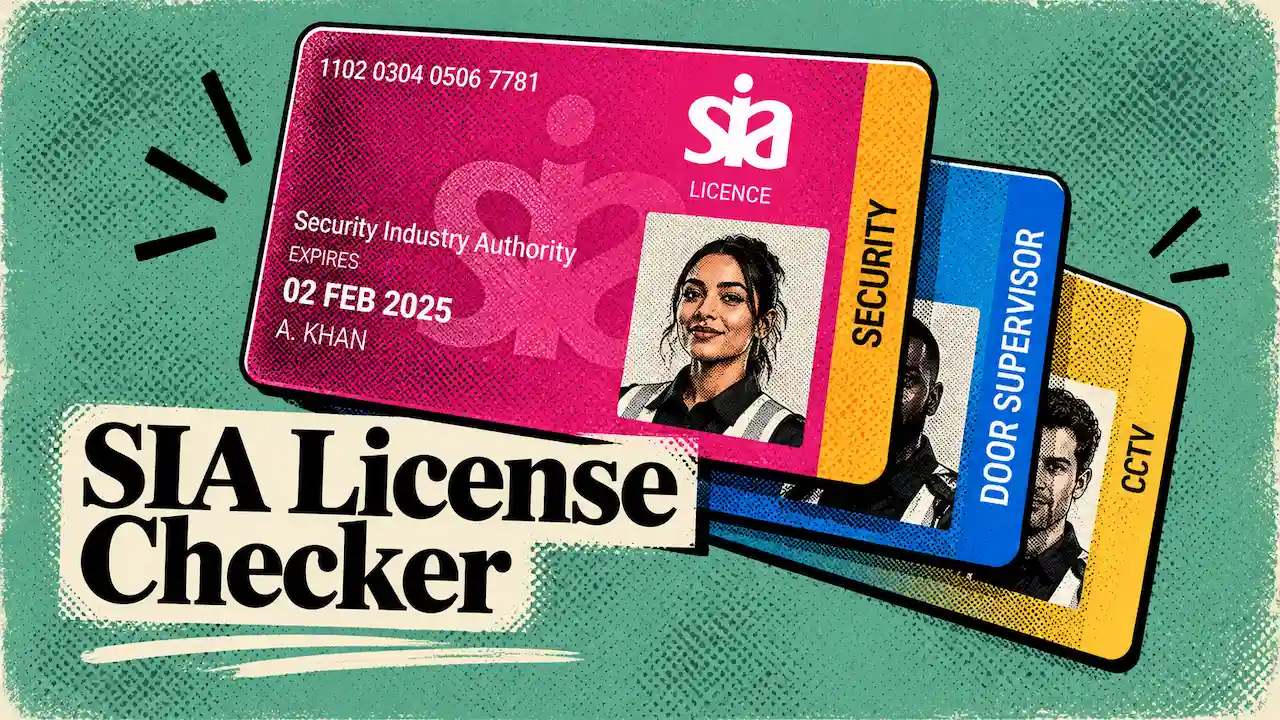
The SIA licence checker is the Security Industry Authority’s public Register of Licence Holders.
It lets anyone confirm whether a security operative holds a valid SIA licence. You search by name or 16-digit licence number, and the result shows the licence status, its type, and its expiry date. The SIA licence checker is free, and you do not need an account to use it.
For a security or event-staffing agency, that check carries legal weight. Deploying an operative without a valid licence is a criminal offence, and the penalty can land on the business as well as the person. Verifying one badge takes seconds.
Keeping a whole workforce compliant, as licences expire and crews move between clients, is the real operational challenge.
- The checker itself is free; the work is everything around it, which is where workforce management software built for staffing agencies and
- Current temporary workforce records stop being optional.
What is the SIA licence checker?
The SIA licence checker is an online register that confirms whether a person is licensed to work in private security in the UK.
It is maintained by the Security Industry Authority, the regulator created under the Private Security Industry Act 2001. The register is public, free, and open to anyone: employers, venue managers, the police, or a member of the public.
There is no login and no fee.
A licence card can be altered or out of date. The register is the only reliable proof.
The SIA does not employ security operatives or find them work. It regulates the industry by licensing individuals and publishing that record for anyone to check. So the SIA licence checker is a verification tool, nothing more. It confirms a licence exists and is current.
It does not tell you where someone has worked or vouch for how they perform on a shift
Inside the SIA licence register
To use the SIA licence register, you need one of two things.
- The first is the operative’s 16-digit licence number, printed on the front of the card.
- The second is their surname plus other details, such as date of birth and role.
Enter either, and the register returns the holder’s name, the licence sector, the current status, and the expiry date. That is the whole tool. Simple, fast, and reliable for a single check.
How to check an SIA licence
Checking an SIA licence takes under a minute.
- Go to the SIA’s Register of Licence Holders on GOV.UK, enter the licence number or the holder’s details, and read the result.
That public register is the SIA licence checker in practice, and you can run the same check for any operative, as often as you need.
One point matters here. A suspended licence card looks identical to a valid one. The photo matches, the hologram is intact, and the expiry date has not passed. The only way to know a licence has been suspended is the register.
This is why a card in someone’s hand is never enough on its own.
What an SIA licence check shows
An SIA licence check returns four things:
- Whether the licence is valid, expired, or suspended
- The licence type, such as door supervision, security guarding, or CCTV
- The expiry date, the last day the operative can legally work
- The holder’s name, so you can match the licence to the person in front of you
Read together, these confirm one thing: that the person is cleared for the specific role you are about to deploy them in. A CCTV licence does not cover door supervision, so the licence type has to match the job.
SIA badge checker: what you are actually verifying
People often search for an SIA badge checker or talk about checking a badge. The badge and the licence are the same thing.
The plastic card is the badge; the licence is the permission it represents. What you verify on the register is the licence behind the badge, not the card in front of you. A card can be faked or expired. The register cannot.
Who needs to check SIA licences, and when
A large security or event-staffing agency uses the SIA licence checker repeatedly, at several points across a worker’s time on the books.
- The first check happens at onboarding, before an operative joins the pool.
- Another happens before deployment to confirm the licence has not lapsed since the last job.
A client may ask for proof at any time, often before a high-profile event or during an audit. And every licence needs re-checking as its renewal date approaches.
Each of these checks is simple on its own. Doing them consistently, for hundreds of people, is where it gets hard.
The stakes are not abstract. Working in a licensable role without a valid licence is a criminal offence, carrying up to six months in prison or a fine of up to £5,000. An agency that deploys an unlicensed operative shares that exposure and adds a failed audit and a lost client to the bill.
The check is cheap. The gap is expensive.
Why one check is easy but staying compliant is hard
Checking a single licence is not the challenge. Managing a whole workforce of them is.
The SIA licence checker verifies one badge in seconds. It cannot watch hundreds of expiry dates for you.
SIA licences run for three years, so expiries arrive quietly, months apart, spread across a pool of hundreds. Crews rotate between clients, and the booker who checked a badge in March is rarely the one deploying that operative in October.
Records make it worse. Licence numbers sit in one spreadsheet, scanned cards in an email folder, expiry dates in someone’s head. When a client sends a compliance flag, the agency often finds the gap the hard way. The documents exist, but they are scattered across systems, and nobody checked before the booking went out.
A spreadsheet does not warn you which licences expire next week. Someone has to remember to look.
This is the failure that compliance teams dread. The danger is subtle. A check that was correct three months ago can quietly go out of date, and nobody notices until a client does.
- As an agency grows and managing a temporary workforce gets more complex, the odds of one licence slipping through climb with every new client.
CASE STUDY:
It is why large, multi-client operations move licence data into one system. THA, an international staffing agency, runs its workforce on Liveforce for this reason: one place to hold and track compliance as the operation scales across borders.
How agencies track security staff compliance at scale
Keeping an SIA-licensed workforce compliant
One badge takes seconds. A whole workforce takes a system.
When licence data lives in one place, security staff compliance stops being a manual chase. A workforce management platform gives an agency a single record for every operative, with their SIA details attached to it.
Liveforce is the platform many event-led agencies run to do exactly that.
Held in one central record, each operative’s compliance profile does three jobs:
- It stores the SIA licence number, type, and expiry date against one profile, replacing scattered spreadsheets and drive folders
- It flags upcoming expiries before they lapse, replacing the reminder someone used to keep in their head
- It produces compliance data on demand for a client or an audit, replacing the two-day scramble to reconcile records
This is the job of a proper central workforce database, built to hold compliance records rather than just shifts. A dedicated staff database earns its place because each capability removes a manual step the agency was doing anyway.
The SIA licence checker still confirms the badge. The database keeps every expiry in view.
For agencies supplying security and stewards to stadiums and large venues, the same record proves compliance to the end-client before a worker sets foot on site. The client asks for evidence; the agency exports it in minutes, not days. The difference is clearest side by side.
| Compliance task | Manual approach | In a central workforce database |
|---|---|---|
| Verify a licence at onboarding | Check the register, then paste the number into a spreadsheet | Number, type and expiry saved to the operative's profile in one step |
| Track expiry dates | Someone remembers to scan the sheet, or nobody does | The system flags each licence before it lapses |
| Prove compliance to a client | Rebuild a report from spreadsheets and email folders | Export current compliance data in minutes |
| Spot a lapsed licence before deployment | Hope the last check still holds | Expired and suspended licences are visible before a shift goes out |
← Swipe to compare →
Compliance is not a one-time check
The SIA licence checker answers one question well: is this badge valid today? For an agency running hundreds of operatives, that is the easy part.
The harder question is whether you will know the moment a licence is about to lapse, before a client does.
A one-off check cannot answer that. A live record can.
Compliance is a moving target. It has to be maintained week after week, across every crew you deploy, because a licence that was valid last month may not be valid now.
The cost of one unlicensed operative
One unlicensed operative on site can undo months of good work. A failed client audit, a fine, or a lost contract costs far more than the few minutes it takes to keep a licence record current. For a large agency, that maths only sharpens as the workforce grows.
See how Liveforce keeps SIA and compliance data in one place, and book a demo.
Frequently asked questions
What is the SIA licence checker?
The SIA licence checker is the Security Industry Authority’s public Register of Licence Holders. It confirms whether a security operative holds a valid SIA licence, and shows the licence type and expiry date. It is free and open to anyone.
How do I check if an SIA licence is valid?
Search the SIA register using the operative’s 16-digit licence number, or their surname and other details such as date of birth and role. The result shows whether the licence is valid, expired, or suspended, with its type and expiry date.
How long does an SIA licence last?
Most SIA licences are valid for three years from the date of issue. Renewal is the holder’s responsibility and does not happen automatically, so expiry dates need tracking to avoid a lapse.
Do in-house security staff need an SIA licence?
In-house staff, employed directly by the organisation they protect, often do not need a licence. There are exceptions: door supervision at licensed premises always requires one, and any operative supplied under a contract for services needs a licence for licensable activities.
How can an agency track SIA licence compliance across its whole workforce?
By holding every operative’s licence number, type, and expiry date in one central workforce database, rather than in separate spreadsheets. A workforce management platform such as Liveforce flags upcoming expiries and produces compliance data on demand for clients and audits.