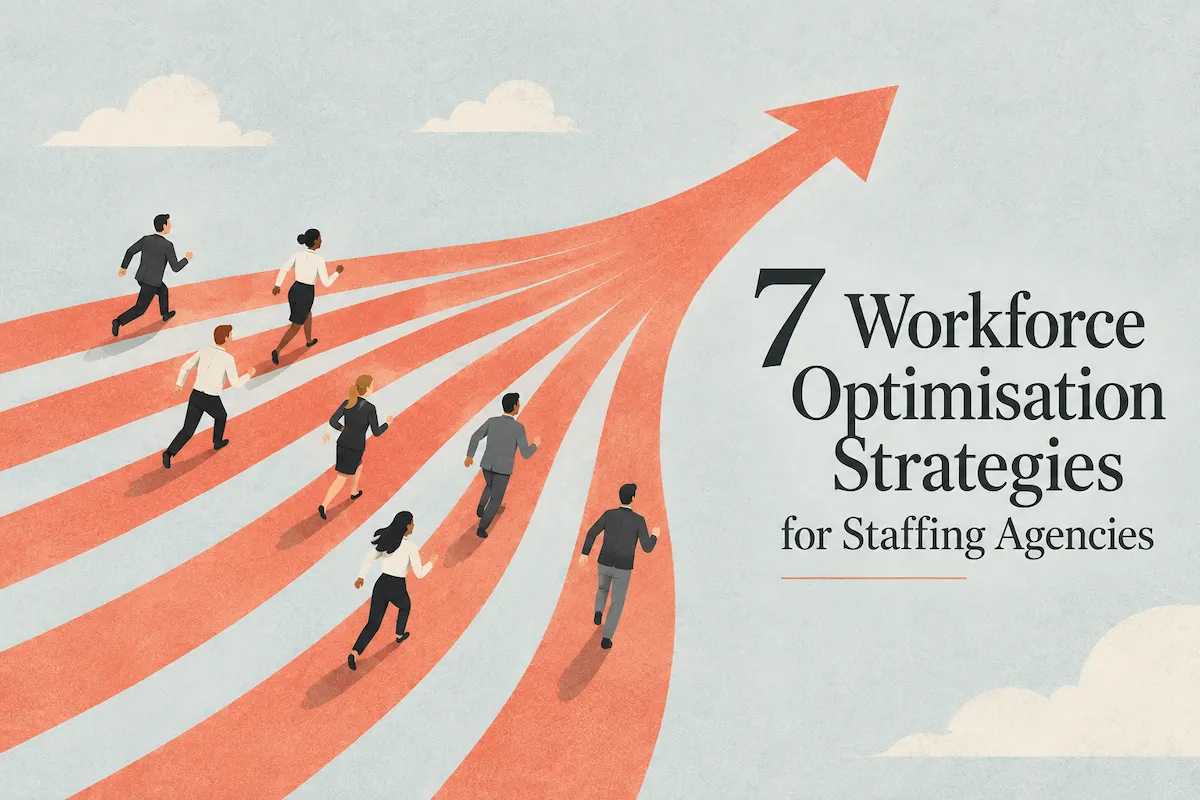
For a growing event staffing agency, workforce optimisation means getting more from the workforce you already manage: higher fill rates, fewer no-shows, the right people in the right roles, and labour costs you can see and control.
Adding more crew is a separate decision. Optimisation is about using the pool you run today with more precision as the work grows.
That matters most in the growth phase, when volume rises faster than the team managing it. Spreadsheets and group chats start to lose shifts, margin, and reliability, and the same principles that keep a small pool tidy stop scaling.
The seven workforce optimisation strategies below help you lift workforce efficiency without adding headcount, so you can take on more clients and more events with the resources you already have.
- They apply whether you run a handful of regulars or the kind of large pool that comes with managing a temporary workforce across several clients, and
- They build on solid planning for seasonal demand.
Most aencies are already paying for the capacity they need. They just are not using all of it.
5 Signs a growing agency is leaving capacity on the table
Before the strategies, a quick gut check. These are the everyday signs that a pool is working below its potential:
- Unfilled shifts you almost certainly had people for, but could not reach in time.
- Repeat no-shows from the same names, event after event.
- Over-staffed low-margin jobs while higher-value work goes short.
- Admin rising faster than revenue as every new client adds manual work.
- No clear view of availability, so booking starts with a round of calls.
7 best Workforce Optimisation Strategies
Workforce optimisation
7 strategies for a growing event staffing agency
Forecast demand from your event pipeline
Put workforce data in one place
Match skills to shifts
Reduce no-shows before they happen
Fill shifts faster with targeted offers
Consolidate communication
Measure utilisation and labour cost
Do more with the workforce you already manage.
1. Forecast staffing demand from your event pipeline
Plan headcount against the work you can already see, not the week in front of you. Growing agencies get caught out because demand arrives in clusters: three events land on the same weekend and the pool is suddenly short.
Reacting week to week means paying for last-minute cover or turning good work away. Map your confirmed and likely events across the next quarter, match each to the roles and skills it needs, and the gaps show up early enough to fix calmly.
Forecasting turns staffing from a weekly scramble into a plan you manage. It is the first move in any serious workforce optimisation effort.
2. Put your workforce data in one place
A single record of every worker’s skills, availability, and compliance is the foundation the other six strategies rely on. When that data sits in scattered spreadsheets and personal phones, no one holds the full picture, and bookings get made half-blind.
- Move it into one central staff database and every decision starts from the same accurate source: who is qualified, who is compliant, who is free.
- Agencies that move off spreadsheets often find the data was never the real problem. The sprawl was.
3. Match skills to shifts, not just empty slots
Workforce optimisation means putting the right person in each role, rather than the first name that shows as free.
Filling a slot with anyone available raises the fill rate on paper and lowers quality on the floor. A supervisor shift handed to someone without the experience costs you in client feedback, not just wages. When you can filter the pool by skill, certification, and past performance, you assign for fit.
That protects the client relationships repeat business depends on, and it keeps your best people on the work that suits them.
4. Reduce no-shows before they happen
Most no-shows are predictable, and prevention costs far less than scramble cover.
A worker who has not confirmed by the day before is a gap you can still fill in good time. Automated confirmations and reminders surface the silent drop-outs early, and a clear reliability history tells you who to trust for the shifts that cannot fail.
The costliest no-show is the one you find out about at the doors.
A no-show you predict is a scheduling task. A no-show that lands on the day is a crisis.
5. Fill shifts faster with targeted offers
Reach the right available, qualified people first, instead of messaging the whole pool and waiting.
Broadcasting every shift to everyone creates noise, double bookings, and a race you cannot track.
Offers sent only to workers who match the role and are free fill shifts faster and with better people. Speed matters most as you grow, because the shifts you fill quickly are often the ones competing agencies are chasing for the same weekend.
A faster, more targeted offer is quiet workforce optimisation in action.
6. Consolidate communication to protect workforce efficiency
One channel for briefings, updates, and changes removes the errors that quietly waste capacity.
When information is split across group chats, email chains, and last-minute calls, people work from the wrong version and mistakes multiply.
A single thread per event means every worker sees the same brief, the same call time, and the same change.
- Clear event staff communication is what real workforce efficiency looks like on the ground: less time chasing, more time running events, fewer costly misunderstandings.
7. Measure workforce utilisation, then act on it
Track workforce utilisation and labour cost per event and per client, so you can see where you are over- or under-staffed. Without the numbers, over-staffing hides inside busy weeks, and thin-margin clients look the same as profitable ones.
- Accurate timesheets and payments turn hours worked into a cost you can compare across jobs.
Turn labour cost into labour optimisation
This is where labour optimisation becomes a figure you manage rather than a feeling.
Measurement is what makes workforce optimisation repeatable rather than lucky.
Compare cost against output by event and by client, and the pattern gets obvious fast.
- Better workforce tracking shows which work earns its margin and which quietly loses it, so you can adjust staffing levels before the next booking, not after the invoice.
How Liveforce works as workforce optimisation software
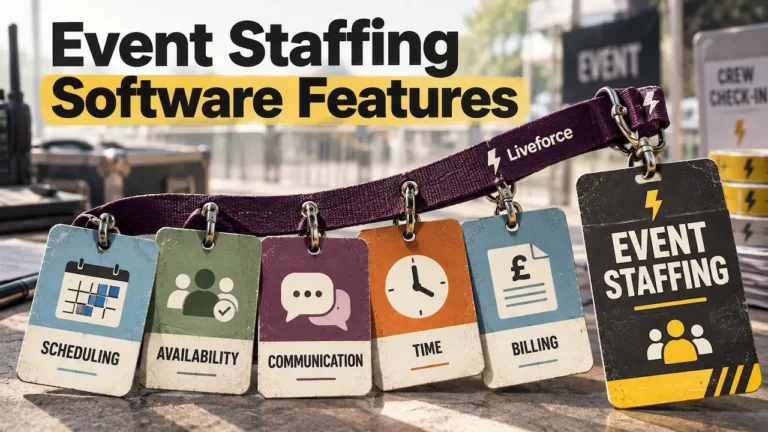
Each strategy works on its own. Together, they need one system, and that is what Liveforce is: workforce optimisation software built for agencies and suppliers that manage temporary and freelance crews across many clients.
It is the platform an agency runs to organise its own workforce. Liveforce does not source, hire, or supply staff.
The value is in bringing the seven strategies into one place, where each capability replaces something manual.
- The staff database is used when you decide who to offer a shift to, in place of scattered spreadsheets, personal contact lists, and out-of-date records.
- Scheduling is used when you book staff across several events at once, replacing paper rotas and generic tools that cannot handle multi-client work.
- Communication carries briefings and last-minute changes, in place of WhatsApp groups and phone chains.
- Timesheets record work as it is done, replacing disputed hours and feeding the cost data the seventh strategy needs. Brought together, these capabilities are what workforce optimisation looks like as a working system.
CASE STUDY:
This is the shift Complete Works described.
The Wimbledon-based agency places actors in visitor attractions such as the National Gallery and Kew Gardens, and before Liveforce it ran on, in its own words, “Excel, and sweat.” Managers texted every worker the night before each shift, then waited for them to log on an hour before the start.
Once that admin sat inside one system, the same small team could spend its hours on client care and winning new work instead of manual scheduling. That is the point of workforce optimisation for a growing agency: the workforce did not get bigger, it got used better.
What a growing agency consolidates into one platform
- Staff records, skills, and compliance in one database, not scattered files.
- Availability and scheduling across every event and client in a single view.
- Briefings and updates through one channel, not competing chats.
- Timesheets and labour cost captured as work happens, ready to report.
Swipe to see the full table →
| Optimisation lever | Manual approach | Structured approach | Outcome |
|---|---|---|---|
| Demand forecasting | Book week to week and react to clashes | Plan headcount against the event pipeline | Gaps spotted early, less last-minute cover |
| Workforce data | Spreadsheets and contacts on personal phones | One central staff database | Every decision from one accurate source |
| Skills matching | Fill the slot with the first name free | Assign by skill, certification, and history | Higher quality, stronger client retention |
| No-shows | Find out at the doors | Confirmations, reminders, reliability history | Fewer gaps, calmer event days |
| Fill speed | Mass-message the whole pool and wait | Targeted offers to matched, available crew | Shifts filled faster, with better people |
| Labour-cost visibility | Guess at margin until the invoice | Track utilisation and cost per event and client | Staffing adjusted before the next booking |
Optimise the workforce you already have
Growth rewards the agencies that get more from their current pool. As you take on more clients, the ones winning work at better margin are those already running lean, reliable operations without adding headcount for every new contract.
That is a structural advantage, and it compounds with every event.
See how Liveforce helps you get more from your existing crew: book a demo with Liveforce.
Frequently asked questions
What is workforce optimisation?
Workforce optimisation is the practice of getting more from the staff an agency already manages: higher fill rates, fewer no-shows, better skills matching, and controlled labour cost. In event staffing, it improves how the existing workforce is scheduled and used, rather than growing the pool.
What is the difference between workforce optimisation and workforce planning?
Workforce planning decides how many people and which skills you will need for future demand. Workforce optimisation makes the workforce you already have perform better against that demand. Planning sets the target, and optimisation hits it more efficiently. You can read more about the planning side in our guide to what workforce planning is.
How do event staffing agencies improve their fill rate?
They match workers to shifts on skill and availability, then send targeted offers to the people who fit, rather than broadcasting every shift to the whole pool. Accurate availability data and fast, focused offers fill more shifts with the right people.
How can a growing agency reduce no-shows?
By confirming attendance ahead of time, sending automated reminders, and tracking reliability so unconfirmed workers are chased or replaced before event day. Most no-shows are visible early when an agency watches the right signals.
What workforce optimisation software do event agencies use?
Event agencies use workforce management platforms for workforce optimisation, combining a central staff database, multi-event scheduling, communication, and timesheets in one system. Liveforce is built for this, giving agencies one place to schedule staff, communicate clearly, and track labour cost across every client.