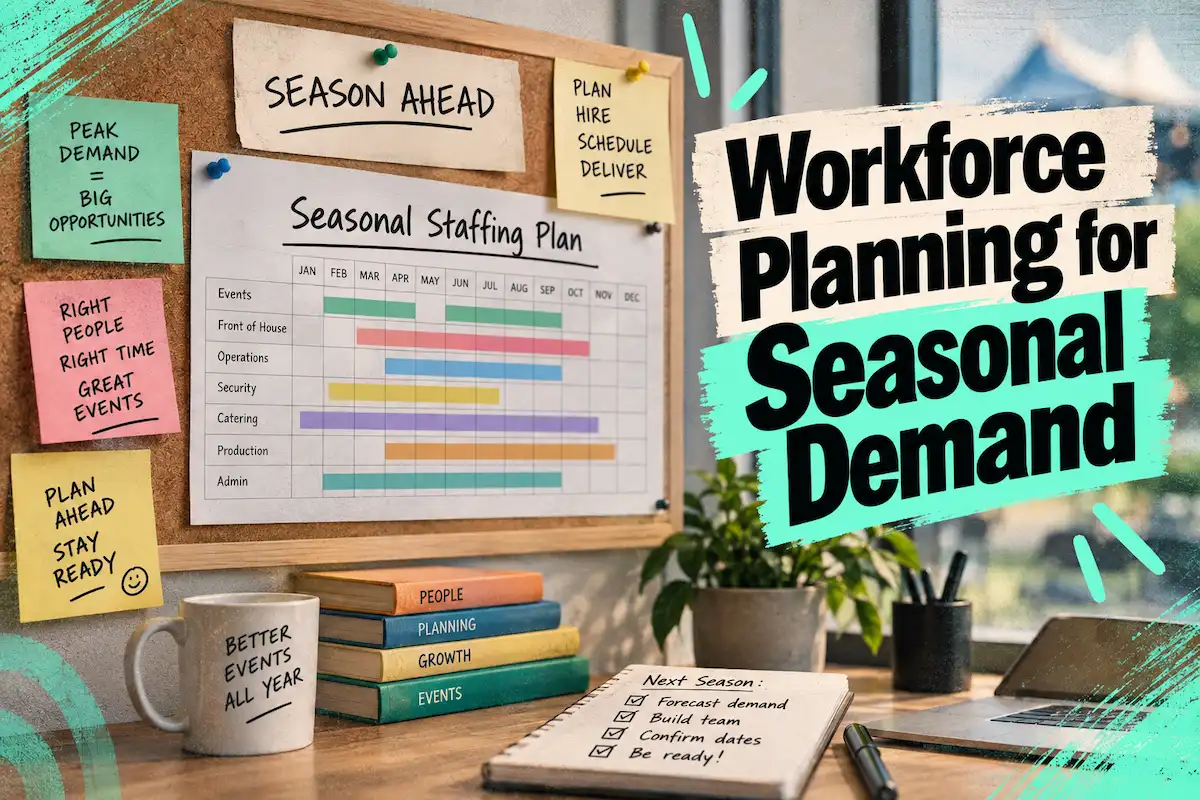
Workforce planning for seasonal demand is what separates agencies that run smooth peak seasons from those that spend every summer or Christmas period firefighting.
Every event staffing agency knows that demand spikes are coming. Festival seasons, corporate hospitality surges, holiday periods and sporting calendars all follow the same patterns year after year.
The agencies that struggle are rarely surprised by the volume. They are caught out by the lack of structure behind their response.
This problem hits hardest at agencies managing multiple clients across overlapping events. A hospitality supplier running Christmas party season for five clients simultaneously faces a different challenge to one covering a single venue.
The complexity is not the number of staff needed. It is tracking who is available, who is confirmed, who has the right credentials, and whether any of those answers have changed since yesterday.
When seasonal demand staffing relies on spreadsheets, WhatsApp groups and personal contact lists, manageable pressure turns into operational chaos.
Why seasonal demand catches you off guard
The obvious answer is volume. More events, more clients, more staff needed. But volume alone does not explain why experienced agencies still end up scrambling. The real causes run deeper, and they tend to sit inside the agency’s own systems and habits.
Most event staffing agencies are operationally reactive by default. During quieter months, the reactive approach works. Coordinators can hold schedules in their heads. A quick WhatsApp message confirms a shift. Availability is checked by scrolling through a phone contact list or a shared spreadsheet. These methods work when volumes are low and the margin for error is wide.
The problem is that these methods do not scale. When June arrives and the agency is suddenly managing three festivals, two corporate hospitality contracts and a product launch weekend, the same coordinator is using the same spreadsheet and the same WhatsApp group. The tool has not changed. The demand has.
Seasonal demand does not create new problems. It exposes the ones that were already there.
Three specific causes sit behind most seasonal breakdowns in seasonal staffing management:
- Fragmented data. Availability, skills, compliance records and contact details spread across multiple documents and apps. No single person has a clear picture of the workforce at any given moment.
- No forward visibility. Without a structured way to see what is coming in the next four to six weeks, agencies cannot plan ahead. They react to each booking as it arrives.
- Communication that depends on individuals, not systems. When shift confirmations rely on a coordinator remembering to message each person, the process fails the moment that coordinator is stretched across too many events.
None of these problems feel urgent in January. By July, they define the entire operation.
What poor seasonal planning costs when the peak arrives
The cost is not abstract. It shows up in specific, measurable ways that agency owners and operations managers recognise immediately.
Under-staffing is the most visible consequence. When availability tracking is unreliable, agencies book staff who turn out to be unavailable, double-book people across events, or simply run short.
The UK’s Recruitment and Employment Confederation has consistently reported that temporary labour demand peaks sharply during summer and Q4 hospitality seasons, and agencies without structured planning bear the brunt of those surges. A festival that needed forty bar staff and gets thirty-two on the day is a failed delivery. The client notices. The relationship takes damage.
A single under-staffed event during peak season can undo six months of client relationship building.
No-shows increase during peak periods because staff are working with multiple agencies and confirmations get lost in message threads. When an agency relies on WhatsApp to confirm shifts, there is no audit trail, no automatic reminder, and no way to see which staff have not responded. The coordinator finds out someone is not coming when they do not arrive.

Where operations break down
The breakdown usually happens at a specific point: the gap between booking confirmation and event delivery.
An agency wins the work, confirms the client, and then turns to the workforce. If availability data is days old, if compliance documents have expired without anyone noticing, if the briefing has to be created from scratch because there is no centralised system, the gap between confirmation and delivery fills with admin, phone calls and guesswork.
Admin overload is a quieter cost but equally damaging. During seasonal peaks, operations teams spend more time chasing confirmations, updating spreadsheets and resolving clashes than they do on the work that actually generates revenue.
The agency is busy, but the busyness is friction, not productivity. Staff burnout follows. Experienced coordinators leave because the peak periods are unsustainable. This creates a secondary problem: the agency loses institutional knowledge about which staff are reliable, which clients are demanding, and which events need specific skills.
Client complaints rise in direct proportion to the amount of manual coordination required. When an agency is managing seasonal demand through reactive methods, errors are inevitable. Late arrivals, wrong uniform briefs, missing credentials, unconfirmed shifts.
Each one is small on its own. Together, they tell the client the agency is not in control.
How to build control before the season starts
The shift from reactive to structured workforce planning for seasonal demand does not require a complete operational overhaul. It requires three things: centralised data, forward visibility, and system-driven communication. Each one replaces a specific manual process that breaks under seasonal pressure.
The agencies that handle peak seasons well are not working harder. They planned earlier and with better tools.
Centralised scheduling means every event, shift and role sits in one place. When a coordinator needs to check whether a staff member is available for a Saturday festival shift, they are not opening a spreadsheet and cross-referencing it with a WhatsApp conversation from three weeks ago.
They can see availability in real time, alongside that person’s skills, compliance status and confirmed bookings. This single change removes the most common source of seasonal scheduling errors: outdated or fragmented information.
Forward visibility means the agency can see its upcoming demand mapped against its available workforce. If a hospitality supplier knows it has forty shifts to fill across three clients in the second week of December, and its workforce planning process shows only twenty-eight confirmed staff, the gap is visible weeks in advance.
That gap can be filled calmly, through targeted outreach and early booking. Without forward visibility, the same gap appears seventy-two hours before the event, and the response is panic.
System-driven communication means shift confirmations, briefings and changes go through a structured channel rather than through individual messages. When a coordinator sends a shift update through a platform, every relevant staff member receives it.
There is a record of who has seen it, who has confirmed, and who has not responded. This replaces the “did I message them?” uncertainty that defines reactive communication during busy periods.
What structured seasonal planning looks like in practice
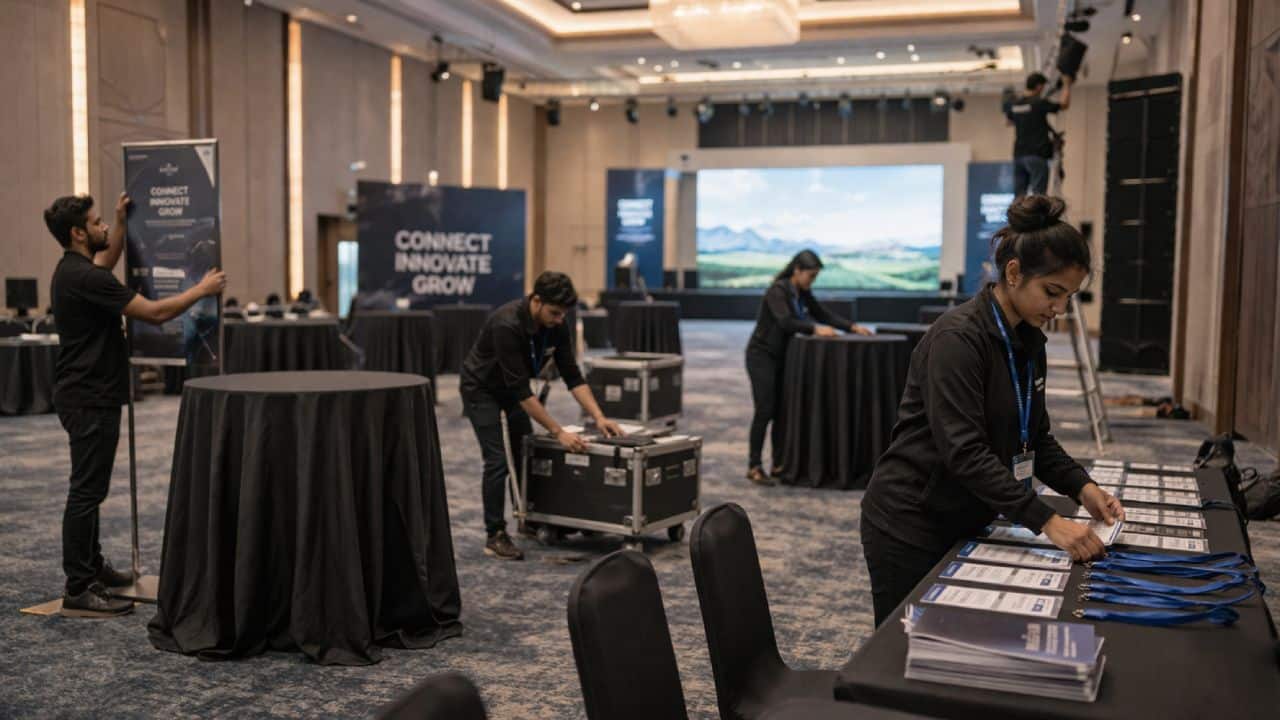
In practical terms, structured workforce planning for seasonal demand follows a clear rhythm. Effective event workforce planning works backwards from the peak, with each stage building on the last:
- Eight to twelve weeks out: audit the workforce. Review which staff are active, which compliance documents expire during the busy months, and which skill gaps exist. This is when recruitment needs become visible, not when events are already booked.
- Six to eight weeks out: schedule and match. Confirmed bookings go into a centralised schedule. Temporary workforce scheduling begins here: staff are matched to roles based on skills, location and availability. Gaps are flagged early enough to act on.
- Four weeks out: confirm and track. Staff receive shift details through a structured system. They confirm or flag conflicts. The agency sees confirmation status across every event in one view. Unconfirmed shifts are followed up systematically.
- During the peak: deliver, not admin. Changes happen, cancellations come in, shifts need reassigning. With centralised data and clear communication channels, these are managed within the system rather than through a flurry of texts and calls. Post-event, timesheets are recorded without the usual delays.
Agencies that treat peak season staff planning as a defined process, rather than a scramble, can use tools like staffing needs calculators to see exactly how many people each event requires and whether the pool can cover it. The rhythm above turns seasonal demand from an emergency into a managed operation.
Agencies that plan seasonally spend peak periods running events. Agencies that react spend them running around.
How Liveforce supports seasonal workforce planning
Liveforce is a workforce management platform built for event-led businesses that manage large temporary teams across multiple projects, clients and locations. For agencies preparing for seasonal demand, it replaces the fragmented tools that fail under pressure with a single operational system.
During seasonal peaks, agencies use Liveforce’s staff scheduling features to manage overlapping events across multiple clients from one central schedule. Instead of maintaining separate spreadsheets for each client or event, every booking, shift and role assignment sits in one place.
Availability clashes are flagged automatically. Double-bookings are prevented before they happen. This is where the difference between centralised scheduling and spreadsheet-based planning becomes most visible: the moment an agency is running five events in a single weekend across three cities.
The workforce database gives agencies an accurate, real-time view of their entire staff pool. Skills, experience, compliance records and availability are stored centrally, replacing the disconnected contact lists and outdated spreadsheets that make pre-season planning unreliable.
When an agency needs to know which thirty of its two hundred registered bartenders are available, compliant and within travel distance of a venue on a specific date, the answer takes seconds rather than hours of cross-referencing.
Communication during seasonal peaks runs through Liveforce’s structured messaging tools. Shift confirmations, briefings and last-minute changes reach every relevant staff member through the platform. There is a clear record of who has received, read and confirmed each message. This replaces WhatsApp groups and text chains where messages get buried, responses are missed, and there is no audit trail when something goes wrong.
The result is that seasonal demand becomes something agencies plan for, not something they survive. Workforce planning for seasonal demand stops being a scramble and becomes a repeatable process. The operational pressure of a busy period does not disappear.
The chaos does.
Seasonal workforce planning: the operational difference
Frequently asked questions
What is workforce planning for seasonal demand?
Workforce planning for seasonal demand is the process of preparing an agency’s staffing capacity ahead of predictable busy periods. It involves reviewing the workforce database, confirming availability, filling skill gaps and scheduling staff weeks before the peak arrives, rather than reacting to each booking as it comes in.
How far in advance should event agencies plan for seasonal peaks?
Most experienced agencies begin seasonal planning eight to twelve weeks before the busy period starts. This allows time to audit the workforce, check compliance expiry dates, identify gaps and begin targeted recruitment. Agencies that start planning four weeks or less before a peak are almost always in reactive mode.
How do agencies track staff availability ahead of a busy season?
Agencies that handle seasonal demand well use a centralised workforce database where staff update their own availability in real time. This replaces the manual process of messaging each person individually and cross-referencing replies against a spreadsheet.
What is the biggest staffing mistake agencies make during peak periods?
The most common mistake is assuming that the same tools and processes that work during quiet months will hold during a peak. Spreadsheets, WhatsApp groups and manual tracking can manage ten events a month. They cannot reliably manage ten events in a single weekend across multiple clients.
How does workforce planning software help during seasonal demand?
Workforce planning software gives agencies centralised scheduling, real-time availability tracking and structured communication in one system. It replaces the fragmented tools that break under seasonal pressure and gives operations teams the visibility to plan ahead rather than react.