Hospitality workforce management is the work of planning, booking, briefing and recording the people who staff hospitality service. It matters most to venues and agencies that run casual teams across many events.
For them, it covers far more than scheduling for hospitality teams, from staff records to approved hours.
Hospitality workforce management in a stadium suite or a showground bar starts with a casual pool. Headcount comes from bookings and fixtures, and the brief changes with every event.
Records have to keep pace with a pool that turns over each season. The zero hours reforms expected in 2027 will also add duties on shift notice and short notice cancellations. The teams that cope well use workforce management built for events, with the pool, shifts and records in one place.
What Is Hospitality Workforce Management?
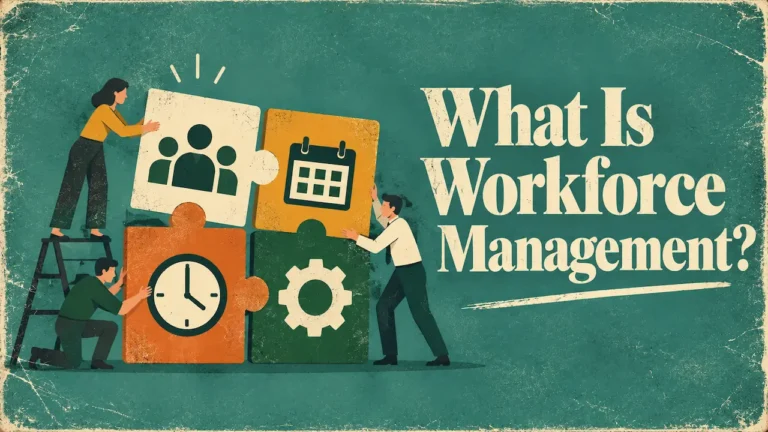
Hospitality workforce management means managing the people who staff hospitality service, from first record to final approved hour.
It covers:
- Staff pool,
- Availability,
- Shifts,
- Briefings,
- Hours worked
- The records behind them
In practice, hospitality workforce management breaks down into six areas of work. The pool holds each person’s details, roles, skills and documents. Availability tells the planner who can work before any shift goes out. Shifts are built across outlets, suites and events.
Briefings and shift updates reach the people booked. Hours worked are recorded and approved, then feed payroll. Compliance records, such as right to work evidence and certificates, stay attached to each person.
Whoever owns the job needs one accurate picture of who is booked and what they worked.
Ownership depends on the business. A venue’s head of hospitality or operations manager usually holds it. In a conference centre, it often sits with the banqueting or events manager. Hospitality agencies give it to an operations lead who works across every client.
Building the rota is one part of workforce management for hospitality. Most of the admin sits in the work before and after it.
How Does Hospitality Workforce Management Differ for Event Teams?
The difference in hospitality workforce management is where demand comes from and who fills it.
A hotel restaurant plans around a steady weekly pattern and a mostly contracted team. An event-led venue plans around bookings, fixtures and shows. It fills them from a large casual pool that changes every season.
Fixed-site and event-led hospitality: how the workforce job differs
| What changes | Fixed-site hospitality | Event-led hospitality |
|---|---|---|
| What sets demand | Covers, occupancy and last year's trading pattern | Bookings, fixtures, show calendars and client briefs |
| Team shape | Mostly contracted staff with a small casual top-up | A large casual pool, often topped up by a hospitality agency |
| Rota rhythm | A repeating weekly rota with small changes | Built for each event or service, with changes up to the day |
| Where people work | One site or a few fixed outlets | Many outlets, suites, marquees or client sites at once |
| Briefing | Standing procedures most staff already know | A new brief for each event: dress code, arrival point, service style |
| Records to keep | Contracts, hours and holiday for a stable team | Right to work, certificates and hours for a pool that turns over each season |
| Typical operators | Hotels, restaurant groups, pubs | Stadium and arena hospitality, showgrounds, conference and banqueting teams, event caterers, hospitality agencies |
Swipe to see more →
Tools and habits built for a fixed week assume a repeating rota, standing procedures and one site. Event-led hospitality works differently on each count. The rota is rebuilt for each event, and the brief changes with each client. Staff may also move between suites or outlets during a single match day.
Many hotels run both models side by side. The restaurant works to a weekly rota, while the conference and banqueting team works like an event operation.
Stadiums, showgrounds and conference centres plan most of their hospitality around events. Staffing for event venues follows the events diary, with each event planned on its own terms.
Event-led hospitality needs one system for the pool, the shifts, the briefings, the hours and the records.
Hospitality Workforce Planning When Demand Comes From Bookings
Hospitality workforce planning in an event-led venue starts with the booking, the fixture list or the show calendar.
Last week’s rota says little about next Saturday’s banquet. The event brief sets the headcount: covers, bars, suites, service style and timings.
From there, the plan has four parts:
- Build the headcount for each event from its brief.
- Publish a season of shifts early, so staff can commit before they take other work.
- Plan a small buffer for late drop-outs, especially on peak days.
- Decide early where agency staff will top up your own pool, so the agency can plan its people too.
Shifts published a season ahead give casual staff a reason to keep those dates free.
Why Does Hospitality Need Workforce Management?
Hospitality runs on more people, more variable hours and tighter margins than most sectors. As a result, the admin grows faster than the team.
The wider sector employs about 3.5 million people, making it the UK’s third largest employer (UKHospitality, 2023). Nearly 100,000 hospitality jobs have gone in the past two years, and part-time staff were among those affected (UKHospitality, 2026).
With fewer people and higher costs, each shift has less room for error.
Without a clear system, the gaps show on event day. Availability is gathered by text. Confirmations are spread across several WhatsApp groups. Certificates sit in someone’s inbox. Hours are rebuilt by hand at month end from paper sheets and messages. On the morning of a big service, nobody can say for certain who is coming in.
The simplest test is whether you can see, on the morning of an event, who has confirmed.
Each gap carries a cost, such as an empty bar station or hours paid twice. Over a busy season these costs add up, as the breakdown of what poor rotas cost a venue shows.
That is why hospitality needs workforce management: the staffing work grows with every new event, outlet and client. Good hospitality workforce management closes those gaps by keeping availability, confirmations, records and hours in one place.
How Will the Zero Hours Reforms Affect Hospitality Rotas?
The Employment Rights Act 2025 gives qualifying zero hours and low hours workers three new rights. They are expected to take effect in 2027, and the details are still being set in regulations (GOV.UK, 2026).
- The first right is an offer of guaranteed hours that reflects the hours worked over a reference period.
- The second is reasonable notice of shifts and of changes to them.
- The third is a payment when a shift is cancelled, moved or cut short at short notice. A worker can turn down a guaranteed hours offer and stay on their existing terms.
The reforms do not ban zero hours contracts.
Agency workers are in scope too. As the government’s consultation on zero hours reforms sets out, the hirer makes guaranteed hours offers to qualifying agency workers. The agency makes the short notice payments and can agree contract terms with the hirer to recover that cost.
The Act limits short notice to seven days at most, and the exact period is still to be decided. The Act received Royal Assent on 18 December 2025. The consultation ran from 2 June to 25 August 2026, and final policy and a start date will follow.
Under the Act, a limited-term contract can be reasonable when a worker is needed for a specific task or event. Its own example is a conference worker needed until the conference ends. The consultation asks whether that covers seasonal work.
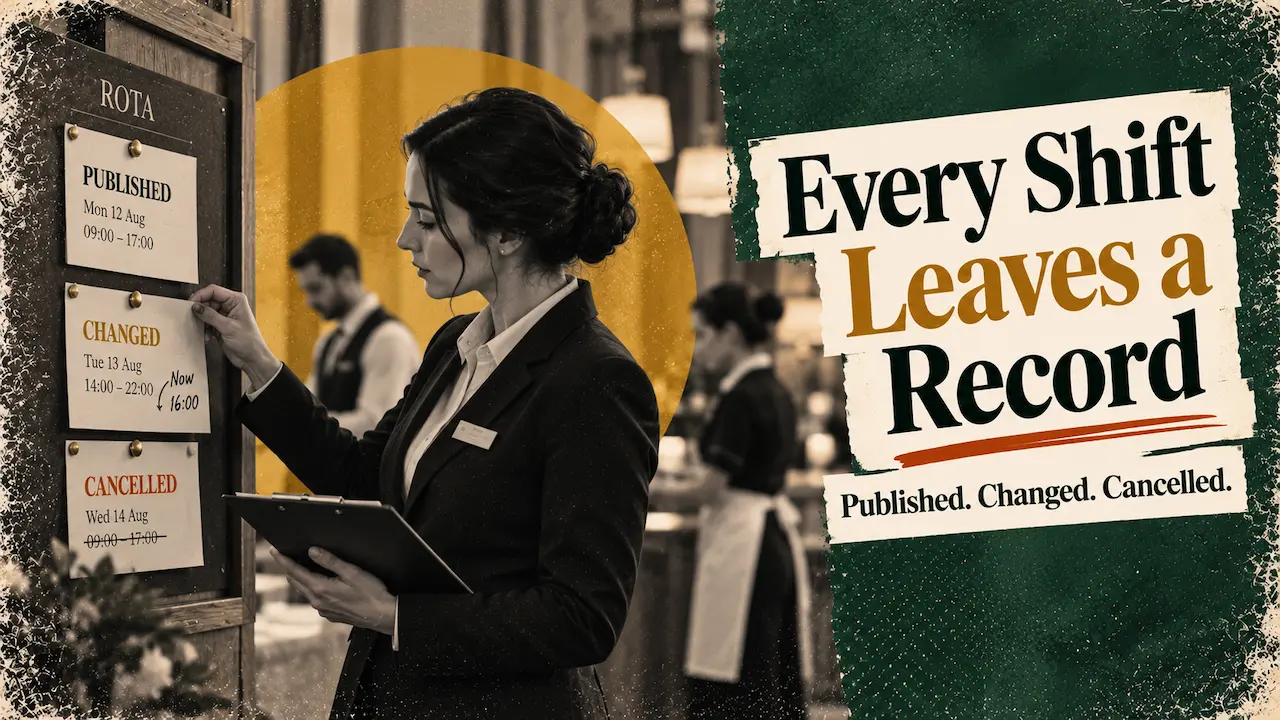
For hospitality workforce management in event-led venues, the practical change is about records. A venue will need to know when each shift was published, changed or cancelled. It will also need each worker’s hours over time, and a clear split between direct and agency staff.
Teams that already keep compliance records organised in one place will find this easier to show. Holiday pay is a separate question, covered in holiday pay for zero hours staff.
The rota on the wall will not show when a shift was offered, changed or cancelled.
Check the final regulations and take employment advice before you change any contracts.
What Does a Hospitality Workforce Management System Cover?
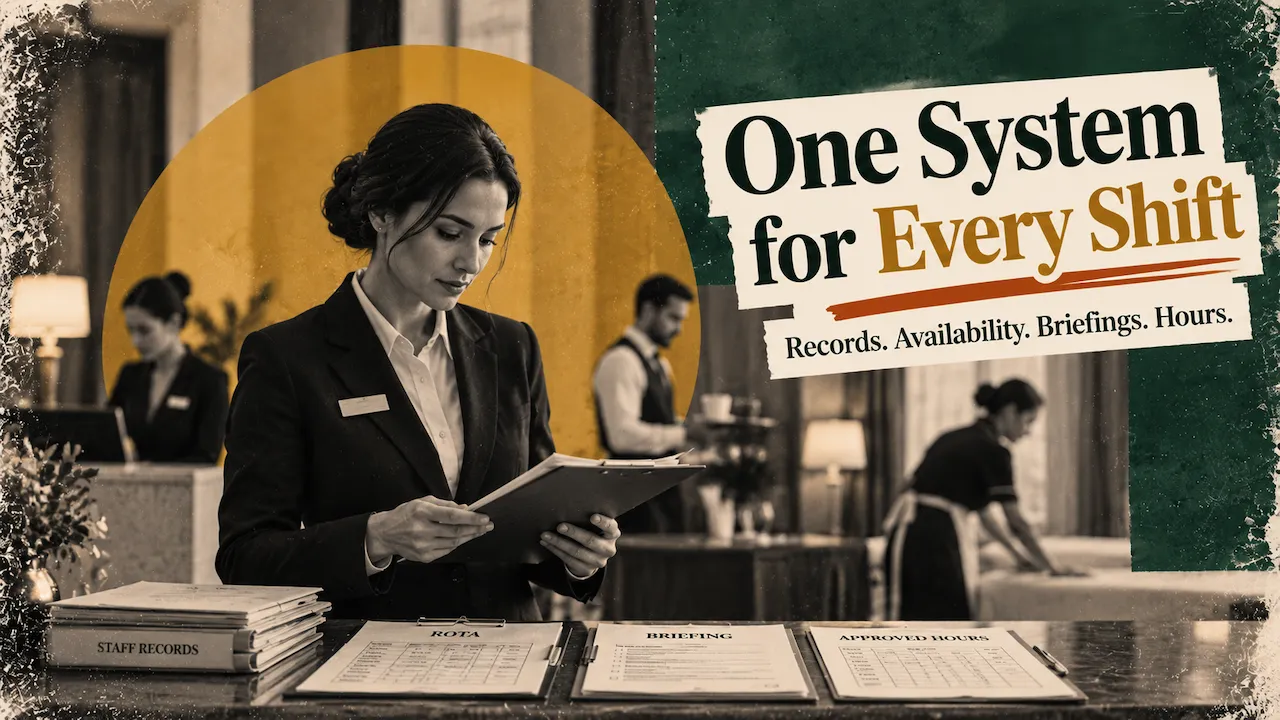
A hospitality workforce management system covers the full life of a shift, from the staff record to the approved hours. Each part replaces a manual step that slows a busy team down.
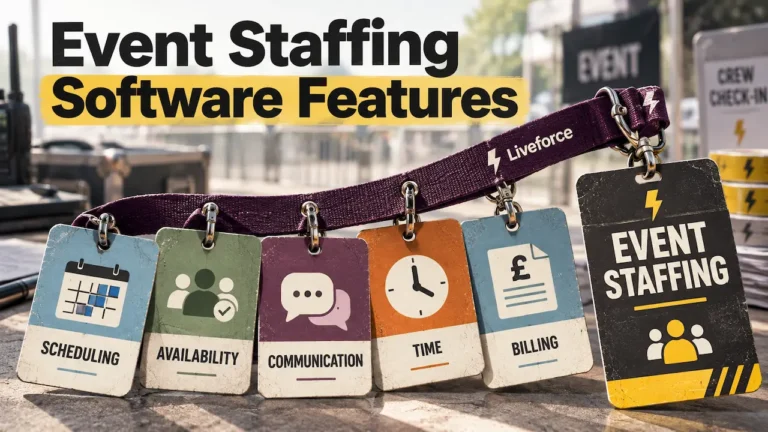
- One staff pool with records attached. Every time a team is picked, the planner works from a central staff database. Roles, skills, right to work evidence and certificates sit on each record, replacing spreadsheets and inbox attachments.
- Availability before the rota. Before a match day or show, one availability request goes to the whole pool. Answers come back in one place, replacing a round of texts and calls.
- Shifts across outlets, events and clients. When several events run at once, one view shows who is booked where. A double booking across two suites is visible before service starts.
- Briefings that reach every shift. Staff need the dress code, arrival point and service style for each event. A system can send briefings and shift updates with each shift and record who has read them. That replaces the group chat.
- Hours that match the shift. After service, clock-ins and timesheets are checked against the rota. Managers approve hours ready for payroll instead of rebuilding them at month end.
Every part of the system should replace something your team does by hand today.
A few measures show whether hospitality workforce management is working. Track shifts filled per event and how quickly confirmations come back. Watch late cancellations and no-shows, and whether hours are approved on time.
Check which records expire before the next event, so nobody is booked into a role they no longer qualify for. When someone drops out late, the same pool and availability data make the gap quicker to fill.
When Do You Need Workforce Management Software for Hospitality?
You need workforce management software for hospitality when your staffing information lives in too many places. The rota, the confirmations and the records have drifted apart. These signs usually show up first:
- The rota lives in more than one place. On a match day, the master spreadsheet says one thing and the printed copy in the suite says another.
- Confirmations come back through WhatsApp. Someone scrolls through three group chats at 7am to count who has said yes.
- Certificates sit in inboxes and folders. A food hygiene certificate expired last month, and nobody noticed until the shift was booked.
- Hours are rebuilt by hand at month end. Paper sheets, texts and memory are pieced together before payroll can run.
- Each new outlet or client adds another booker. Two people book the same waiter for different suites, and the clash appears on the day.
Each of these signs costs time on the morning of an event.
A handful of casual staff on a spreadsheet can work well. The trigger for hospitality workforce management software is volume, outlets, and change, more than headcount alone.
Moving From Ad Hoc Rotas to Hospitality Workforce Management Software
The move to a new system works best in small steps, tested on live events. Start with the pool and the records, so everyone you book already sits in the system. Then collect availability for the next run of events.
Run one real event end to end in the new system, from shifts to approved hours. Brief and confirm staff through it, so they get used to one place for updates. Approve the hours after that event and check them against what was worked. Then roll it out across the season, one event type at a time.
A single live event shows where the set-up needs work before the busy season starts.
How Liveforce Runs Workforce Management for Hospitality Venues
Event-led hospitality starts to slip when availability comes back by text and the brief lives in an email.
Certificates sit in an inbox, and nobody can say on the morning who has confirmed. Liveforce is a workforce management platform built for event-led businesses. They use it to manage large temporary or freelance teams across multiple projects, locations and clients.
The staff database holds each person’s skills, experience, qualifications, previous performance and work history. When a team is picked for a banquet or a match day, the right people are easy to find.
Right to work evidence, licences and certificates sit together on each record. Upcoming expiries are visible before they affect the rota, and the business still carries out the checks.
An expired certificate is easiest to deal with at the moment someone is booked.
Before a busy run of events, one availability request goes to the whole pool, and confirmations return to the rota. Open shifts go to available staff, who accept them from their phone.
Existing commitments show at the point of booking, which helps catch a double booking before it reaches a client. Several bookers can work from the same rota and staff database.
Each shift carries its own brief, covering dress code, arrival point and service style. Messages can go to one role or the whole shift, with a record of who has read them. Teams reuse a previous event’s set-up and adjust what changed.
That makes it practical to run a season of events, with shifts published up to a year ahead.
After service, staff clock in and out from their phones, and the right rates apply by role and shift. Managers review and approve hours, and approved timesheets become payroll-ready reports. Those reports feed the payroll system the business already uses.
Venues use Liveforce for hospitality workforce management across their own casual pool. Hospitality agencies use it for the pool they supply to clients. Large venues and enterprise teams run the same set-up at scale, with a dedicated account team and custom onboarding. Staff see their shifts, briefs and updates in the Crew App.
Each business manages its own people, and Liveforce is the system it runs them on.
Three Counties Showground in Malvern runs its show season this way.
Run Venue Hospitality From One Place
Running hospitality across a season of matches, shows or conferences means hundreds of shifts, briefs and timesheets.
Stadium, showground and conference teams use Liveforce to keep the pool, rota, briefings and hours together. Hospitality agencies supplying those venues use the same system for their own staff.
Book a demo to see how it fits your venue.
FAQs: Hospitality Workforce Management
Do the zero hours reforms apply to agency workers in hospitality?
Yes, the Employment Rights Act 2025 extends guaranteed hours, reasonable notice and short notice payments to qualifying agency workers. The hirer makes guaranteed hours offers, and the agency pays short notice payments. The details are still being set in regulations expected in 2027.
Should a venue use its own casual pool or a hospitality staffing agency?
Many venues use both: their own casual pool for regular events and agency staff for peaks or specialist roles. Each business manages and keeps records for its own people. Agreeing early which events need agency cover makes both sides easier to plan.
How do hotels manage casual staff for conference and banqueting events?
A hotel’s conference and banqueting team usually works like an event operation, even inside a fixed-site hotel. Headcount comes from each booking, staff come from a casual pool, and every event needs its own brief. So banqueting is best planned event by event, alongside the weekly restaurant rota.
What records should a hospitality business keep for casual staff?
Keep a copy of each person’s right to work documents and the date you checked them. Keep pay, deduction and leave records for three years after the tax year, plus working hours records. Records of shift notice and changes are expected to matter once the zero hours reforms take effect.
What is the difference between hospitality workforce management and labour management?
Labour management usually focuses on labour cost against sales or covers. Hospitality workforce management covers the whole cycle of staffing service: the pool, availability, shifts, briefings, hours and records. The two connect, because labour cost reporting depends on accurate, approved hours.