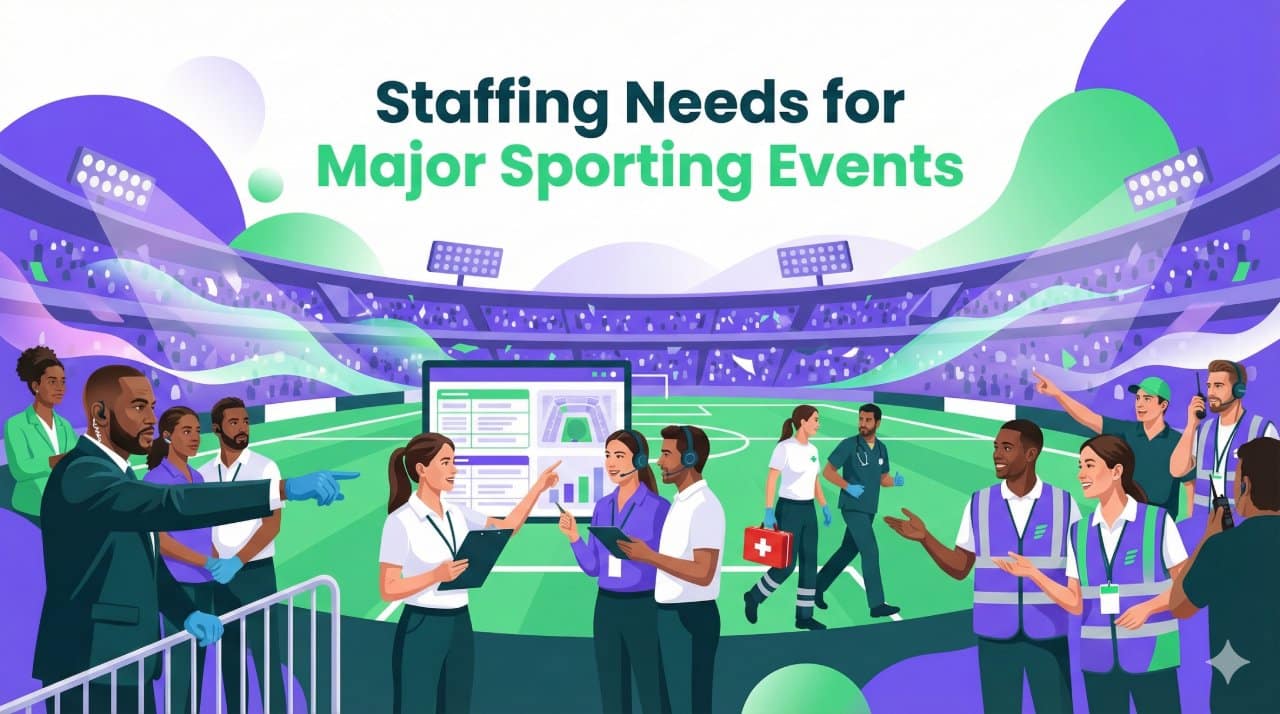
Major sporting events place extreme pressure on staffing operations. Stadiums, race circuits, arenas and temporary venues must scale workforces quickly, deploy people across multiple roles, and adapt to constant change. For agencies and suppliers, understanding the staffing needs for major sporting events is essential to delivering safely, smoothly and on time.
This guide breaks down the ten most critical staffing needs for major sporting events and explains how each one affects delivery. It is written for event staffing agencies, operations managers and project teams who manage large temporary workforces under pressure.
Why staffing planning makes or breaks major sporting events
At major sporting events, staffing issues do not stay hidden. They appear live, in front of spectators, broadcast partners and senior stakeholders, with no pause button and no margin for recovery.
These environments run on fixed schedules, strict safety thresholds and intense crowd movement. Thousands of people arrive within narrow timeframes, roles overlap across days and locations, and conditions can change without warning. In this context, staffing is not about filling shifts. It is about maintaining control as pressure builds.
When planning is weak, problems rarely arrive as one dramatic failure. They build quietly. A missing role increases strain elsewhere. Delayed decisions slow response times. Small gaps become visible disruptions.
The following section breaks down the 10 crucial staffing needs for major sporting events, and explains how each one directly affects delivery on the ground.
1. Accurate workforce forecasting at scale
Forecasting for major sporting events is not about headcount alone. It is about predicting pressure points across time, location and role. Crowd flow changes throughout the day. Broadcast schedules shift. Weather alters arrival patterns. Each of these variables impacts staffing demand.
When forecasting is too basic, teams end up reacting instead of leading. Supervisors scramble to cover gaps. Admin teams chase availability at the worst possible moment. Costs rise because decisions are rushed.
Strong forecasting considers:
- Peak ingress and egress windows
- Role intensity at different moments of the event
- Break coverage and fatigue across long shifts
- Buffer staff for known risk periods
This level of planning gives you control before recruitment even begins.
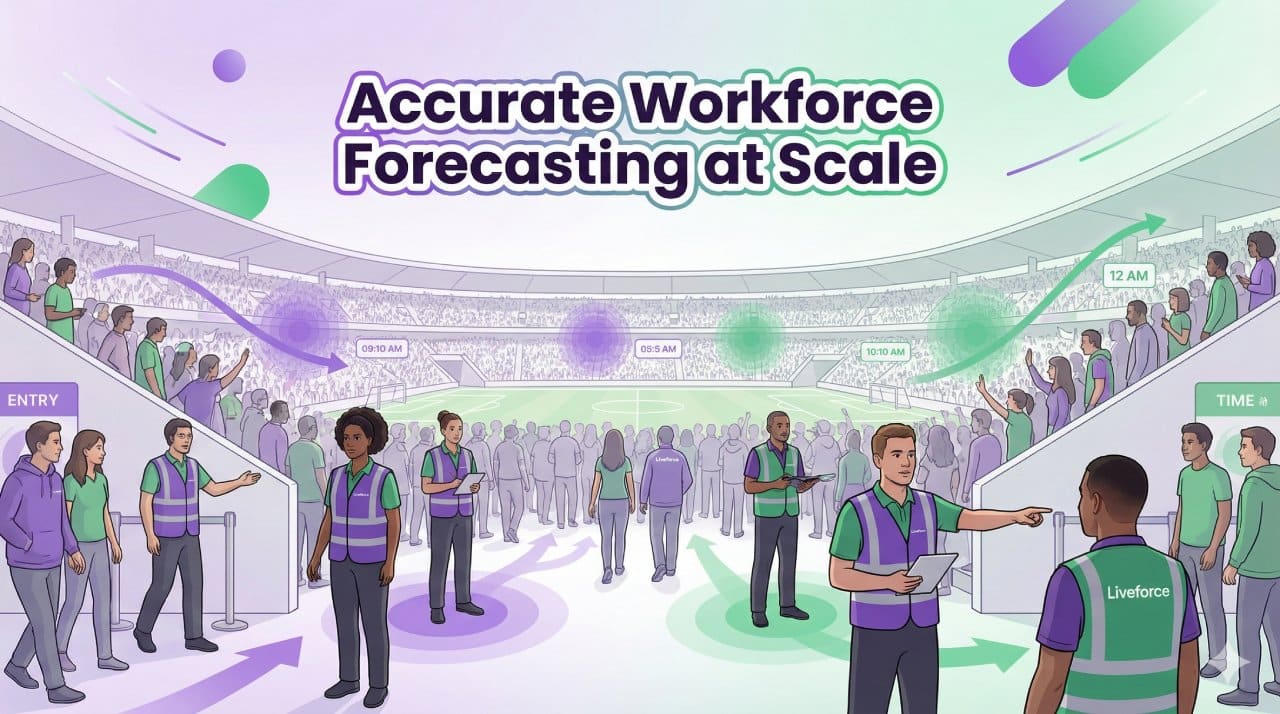
Real-world example:
At a three-day international athletics event with a daily attendance of around 45,000 spectators, the staffing agency initially forecasted 180 stewards for peak arrival periods based on historic averages.
On day one, public transport changes meant a much higher proportion of spectators arrived within a 30-minute window rather than being spread across an hour. As a result, the original stewarding team was short by around 25 people at the main entry points. Queues built quickly and supervisors were forced to redeploy staff from other zones, leaving gaps elsewhere.
That evening, the agency reviewed entry scan data and crowd arrival times. For days two and three, shift start times were brought forward by 20 minutes, and an additional 30 stewards were scheduled specifically for the peak arrival window, rather than across the full shift.
The result was smoother entry flow, shorter queues, and no need for last-minute redeployment. By forecasting pressure points instead of just headcount, the team regained control before doors even opened.
2. Clear role definitions and skills matching
Major sporting events expose weak role definitions quickly. When responsibilities are vague, staff default to assumptions. Supervisors waste time reallocating people. Clients notice friction.
Each role should be defined clearly, not just by title but by:
- Required experience level
- Expected decision-making authority
- Physical or technical demands
- Location-specific context
Matching people to roles is one of the most overlooked staffing needs for major sporting events, yet it has a direct impact on safety, efficiency and confidence on the ground.

Real-world example:
At a large three-day motorsport event with over 120,000 spectators, the staffing plan included 110 people under the single role title “event operations”. On paper the numbers looked right, but the responsibilities were not clearly separated.
Around 35 of those staff were required to work in restricted pit-lane areas, using radios and responding directly to race control. The remaining 75 staff were needed for spectator guidance, access points and crowd flow.
On day one, several less-experienced staff were assigned to pit-lane roles because the role titles appeared identical. Within the first two hours, supervisors had to intervene repeatedly, pulling people off post and reassigning them. Response times to minor incidents slowed, and radio traffic became congested as staff sought clarification.
For day two, the agency split the role into two clearly defined positions with different experience requirements and access levels. Staff were filtered by experience and reassigned accordingly. No additional headcount was added.
The impact was immediate. Reassignments dropped to zero, incident response times improved noticeably, and supervisors were able to focus on oversight rather than correction. By clarifying roles rather than increasing numbers, the event ran more smoothly with the same workforce.
3. Fast and flexible recruitment processes
Recruitment for major sporting events rarely happens neatly. Schedules change. Roles expand. Client demands evolve. You need recruitment workflows that can absorb this without slowing everything else down.
Slow recruitment creates pressure points where:
- Quality drops because decisions are rushed
- Admin teams become bottlenecks
- Availability data becomes outdated
Effective recruitment processes allow you to move quickly while still maintaining structure.
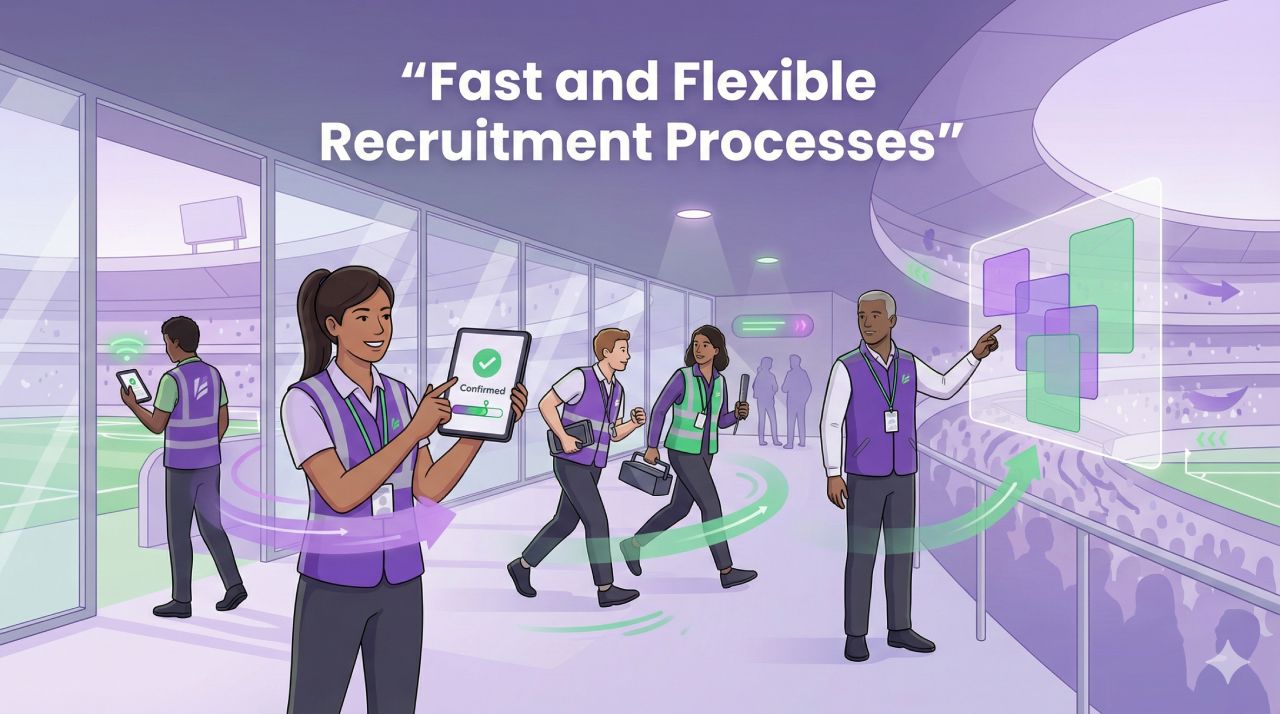
Real-world example:
Ten days before a sold-out stadium event with 60,000 attendees, the client confirmed an additional sponsor activation that required 40 brand-facing staff to be on-site during peak arrival and half-time periods.
The roles required previous brand experience, short shift windows of 4–5 hours, and specific availability across two event days. With limited lead time, reopening recruitment from scratch would normally have taken 5–7 days, pushing the team dangerously close to event day.
Instead, the agency reviewed its existing staff pool of over 600 active profiles. By filtering for prior brand work, recent event experience and confirmed availability, a shortlist of 58 suitable staff was identified within a few hours.
Shift offers were sent the same day. Within 24 hours, 32 roles were confirmed. The remaining 8 positions were filled the following day after a small number of declines, completing recruitment in under 48 hours without additional advertising or emergency sourcing.
Because recruitment was structured and availability data was current, the team absorbed a major late change without disruption. The activation launched on time, supervisors were fully staffed, and no last-minute cover was required on event day.
4. Compliance, accreditation and eligibility checks
Compliance failures at major sporting events do not stay hidden. Accreditation delays cause queues. Ineligible staff create reputational risk. In some cases, operations are halted entirely.
Manual compliance tracking becomes unmanageable at scale. Spreadsheets fail. Emails are missed. Files are outdated.
Digital compliance management ensures:
- Only eligible staff are scheduled
- Accreditation is ready before arrival
- Supervisors are not firefighting at access points
This is one of the most critical staffing needs for major sporting events.
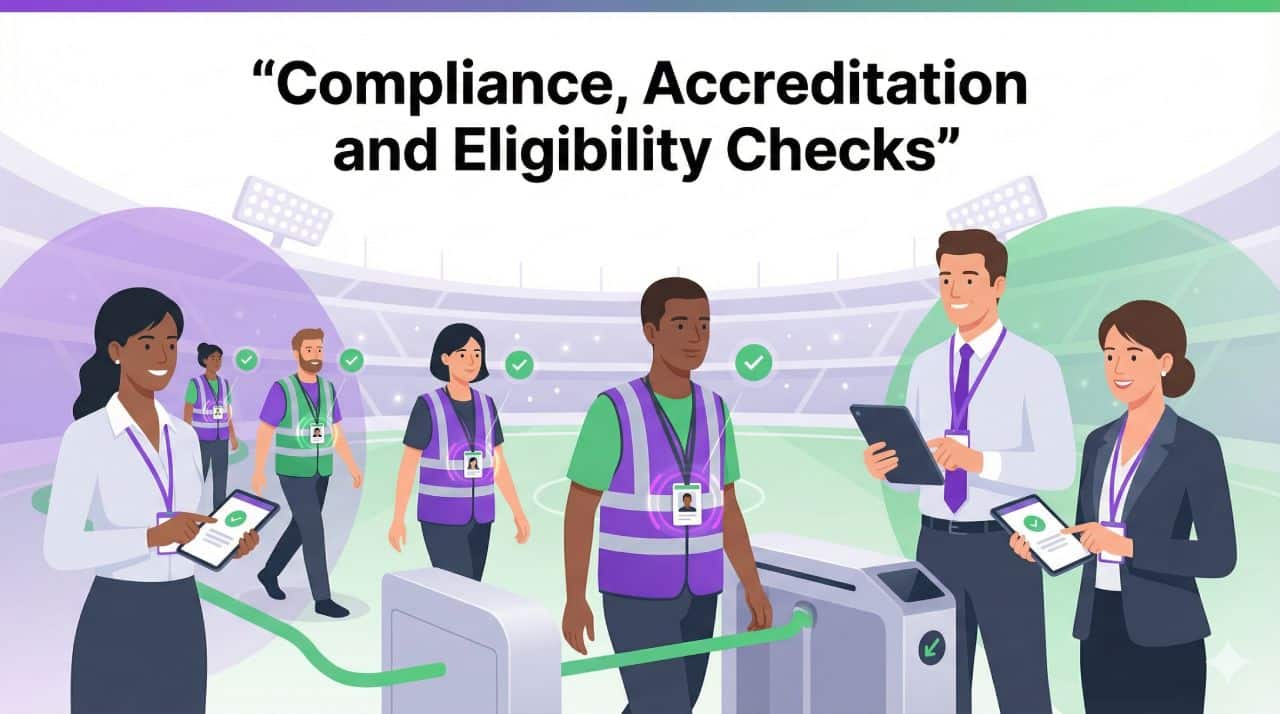
Real-world example:
At a four-day stadium tournament with 55,000 spectators per day, the staffing agency deployed 260 event staff across stewarding, hospitality and access control roles.
On day one, 12 staff members were denied accreditation at the venue because required documentation had not been fully approved in advance. Each denial created delays at access points, with supervisors pulled away from operations to resolve issues manually. Within the first hour, queues formed at two staff entrances and coverage gaps appeared in nearby zones.
That evening, the agency reviewed all compliance records centrally. Outstanding documents were identified, approved and linked to staff profiles before the next day’s shifts. For days two to four, 100% of scheduled staff arrived with confirmed accreditation.
Access issues dropped to zero. Supervisors were no longer troubleshooting paperwork at entry points and could focus on oversight and crowd safety instead. By centralising compliance tracking, the team removed a major operational risk without increasing headcount or on-site admin.
5. Multi-day and multi-location scheduling
Major sporting events rarely operate in one place or one time window. Staff move between zones. Shifts overlap. Fatigue builds.
Scheduling without full visibility leads to:
- Overworked staff
- Missed rest periods
- Gaps during transitions
Clear scheduling must account for the full event lifecycle, not just individual shifts.
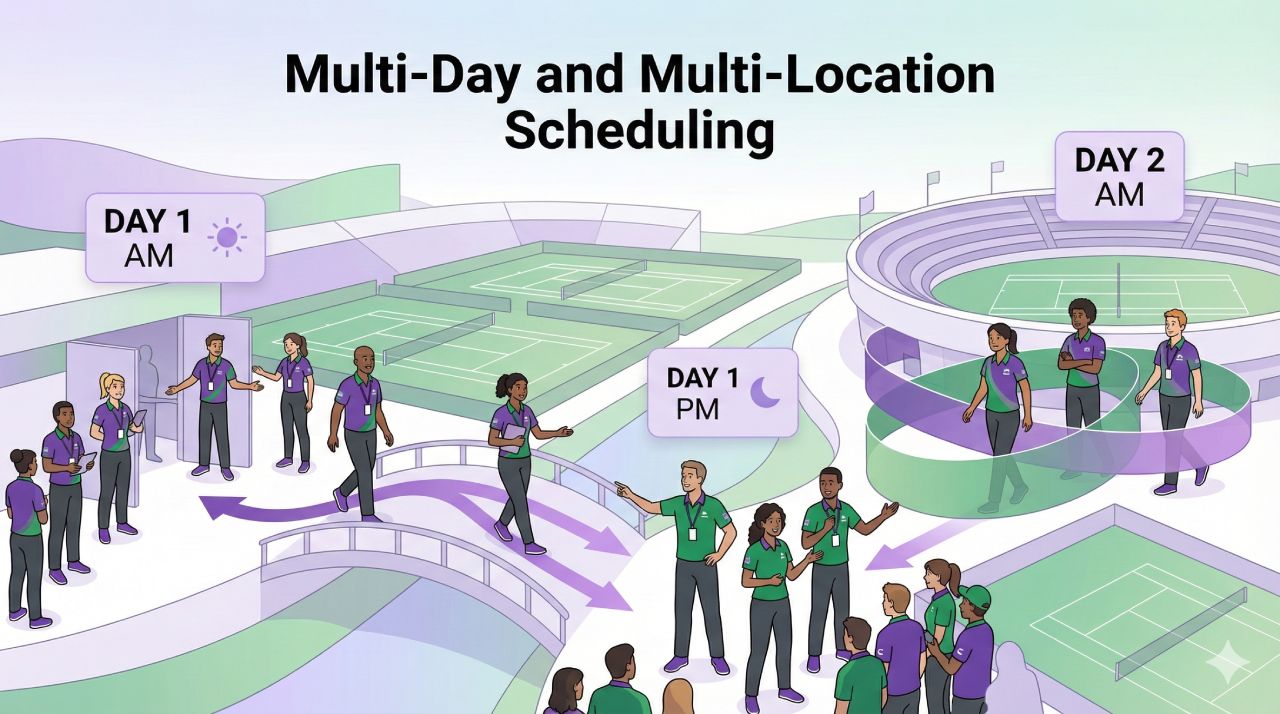
Real-world example:
At a week-long international tennis event with seven match courts operating daily, the agency supplied 140 hospitality staff covering bars, lounges and premium seating areas from morning through evening.
Initially, staff were scheduled by court only, with each court managing its own rota. On paper, all shifts were filled. In reality, some staff worked six consecutive long shifts, while others had uneven workloads or overlapping rest periods. By day three, fatigue was visible, late arrivals increased, and supervisors were dealing with coverage gaps during court changeovers.
Midway through the week, the schedules were reviewed centrally. Instead of viewing rotas by court, the agency looked at each individual’s total hours, rest periods and movement between locations. Rotations were adjusted so staff alternated between high-pressure and lower-intensity shifts, and rest periods were evenly distributed.
The total headcount stayed the same. However, fatigue-related issues dropped noticeably, transition gaps between sessions were eliminated, and staff completed the week with higher attendance and fewer last-minute dropouts. By scheduling across the full event lifecycle rather than isolated shifts, the operation became more stable as the event progressed.
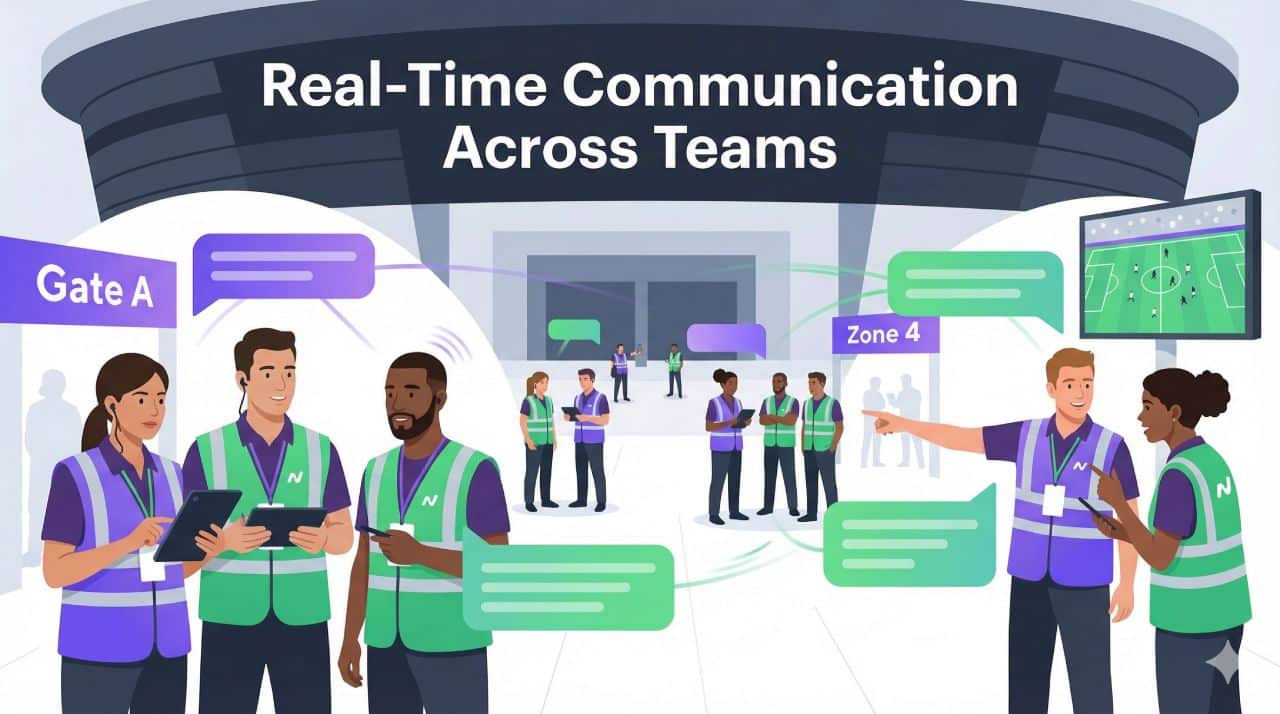
6. Real-time communication across teams
Major sporting events are live environments. Static information becomes outdated quickly. When communication is slow or fragmented, problems spread faster than solutions.
You need to communicate:
- Schedule changes
- Location updates
- Access instructions
- Incident responses
Real-time communication is not a convenience. It is a requirement for managing staff at major sporting events.
Real-world example:
During a sold-out evening football match with 52,000 spectators, severe weather developed 90 minutes before kick-off, forcing operations teams to change external queuing and entry routes at short notice.
The venue had eight public entry gates, each staffed by teams of 6–10 stewards. A revised queuing plan was issued 45 minutes before gates opened. Teams connected to a single real-time communication channel received the update immediately and adjusted positioning within minutes.
At three gates, however, stewards relying on group text messages did not see the update in time. Those gates continued using the original layout for nearly 20 minutes, leading to uneven crowd flow, longer queues and increased pressure on nearby teams who had already switched to the new plan.
Once the issue was identified, supervisors redirected staff and aligned all gates to the updated instructions. The lesson was clear. Where information moved instantly, teams adapted smoothly. Where communication lagged, inconsistency appeared. In live environments like major sporting events, real-time communication directly determines how evenly and safely operations run.
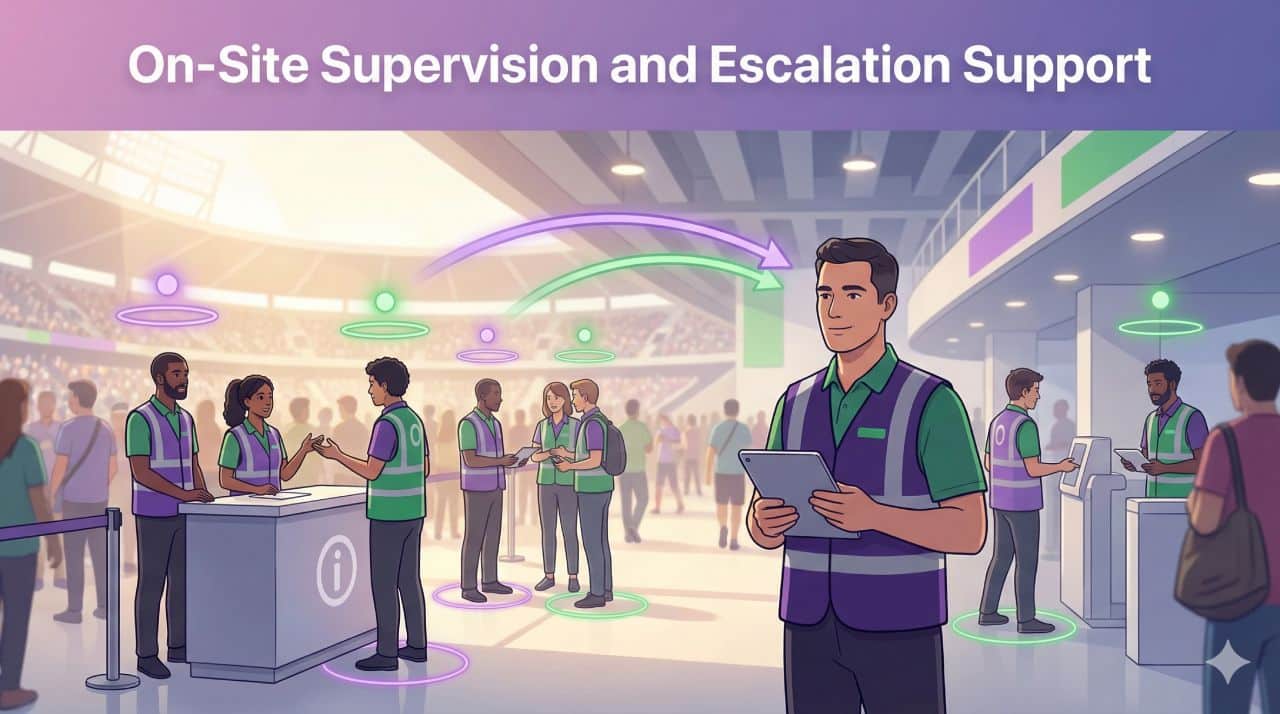
7. On-site supervision and escalation support
Supervisors are the backbone of large-scale event staffing. Without clear oversight, small issues escalate unnoticed.
Effective supervision relies on:
- Visibility of attendance
- Clear role ownership
- Fast escalation paths
When supervisors are supported, teams feel confident and responsive.
Real-world example:
At a one-night combat sports event with 18,000 spectators, the staffing plan included 95 event staff split across concourse management, seating access and backstage support. One high-traffic concourse zone was staffed by 12 people under a single on-site supervisor.
Within the first 40 minutes of doors opening, the supervisor noticed that 3 staff members in that zone arrived between 10 and 15 minutes late. Individually, the delays were small, but together they reduced coverage during the busiest arrival period, increasing pressure on the remaining team.
Because attendance data was visible in real time, the supervisor escalated the issue immediately. Two standby staff were reassigned from a lower-pressure zone, and shift start times were adjusted for the affected roles the following hour. The concourse returned to full coverage before queues built up.
If the issue had only been reviewed after the event, the cause would have been missed and repeated at future shows. Instead, early visibility allowed a quick intervention, protecting crowd flow and giving the team confidence that problems would be handled as they emerged.
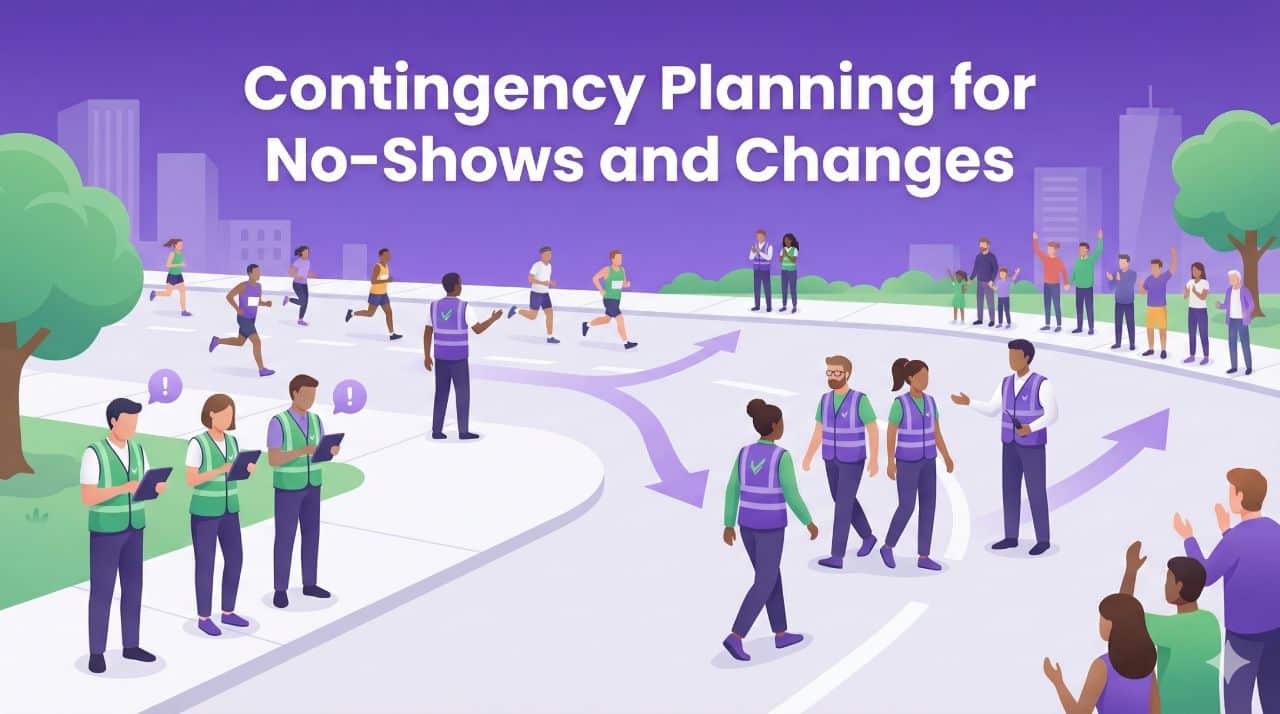
8. Contingency planning for no-shows and changes
No-shows are inevitable. What matters is how quickly you recover. Major sporting events magnify the impact of even small absences.
Contingency planning includes:
- Standby staff
- Clear reassignment rules
- Fast communication workflows
Agencies that plan for disruption protect delivery without panic.
Real-world example:
At a city marathon with 22,000 runners and a course stretching over 42 kilometres, the staffing plan required 180 stewards positioned at junctions, water stations and finish-line access points.
On the morning of the event, 14 stewards were delayed due to a rail disruption affecting multiple routes into the city. Without cover, several early-course junctions would have been left unmanned during the busiest setup period.
Because contingency planning was in place, the agency had 20 standby stewards scheduled to arrive 90 minutes before the start time. Within 15 minutes of the delays being confirmed, 12 standby staff were reassigned to cover the affected locations, following pre-defined reassignment rules.
All route positions were fully staffed before the first runners arrived. The race started on time, no junctions were left uncovered, and spectators and runners experienced no disruption. By planning for no-shows in advance, the agency absorbed a transport issue without panic or last-minute improvisation.
9. Payment accuracy and timesheet control
Post-event admin often determines how staff remember the job. Payment errors damage trust and increase churn.
At scale, manual timesheets create:
- Disputes
- Delays
- Exhausted admin teams
Accurate tracking protects relationships and reduces operational drag.

Real-world example:
After a three-day stadium event with 210 temporary staff working across hospitality, stewarding and operations roles, the agency needed to process over 620 individual shifts.
In previous events, manual timesheets meant approvals took 7–10 days, with frequent disputes over hours worked, break deductions and shift extensions. Admin teams spent hours reconciling discrepancies, and staff regularly followed up about payment status.
For this event, timesheets were approved digitally by supervisors at the end of each shift. Within 48 hours, 98% of timesheets were fully approved and ready for payroll. All payments were processed within three days of the final event date.
As a result, payment queries dropped to almost zero. In post-event feedback, more than 70% of staff referenced fast and accurate payment as a reason they accepted future shifts with the agency. By controlling timesheets at source, the agency reduced admin pressure and improved staff retention without increasing headcount.
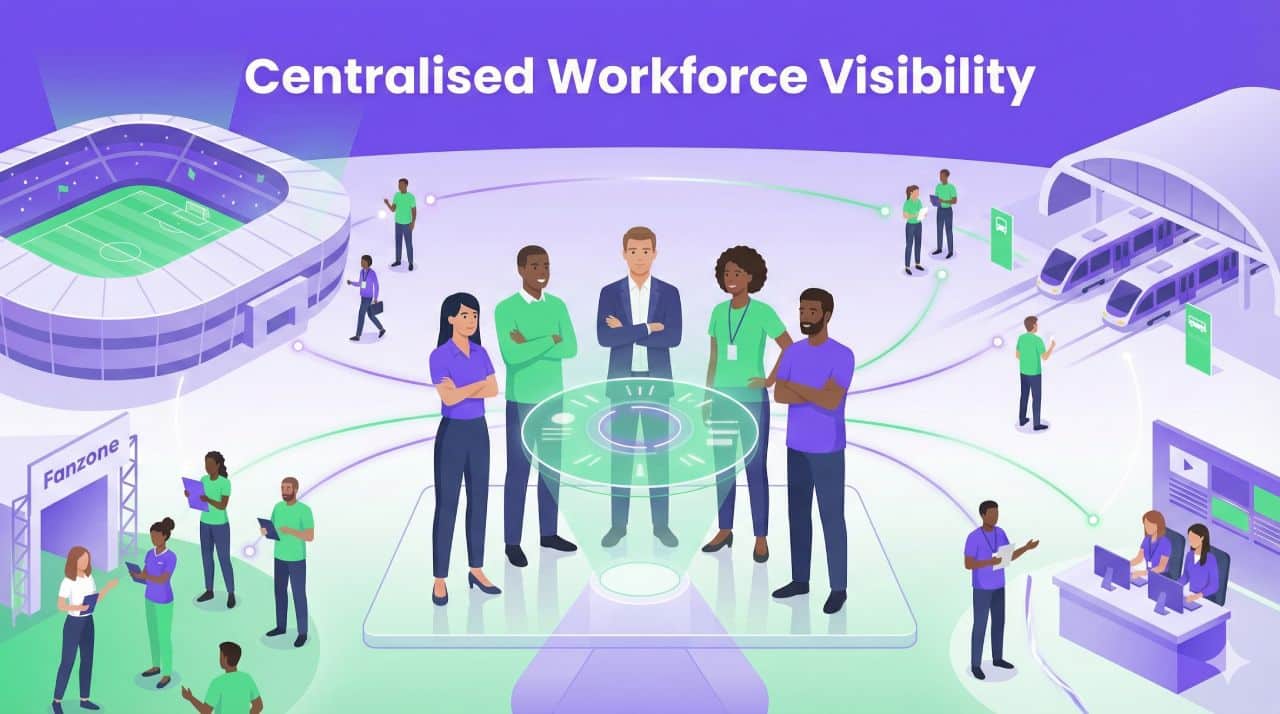
10. Centralised workforce visibility
The final staffing need for major sporting events underpins all others. Visibility allows you to see the whole picture, not just fragments.
With central visibility, you can:
- Anticipate problems
- Make confident decisions
- Support teams proactively
Without it, every issue feels urgent and disconnected.
Real-world example:
At a four-day international sports event delivered across three venues, the agency managed a workforce of 320 temporary staff covering operations, hospitality, stewarding and accreditation roles. In total, the event involved more than 900 individual shifts across the week.
Midway through day two, the client introduced a change to hospitality operations that required 25 staff to be redeployed to different locations and 15 shift times to be adjusted within a two-hour window.
Because the operations team had a single, central view of recruitment status, live attendance, role assignments and communication, the impact of the change was clear immediately. Staff availability was checked in minutes, suitable replacements were identified, and updated shift instructions were issued before the next peak period began.
No additional staff were brought in. No roles were left uncovered. Most importantly, supervisors were able to make decisions calmly because they could see the full workforce picture rather than piecing together updates from multiple sources.
Without centralised workforce visibility, the same change would have required phone calls, spreadsheets and guesswork. With it, a potentially disruptive mid-event adjustment became a controlled operational update.
How Liveforce supports major sporting event staffing
Liveforce is designed to support agencies and suppliers managing complex event workforces. It provides:
- Clear workforce visibility
- Structured staff scheduling
- Real-time event staff communication
- Digital compliance management
By centralising these processes, Liveforce helps reduce admin pressure and improve operational confidence during major sporting events.
The staffing needs for major sporting events are complex, fast-moving and unforgiving. Success depends on planning, visibility and the ability to adapt in real time.
By understanding these ten core needs, you can:
- Reduce operational risk
- Improve staff experience
- Deliver consistent results under pressure
Strong systems and clear processes allow you to focus on delivery rather than damage control.
Book your demo now with Liveforce and see how structured workforce management supports major sporting events from planning to final whistle.
Frequently asked questions
How many staff are needed for major sporting events?
This depends on event size, venue layout and role requirements. Large stadium events often require several hundred to several thousand staff across multiple functions.
What roles are required at large sports events?
Typical roles include stewards, hospitality staff, accreditation teams, operations support, supervisors and specialist technical staff.
How do organisers manage staffing at stadium events?
Successful organisers rely on centralised workforce planning, structured scheduling and real-time communication to maintain control.
How can Liveforce support staffing for major sporting events?
Liveforce supports staffing needs for major sporting events by centralising scheduling, communication, and compliance in one system. This gives agencies clear visibility across large temporary workforces and helps teams adapt quickly when plans change.
How do agencies manage last-minute changes during major sporting events?
Agencies manage last-minute changes by maintaining clear workforce visibility, having standby staff available, and using real-time communication to redeploy teams quickly. Without this structure, small disruptions can escalate rapidly.