An event budget rarely falls apart because of one large, obvious error. It breaks down into dozens of small costs that were never properly recorded, tracked, or approved.
- A shift extended by two hours here.
- A last-minute role added there.
- A verbal agreement that nobody logged.
By the time the final invoice lands, the gap between planned spend and actual spend can be significant.
This is the reality for agencies and suppliers running complex, multi-client operations. When staffing volumes shift between booking and delivery, when projects overlap, and when approvals happen over the phone instead of inside a system, event budget management becomes guesswork.
The numbers on the original plan stop reflecting what is actually happening on the ground.
This article breaks down how event budgets lose accuracy in practice, what that costs over time, and what changes when teams move from reactive tracking to structured, real-time cost control.
For anyone asking how to manage an event budget that actually holds up under operational pressure, the answer starts with understanding where budgets break.
How Event Budgets Break Down in Practice
Most agencies start with a solid budget. The venue costs are confirmed. The staffing estimate is built on previous experience. The client has signed off on scope. On paper, everything adds up. The problem is that event delivery is rarely as clean as the plan.
Staffing is where the cracks appear first.
Take a typical example: an event budget allocates for 30 crew members across a weekend activation. But between the booking date and the event itself, things change:
- The client requests an additional bar station, adding four crew to the plan.
- Two crew members cancel 48 hours before the event, requiring last-minute replacements at higher rates.
- A supervisor role gets added after the brief changes, with no time to revise the original costing.
- Overtime runs longer than expected on the final day because the load-out schedule shifts.
Each adjustment is small. Each one seems manageable. But collectively, they shift the cost base in ways that are hard to see until the project closes.
To illustrate, here is how that same weekend activation might drift from plan to reality:
| Budget Line | Planned | Actual |
|---|---|---|
| 30 crew × 8hrs @ £14/hr | £3,360 | £3,360 |
| +4 crew (late client request) | – | £448 |
| 2 replacements at short notice (+£2/hr) | – | £256 |
| Supervisor added post-briefing | – | £168 |
| Overtime (2hrs, 12 crew) | – | £403 |
| Total staffing cost | £3,360 | £4,635 |
In this example, there is a 38% overrun on staffing alone, from changes that each seemed minor at the time. Multiply this across three or four concurrent projects and the cumulative impact on the event budget becomes serious.
This pattern repeats across the events industry. As one example, agencies supplying hospitality staff for large-scale sporting events routinely deal with volume changes right up to the day of delivery.
A Premier League hospitality supplier managing matchday service across a full season might handle hundreds of shift adjustments per month. Each adjustment carries a cost. When those costs are tracked manually, through updated spreadsheets or amended emails, some inevitably fall through.
The budget that looked accurate at the planning stage is already out of date by the first day of delivery.
The Warning Signs Teams Ignore
Budget drift in event operations rarely announces itself. It shows up as small, forgettable moments that add up fast:
- A project manager approves additional hours over the phone but forgets to update the tracker.
- A client adds a requirement mid-week that changes the staffing plan, but the revised cost is not sent until after delivery.
- Timesheets arrive late, incomplete, or rounded to the nearest hour.
In week one of a project, these gaps look like noise. By event week, they are structural. An agency running three or four concurrent projects, each with its own client, its own staffing requirements, and its own approval process, can accumulate budget gaps across every single one.
The data needed to catch it is not available in real time.
What Poor Event Budget Management Costs Over Time
The financial cost of budget overruns is the most visible problem, but it is rarely the most damaging. Agencies that consistently overshoot their cost plan lose something harder to recover: margin predictability. Poor event budgeting compounds with every project.
When an agency cannot reliably forecast the gap between estimated and actual costs, the damage spreads across the business:
- Quotes get padded with excessive contingency, making the agency less competitive on price.
- Clients lose confidence when final invoices regularly exceed the agreed estimate.
- Project managers spend days reconciling costs after events instead of planning the next one.
- Repeat business suffers because agencies that cannot demonstrate cost control look unreliable.
Over time, the agencies that can reconcile planned spend against actual spend within days of an event closing stand apart from those that cannot.
Budget overruns cost more than money. They cost credibility, confidence, and repeat business.
The UK events industry generated £61.65 billion in 2023, according to the UKEVENTS Report 2024. Within that, leisure and outdoor events alone contributed £28 billion. The agencies supplying staff to this sector operate on tight margins, often between 15 and 25 percent. A budget overrun of even 5 to 10 percent on a major project can wipe out the margin entirely.
The ESSA Stronger Together survey, published in late 2024, found that almost half of event suppliers (49%) reported that clients had a poor understanding of the true costs of delivering services. That gap in understanding makes accurate budget reporting even more important. If the client does not grasp the cost reality, the agency has to prove it with data, not just conversation.

Where the Numbers Stop Adding Up
Staffing is typically the highest variable cost in any project. It is also the hardest to control. Unlike venue hire or equipment rental, which are locked in at the contract stage, staffing costs move constantly across several dimensions:
- Rates vary by role, skill level, and whether replacements are booked at short notice.
- Overtime accrues by the hour and is often only visible after the shift ends.
- Travel and accommodation costs change based on location, notice period, and availability.
- Cancellation fees and rebooking charges add up when crew changes happen close to delivery.
The gap between estimated and actual staffing costs widens fastest when hours are not tracked in real time. If timesheets are submitted manually, days after the event, the agency loses the ability to course-correct during delivery. By the time the data arrives, the money has already been spent.
Rising employment costs in the UK have made this worse. The 2024 Autumn Budget introduced increases to employer National Insurance contributions and the National Living Wage.
For event staffing agencies, these changes pushed up the per-head cost of every shift. Agencies that were already running on tight margins found their budgets under even greater pressure. Industry bodies including ESSA and the MIA reported widespread concern about the impact on operational costs.
The Turning Point: When Spreadsheets Stop Working
Every agency reaches a point where manual event budget management can no longer keep up with operational reality. For some, it happens during a peak season when three projects overlap and the admin team cannot reconcile costs fast enough.
For others, it happens after a bad project where the final cost was 20 percent above the original estimate and nobody saw it coming.
The common thread is scale. A spreadsheet works when an agency runs a handful of events per month with a stable crew. It stops working when the operation involves multiple clients, multiple locations, shifting rotas, and hundreds of individual timesheets.
At that point, the spreadsheet is not a tool. It is a liability. Agencies that manage event budgets across this level of complexity need a different approach to event budgeting entirely.
The turning point is when teams stop treating budget tracking as an admin task and start treating it as operational control.
This shift in thinking changes how approvals work, how hours are recorded, and how costs are reported. Instead of reconciling the budget after delivery, the goal becomes tracking it during delivery.
Instead of reviewing timesheets a week after the event, the goal becomes capturing hours as they happen.

What Changes When Teams Take Budget Control Seriously
The practical difference is straightforward. When teams take budget control seriously, the operation shifts:
- Approvals happen before costs are incurred, not after.
- Role additions are logged and costed at the point of request.
- Hours are recorded in real time and matched against the original staffing plan.
- Budget reports are available during the event, not two weeks later.
This requires a system. Not a more complex spreadsheet, but event budget tracking software built for the way event staffing operations actually work. One that can handle multiple projects running simultaneously, each with different clients, different rates, and different staffing structures.
Five Practical Steps to Manage an Event Budget
Understanding why budgets break is one thing. Knowing how to manage an event budget so it holds up under pressure is another. These are the practical steps that experienced agencies build into their process.
1. Separate Fixed Costs from Variable Costs at the Planning Stage
Before a single crew member is booked, the event budget should split clearly into costs that are locked (venue, equipment hire, permits) and costs that will move (staffing, travel, overtime).
Fixed costs are commitments. Variable costs are estimates. Treating them the same way in a budget is where the trouble starts. When staffing sits alongside venue hire as a single line, the variability is invisible until the invoice arrives.
2. Build Staffing Contingency as a Percentage, Not a Flat Number
A flat contingency line of £500 or £1,000 might feel safe, but it has no relationship to the actual risk. A better approach is to calculate staffing contingency as a percentage of the variable cost base.
For most event staffing operations, 10 to 15 percent covers the typical range of last-minute changes, cancellations, and overtime. This scales naturally with project size.
A small brand activation and a multi-day festival get proportional buffers rather than the same fixed number.
3. Track Hours in Real Time, Not After Delivery
This is the single biggest lever for event budget accuracy. When hours are recorded as they happen, the project manager can see the gap between planned and actual staffing costs during the event.
That means adjustments can be made before the budget is already overspent. Waiting for timesheets to arrive days after the event removes the ability to act on the data. By that point, the overrun is a fact, not a forecast.
4. Log Every Scope Change with a Cost Attached
Client requests mid-project are normal in event staffing. An extra bar, an additional supervisor, a late shift extension. The problem is not the change itself. It is the change that happens without a cost being recorded.
Every scope adjustment, no matter how small, should be logged with the cost implication noted at the point of request. This creates a clear audit trail and prevents the end-of-project shock when the final figure does not match the original estimate.
5. Review the Budget at the Midpoint, Not Just at Close
Most agencies review their event budget once: after the event is over. By then, the numbers are historical. A midpoint review, even a brief one, catches drift while there is still time to respond.
For a week-long build and delivery cycle, that review might happen on day three. For a festival or multi-day event, it might happen daily. The goal is not a full audit. It is a quick comparison of where the budget stands versus where it should be.
How These Steps Work Together:
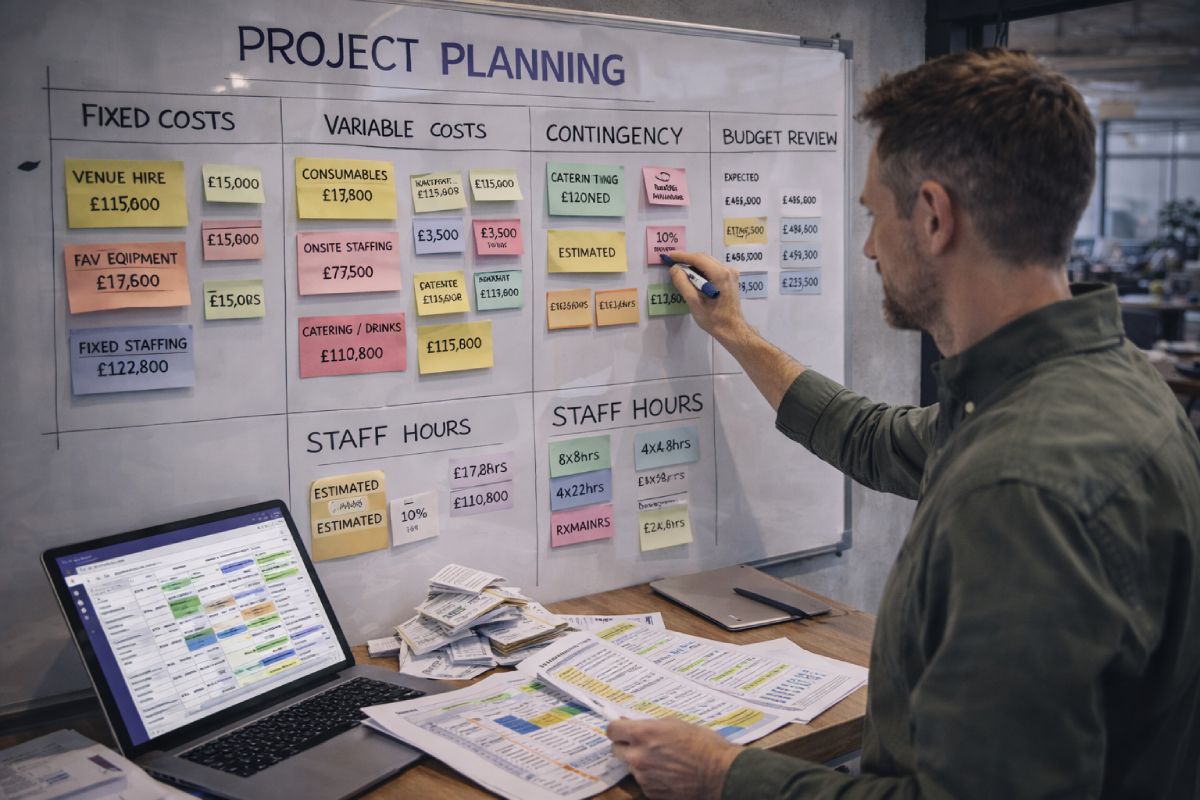
- Total event budget of £22,000. At the planning stage, they separate £8,000 in fixed costs (venue, equipment, permits) from £14,000 in variable staffing costs. They set a 12% staffing contingency, adding £1,680 as a buffer.
- On the morning of day two, the client requests an additional product sampling station. The project manager logs the change immediately: four extra crew for one day at £14 per hour across eight-hour shifts, totalling £448. That figure is recorded against the contingency line at the point of request.
- That same evening, the midpoint review shows actual hours tracking 8% above the original staffing plan, partly driven by the scope change and partly by a slower-than-expected load-in on day one. With this data visible in real time, the project manager adjusts the final day’s rota, trimming two crew from a role that was overstaffed during the afternoon session. The adjustment saves roughly £220.
- By the time the event closes, the total variable spend is £15,100, an overrun of 7.9% against the original £14,000 plan, but within the contingency buffer. Every cost is documented. The client receives a clean reconciliation within 48 hours. No surprises. No disputes. And the data from this project feeds directly into the next estimate.
These five steps do not require new software. But they become significantly easier to maintain when the tracking is digital rather than manual.
What Changes When the Problem Is Addressed
When event businesses move from reactive to structured budget management, the first thing that changes is visibility. Project managers can see where costs stand at any point during delivery, not just after the event closes.
That visibility removes the guesswork that leads to overruns.
The second change is speed. Invoicing becomes faster because staffing data is already captured and verified in one system. There is no waiting for timesheets to trickle in or for managers to manually reconcile hours.
The numbers are there, verified, and ready to report. For agencies managing budgets across dozens of projects per quarter, this saves days of admin time per cycle.
Accurate data from one event becomes the foundation for better planning on the next.
To see how this plays out in practice, consider the following example. An agency runs four events in a single quarter. The first two are managed using spreadsheets and manual reconciliation. The second two use structured, real-time tracking:
| Event | Planned | Actual | Variance | Caught During? | Tracking Method |
|---|---|---|---|---|---|
| Corporate launch | £12,400 | £14,870 | +19.9% | No | Spreadsheet |
| Festival hospitality | £28,600 | £33,240 | +16.2% | No | Spreadsheet |
| Brand activation | £9,800 | £10,340 | +5.5% | Yes | Real-time tracking |
| Sports hospitality | £18,200 | £18,750 | +3.0% | Yes | Real-time tracking |
In this example, the two spreadsheet-managed events produced an average overrun of 18%.
The two events tracked in real time came in at an average variance of just 4.3%. The difference is not in the complexity of the events. It is in when the overruns were spotted. With structured tracking, the project manager caught the variance during delivery and adjusted before it compounded.
This is where timesheet and payment tracking becomes the mechanism that closes the gap. When hours are logged digitally, matched against the original schedule, and available for review in real time, the agency gains the one thing that manual tracking cannot provide: a live view of staffing costs against the project budget.
Liveforce provides this through its staff scheduling and workforce management platform.
With Liveforce, agencies can:
- Track confirmed shifts and compare them against the original staffing plan in real time.
- Monitor actual hours worked as they are logged, rather than waiting for manual timesheets.
- Compare planned costs against actual spend as the event unfolds, catching overruns early.
The result is fewer surprises at reconciliation, faster invoicing, and a clearer cost picture for every project.
Running the Next Event with Better Numbers
One of the most overlooked benefits of structured event budget management is the compounding effect. When an agency has accurate cost data from a completed project, that data feeds directly into the next estimate:
- Staffing ratios become more precise because they are based on actual delivery data, not assumptions.
- Rate assumptions reflect what was actually paid, not what was originally quoted.
- Contingency lines shrink because the unknowns from previous projects have been measured and resolved.
Over three or four project cycles, this creates a measurable improvement in margin accuracy. The agency quotes more confidently, delivers with fewer overruns, and builds a track record that clients trust. In an industry where repeat business depends on reliability, that track record is worth more than any individual cost saving.
Teams that want to go deeper on choosing the right tools for this process can find additional guidance in this article on how to choose the best event staffing software in 2026.
The Real Question Is When, Not Whether
Every agency that manages event budgets across multiple projects will reach the point where manual tracking cannot keep pace. The only variable is how much margin is lost before the change happens.
The agencies that make the shift early, before a bad project forces it, are the ones that build cost control into their competitive advantage. They quote tighter, deliver cleaner, and report faster. Their clients see it. Their teams feel it.
If the gap between your planned event budget and your actual costs has been growing, the answer is not a better spreadsheet. It is a system built for the complexity of event staffing operations.
Book a Liveforce demo and see how real-time staffing and cost tracking can give you control of every event budget you manage.
Frequently asked questions
What are the biggest cost categories in an event budget?
The largest categories are typically venue hire, staffing, production or equipment, and catering. Staffing is usually the biggest variable cost because volumes, rates, and hours change between the planning stage and event delivery. Agencies that do not track staffing costs separately from fixed costs often find their overall cost position is harder to control.
Why do event budgets go over more often than other project budgets?
Event budgets are uniquely vulnerable because the scope changes constantly. Client requests shift, crew numbers adjust, and operational conditions on the ground rarely match the original plan. Unlike construction or manufacturing, where scope changes trigger formal change orders, event staffing changes are often approved verbally and recorded late.
How does real-time tracking improve event budget accuracy?
Real-time tracking means hours, costs, and changes are recorded as they happen rather than after the event. This gives project managers a live view of actual spend versus planned spend. It also means problems can be caught and corrected during delivery, before they become overruns that only appear in the final reconciliation.
How far in advance should an event budget be finalised?
The initial budget should be set as early as possible, ideally at the point of client agreement. However, a budget is only useful if it is updated as scope changes occur. Agencies that lock their budget at the planning stage and do not revisit it during delivery are the ones most likely to face surprises at close.
What is the difference between a budget estimate and a live cost tracker?
A budget estimate is a projection based on planned scope, staffing, and rates. A live cost tracker records actual spend in real time as shifts are confirmed, hours are worked, and costs are incurred. The gap between the two is where overruns hide. Closing that gap requires a system that captures data during the event, not after it.