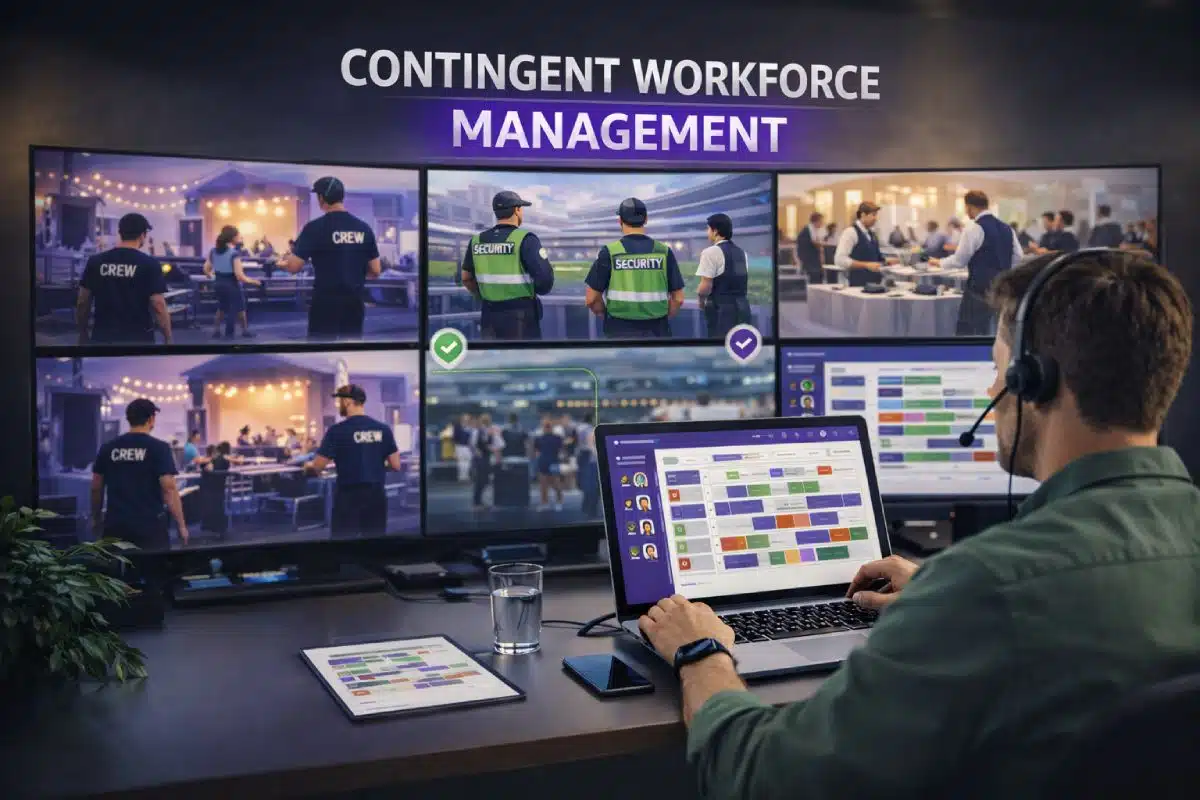

Contingent workforce management is the process of planning, scheduling, communicating with, and tracking temporary or freelance workers across multiple projects and clients.
A contingent workforce is made up of people hired on a project-by-project basis rather than as permanent employees. For any business that relies on this model, contingent workforce management is the system that keeps operations running.
Event staffing agencies, hospitality suppliers, and experiential marketing companies have operated this way for years. Large pools of temporary crew, shifting volumes, different clients every week, and tight delivery windows are the norm.
The term contingent workforce management may sound corporate, but the operational reality behind it is familiar to every agency owner who has scrambled to fill a last-minute no-show or juggled three events in the same weekend.
This guide explains what contingent workforce management is in the context of event-led businesses.
It covers where most agencies go wrong, what experienced operations teams do differently, and how the right platform turns a patchwork of manual processes into a structured, scalable operation.
Why Event Agencies Keep Asking This Question
The phrase contingent workforce management has traditionally belonged to corporate HR departments and large procurement teams. SAP, Oracle, and PwC have written extensively about it in the context of managing global contractor programmes and vendor management systems.
That framing has very little to do with how a 15-person staffing agency in Manchester runs three festival activations in one weekend.
Yet the underlying challenge is identical. Agencies manage hundreds or even thousands of temporary workers. Those workers are not permanent employees. They move between agencies, pick up shifts based on availability, and need clear communication before every job.
The differences lie in scale, speed, and sector.
Event businesses have always run contingent workforces. Most have never had the systems to match.
The question keeps coming up because agencies are growing.
A team that once managed 30 crew across a handful of events now manages 300 crew across 15 clients. The spreadsheets that worked at the smaller scale collapse under that weight. Double bookings appear. Compliance documents expire without anyone noticing. Briefings go out late, or not at all.
Understanding what is contingent workforce management helps agencies see the gap between how they work now and how they need to work at the next stage of growth.
The answer is structure, and the right platform to support it.
Where Most Agencies Get It Wrong
Most staffing agencies do not fail because they lack good people. They fail operationally because their systems cannot keep pace with their growth. The tools they rely on were never designed for contingent workforce management at any real scale.

Spreadsheets as a Scheduling System
A spreadsheet can hold a shift plan. It cannot check whether a crew member is already booked on another project. It cannot flag an expired DBS certificate. It cannot send a confirmation to 40 people at once.
When agencies use spreadsheets as their primary scheduling tool, errors compound silently until they surface on the day of an event.
WhatsApp as a Communication Channel
Group messages work between three or four people. They do not work when an agency is sending shift details, uniform requirements, venue addresses, and last-minute changes to different teams across different events.
Messages get buried. People miss updates. Important information sits in a personal chat thread that no one else on the operations team can access.
If the entire operation depends on one person’s phone, the operation has a single point of failure.
Compliance Stored Across Multiple Places
Right-to-work documents in one folder. DBS checks in another. Food hygiene certificates in a shared drive that three people have access to.
When compliance data lives in different systems, the agency cannot verify a crew member’s eligibility at the point of scheduling. That gap creates legal risk and reputational damage.
Timesheets Processed Manually
Paper timesheets or emailed hours introduce delays and disputes. A crew member claims eight hours; the client says seven. Without a digital record tied to check-in and check-out times, the agency spends hours resolving discrepancies that a proper system would prevent entirely.
Each of these problems is manageable in isolation. Combined, they create a constant background of operational friction that drains time, increases errors, and makes scaling the business harder than it needs to be.
What Experienced Agencies Do Differently
Agencies that manage contingent workforces well share a common trait: they treat their operations like a system, not a collection of workarounds. The difference is visible in how they schedule, communicate, track compliance, and process payments.
Centralised Scheduling Across Every Project
Experienced agencies schedule all projects through one platform. This means every shift, every role, and every crew member is visible in a single view. Clashes are caught before they happen. Availability is checked in real time. Managers can see gaps days before an event, not hours before.
- Platforms with dedicated staff scheduling features make this level of visibility standard.
Centralised scheduling also means the agency can operate even when a key team member is unavailable. The information lives in the system, not in someone’s head.
Consistent, Structured Communication
Instead of scattered messages, experienced agencies send updates through a single channel that every crew member can access.
Shift confirmations, briefing documents, uniform requirements, and venue details all come from one place. Changes are logged and visible to the whole team.
- Structured event staff communication removes the guesswork from every shift.
This removes ambiguity. When a crew member arrives at a venue, they have exactly the information they need. When an operations manager needs to check what was communicated, there is a clear record.
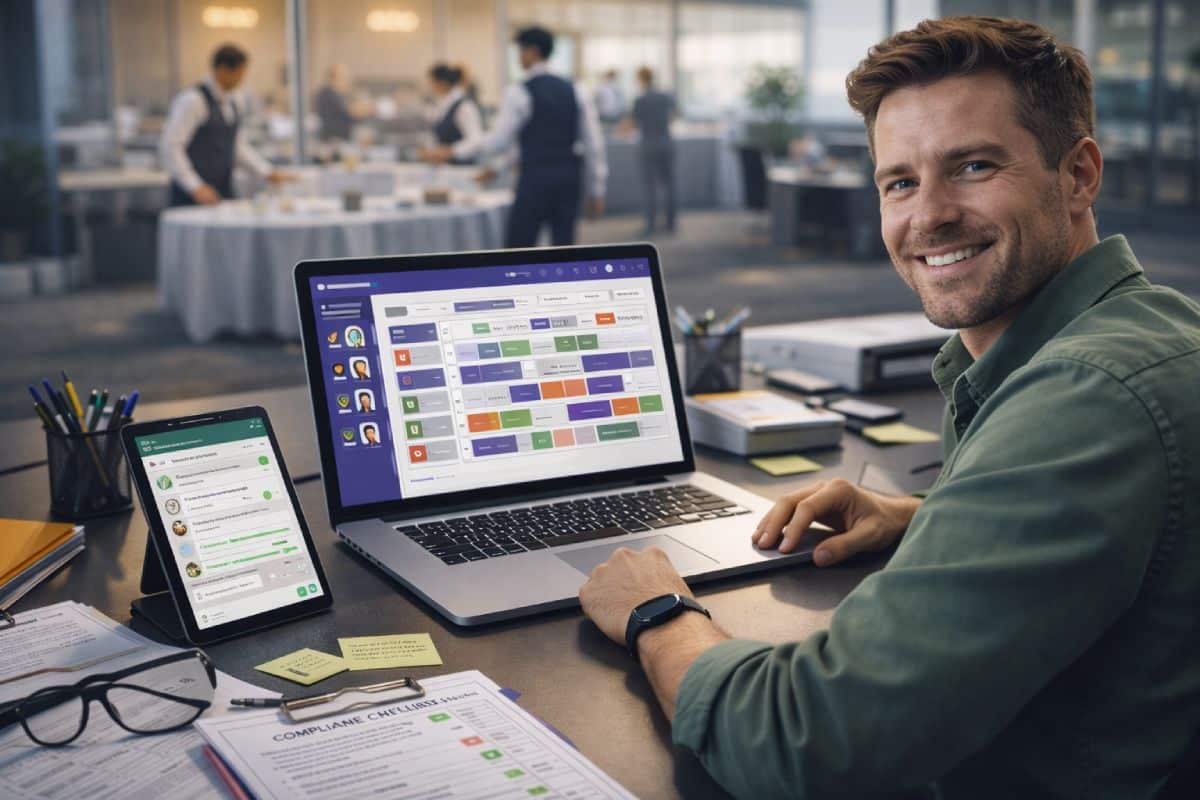
Digital Compliance Built into the Workflow
Rather than checking compliance after scheduling, experienced agencies build it into the scheduling process. A crew member without a valid certificate cannot be assigned to a role that requires one.
Expiry dates trigger automatic alerts. Document uploads are tracked and timestamped.
This approach means compliance is not a separate admin task. It is part of how the agency operates every day.
Accurate Timesheet Records from Day One
Digital check-in and check-out creates an auditable record of hours worked. Disputes drop. Payroll processing speeds up. Crew trust the agency because payments are based on verified data, not estimates.
Each of these practices is a component of effective contingent workforce management. Together, they create an operation that can absorb complexity without breaking.
Applying Contingent Workforce Management to Event Operations
Understanding what is contingent workforce management is useful. Applying it to a real agency operation is where the value sits.
The starting point is honest assessment. How many of the agency’s current processes would survive if the team doubled in size? If the answer is “very few”, the agency has outgrown its tools.
The right time to build a structure is before it becomes urgent.
Contingent workforce management in the events sector means building a repeatable system for every operational stage. From the moment a project is confirmed to the moment the final timesheet is approved, every step should follow a clear, documented process.
That process covers every stage of delivery:
- Confirming crew availability against real-time schedules, not outdated spreadsheets
- Assigning roles based on skills, location, and compliance status
- Sending detailed briefings well before the event, not the night before
- Tracking attendance on the day through digital check-in and check-out
- Recording verified hours for payroll without manual disputes
None of these steps is optional for a professional agency. The question is whether they happen inside a structured system or across a dozen disconnected tools.
Agencies that adopt a platform-based approach to contingent workforce management typically see fewer last-minute problems, lower admin workload, and stronger relationships with both clients and crew. The operations team spends less time firefighting and more time on work that actually grows the business.
For any agency still asking what is contingent workforce management, the practical answer is this: it is the difference between reacting to problems and preventing them.
How Liveforce Supports Contingent Workforce Management
Liveforce is a workforce management platform built for event-led businesses. It gives agencies one central system to manage their contingent workforce across multiple projects, clients, and locations.
Where most contingent workforce management software is designed for corporate procurement teams managing global contractor programmes, Liveforce is built for the speed and complexity of the events industry.
Every feature is designed around the way agencies actually work. For event-led businesses exploring what is contingent workforce management and how to do it well, Liveforce is the platform that turns theory into daily practice.
- Scheduling across multiple events, clients, and roles from a single dashboard with real-time availability checks and conflict prevention.
- A centralised staff database that stores skills, experience, availability, and compliance documents in one place.
- Structured communication tools that replace scattered WhatsApp groups with clear, logged updates visible to the entire operations team.
- Digital timesheet tracking with check-in and check-out records that feed directly into payroll processing.
- Compliance management built into the scheduling workflow so that only qualified, verified crew are assigned to the right roles.
Liveforce replaces the spreadsheets, group chats, and fragmented admin processes that hold agencies back. It is the operational backbone that allows contingent workforce management to work at scale.
Agencies looking at the broader benefits of workforce management software will find that Liveforce delivers each of those benefits within a system designed specifically for event-led operations.
Book a demo with Liveforce to see how one platform can bring structure, clarity, and control to your contingent workforce.
Managing a Contingent Workforce: Without a System vs. With Liveforce
| Managing Without a System | Managing With Liveforce |
|---|---|
| Shift plans spread across multiple spreadsheets with no conflict detection | All shifts visible in one dashboard with automatic clash alerts |
| Crew availability confirmed via text messages and phone calls | Real-time availability tracked in a centralised staff database |
| Compliance documents stored in separate folders and drives | Compliance built into scheduling with automatic expiry alerts |
| Briefings sent via WhatsApp with no record of who received them | Structured updates sent through the platform with delivery tracking |
| Paper timesheets causing disputes and payroll delays | Digital check-in and check-out with verified hours for payroll |
FAQs
What is contingent workforce management?
A contingent workforce management is made up of temporary, freelance, or contract workers who are engaged on a project-by-project basis rather than as permanent employees. In the events industry, this includes crew hired for festivals, activations, hospitality shifts, and sporting events.
What is the difference between contingent workforce management and general workforce management?
General workforce management typically covers permanent employees with fixed schedules. Contingent workforce management focuses on temporary workers with variable availability, multiple clients, and project-based assignments. The complexity of managing a contingent workforce requires different tools and processes.
Why do event staffing agencies need contingent workforce management?
Event staffing agencies manage large pools of temporary crew across multiple projects, locations, and clients. Without a structured approach to contingent workforce management, agencies face scheduling clashes, compliance gaps, communication breakdowns, and payroll errors that all increase as the business grows.
How to manage a contingent workforce?
Managing a contingent workforce starts with centralising scheduling, availability, compliance, and communication into one system. Agencies that replace spreadsheets and group chats with a dedicated platform reduce errors, speed up admin, and give their operations team full visibility across every project and client.
How does Liveforce support contingent workforce management?
Liveforce gives event staffing agencies a single platform to schedule crew, track availability and compliance, communicate with workers, and manage timesheets across every project. It replaces disconnected spreadsheets and manual processes with a structured system built for the speed and scale of the events industry.