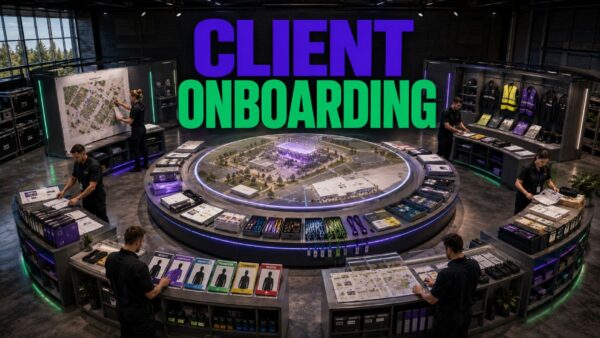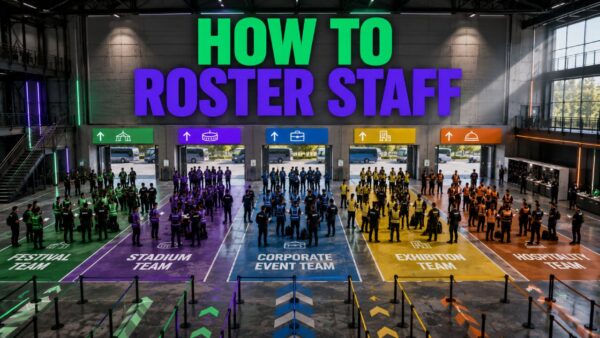


Temporary staffing software helps agencies manage the day-to-day realities of working with temporary or freelance staff at scale. It exists to provide structure for planning, coordination, and communication when spreadsheets and manual tools no longer suffice.
For agencies running multiple events, campaigns, or client projects, the challenge is rarely finding people. The challenge is managing complexity without things slipping through the cracks. Temporary staffing software sits at that operational centre.
This article explains what temporary staffing software is, why agencies use it, and when it becomes necessary. It also clarifies what it is not, and where a platform like Liveforce fits into modern agency operations.
What is temporary staffing software?
Temporary staffing software is a system agencies use to organise, schedule, communicate with, and track temporary or freelance staff across multiple jobs, clients, and locations.
It provides one central place to manage people, availability, assignments, and changes as work moves from planning to delivery. The purpose is operational control as staffing volumes and complexity increase.
In practical terms, temporary staffing software replaces fragmented tools with a single operational view of the workforce.

Why the term causes confusion
The term “temporary staffing software” is used broadly across the industry. This often makes it unclear what type of system agencies actually need.
Some tools focus on hiring. Others focus on payroll. Some attempt to cover everything at once. Temporary staffing software sits between these categories, which is why it is frequently misunderstood.
Staffing software vs recruitment platforms
Recruitment platforms are designed to source candidates and match people to roles. Temporary staffing software assumes the agency already has a workforce.
Its role begins once people exist in the system and need to be organised, assigned, and managed across real work.
Staffing software vs payroll and HR tools
Payroll and HR tools focus on contracts, pay, and employment records. Temporary staffing software focuses on operations.
It supports planning, coordination, communication, and tracking of work delivered. It may connect to payroll processes, but it does not replace them.
Clarifying this early matters. Many agencies delay adopting the right system because they look for recruitment or HR tools, when the real issue is operational coordination.
Why temporary staffing software exists in the first place
The operational problem agencies hit as they grow
Agencies often start with simple tools. A spreadsheet. A shared inbox. A few calendars. This works while volumes are low and work is predictable.
Problems appear when agencies begin running multiple jobs at once. Different clients. Different locations. Different teams. Availability changes. Roles overlap. Information lives in too many places.
Temporary staffing software exists because manual systems cannot keep pace with that level of coordination.
Why spreadsheets and shared inboxes stop working
Spreadsheets struggle when data changes constantly. Shared inboxes struggle when decisions need clarity and speed.
At scale, agencies experience:
- Conflicting availability
- Double bookings
- Missed updates
- Unclear responsibility
- Time lost checking and rechecking information
Where errors and friction start to appear
Most issues are not dramatic failures. They are small, repeated problems. A missed update. A late change was not seen in time. A role filled with the wrong skill set. Over time, these compound into stress, rework, and risk.
Temporary staffing software exists to remove this friction by creating one operational source of truth.
What temporary staffing software actually helps agencies manage
Temporary staffing software is not defined by features. It is defined by the problems it removes.
Managing availability across multiple clients and events
Availability is one of the hardest things to manage manually. Staff work across different clients. Dates overlap. Preferences change.
Avoiding clashes, gaps, and last-minute reshuffles
When availability lives in emails or spreadsheets, accuracy drops quickly. Temporary staffing software centralises availability so planners can make decisions with confidence, even when things change.
Keeping staff, roles, and information organised
As teams grow, information spreads. Skills. Experience. Compliance details. Past work.
Why central records matter when teams scale
A central workforce record allows agencies to assign people based on reality, not memory. It reduces reliance on individuals holding knowledge in their heads. This becomes critical when teams expand or turnover increases.
Communicating clearly when plans change
Change is constant in temporary work. Times move. Locations shift. Requirements adjust.
Temporary staffing software provides structured communication so updates reach the right people at the right time, without relying on last-minute messages or long email threads.
How agencies use temporary staffing software
Understanding how temporary staffing software fits into daily operations helps clarify its role.
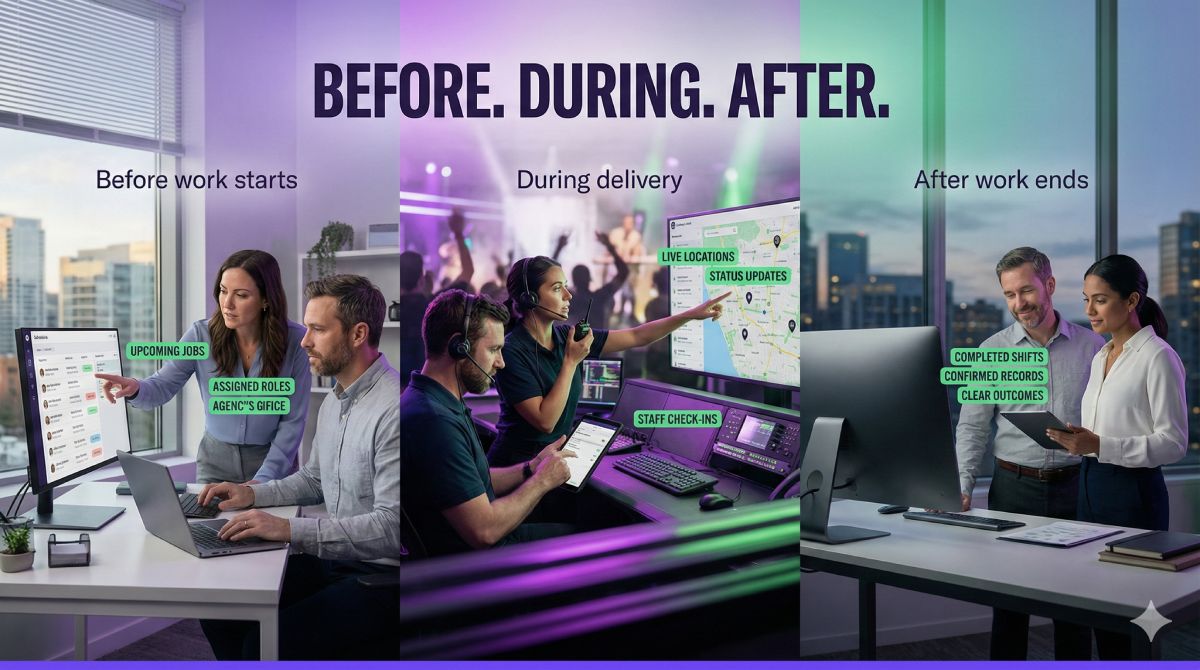
Before work starts
During planning, agencies use temporary staffing software to:
- Organise upcoming work
- Assign people to roles
- Confirm availability
- Share initial information
This stage sets the foundation. Clear planning reduces downstream problems.
During delivery
Once work is live, visibility matters. Agencies need to know:
- Who is where
- What has changed
- Who needs to be informed
Temporary staffing software supports this by keeping information current and accessible as conditions shift.
After work ends
After delivery, agencies still need structure. Tracking what happened supports:
- Accurate records
- Reduced disputes
- Better future planning
This closes the loop and feeds back into the next cycle of work.
When agencies usually start looking for temporary staffing software
It’s not about company size
Many small agencies use temporary staffing software. Many large ones delay too long.
It’s about complexity and repetition
The tipping point is not headcount. It is the number of moving parts. Multiple clients. Repeat work. Overlapping schedules.
Common tipping points
Agencies often start searching for temporary staffing software when:
- Spreadsheets no longer reflect reality
- Planning takes longer than delivery
- Too much depends on one or two people
- Mistakes feel avoidable but keep happening
At this stage, software is not a “nice to have”. It becomes operational infrastructure.
What temporary staffing software is not
Clarity here prevents wasted time and wrong decisions.

Not a recruitment marketplace
Temporary staffing software does not match workers to employers. Agencies bring their own workforce.
Not a job board
It does not advertise roles publicly or accept registrations from people looking for work.
Not an employer
The agency remains responsible for hiring, onboarding, and paying staff.
Not payroll software
Temporary staffing software supports operational tracking but does not run payroll.
Understanding these boundaries helps agencies choose systems that solve the right problem.
How Liveforce fits into this picture
Liveforce as a workforce management platform for agencies
Liveforce is a workforce management platform built for event-led agencies and suppliers who manage temporary or freelance teams across multiple projects, locations, and clients.
It exists to bring structure where manual systems break. Planning. Assignment. Communication. Visibility.
Liveforce is designed for operations teams. It supports repeat work and increasing complexity without adding noise.
When agencies typically introduce Liveforce
Agencies usually introduce Liveforce when coordination becomes the bottleneck. When growth is limited by admin load. When confidence in spreadsheets drops.
At this stage, Liveforce replaces fragmented tools with one system built for real-world agency operations.
What Liveforce replaces operationally
Liveforce replaces:
- Disconnected spreadsheets
- Shared inbox decision making
- Manual tracking across tools
It does not replace the agency. It supports it.
For agencies exploring workforce management at this stage, understanding how structured scheduling works in practice is useful. Liveforce’s approach to staff scheduling shows how operational clarity improves as complexity increases.
Agencies managing growing pools of people across projects also benefit from central workforce records. A clear staff database supports better decisions over time.
What to understand before choosing any temporary staffing software
Focus on operations, not feature checklists
Software choices should start with operational reality. How work is planned. How often it change? How many people are involved?
Feature lists rarely reflect how agencies actually operate.
Look for systems built for multi-client work
Agencies working across different clients and locations need systems designed for that complexity. Temporary staffing software built for single-location use often struggles when work scales.
Understanding these distinctions helps agencies choose software that supports growth rather than adding friction.
For further context on workforce management decisions, agencies often find it useful to read about the broader benefits of workforce management software and how structure supports long-term operations.
Temporary staffing software exists to manage operational complexity, not to find people. For agencies running temporary or freelance work at scale, it provides structure where manual systems fail.
Platforms like Liveforce fit into this space by supporting agencies through growth, complexity, and repeat delivery, without trying to be something they are not.
For agencies feeling the strain of coordination, clarity is the first step.
FAQs
What is temporary staffing software used for?
Temporary staffing software is used by agencies to manage temporary or freelance staff across multiple jobs, clients, and locations. It helps organise availability, assignments, communication, and workforce data in one system so operations stay controlled as complexity increases.
Is temporary staffing software the same as recruitment software?
No. Temporary staffing software is not designed to find or recruit people. It is used after staff are already hired, to manage scheduling, coordination, and delivery of work at scale.
When does an agency need temporary staffing software?
Agencies usually need temporary staffing software when spreadsheets and manual tools stop keeping up with day-to-day coordination. This often happens when teams manage repeat work, overlapping schedules, multiple clients, or frequent last-minute changes.
Does temporary staffing software replace payroll or HR systems?
No. Temporary staffing software focuses on workforce management and operational tracking, not payroll or HR. It supports accurate records of work completed but does not run payroll or handle employment contracts.
How does Liveforce fit into temporary staffing software?
Liveforce is a workforce management platform used by event-led agencies and suppliers to manage temporary staff across multiple projects and locations. It provides structure and visibility for planning, communication, and coordination without acting as a recruitment platform or employer.