Temporary staffing is the operating model that allows event, hospitality, and experiential agencies to scale people up and down in line with demand. Instead of maintaining a fixed workforce year-round, agencies build flexible pools of workers they can deploy when work exists and stand down when it does not.
In live environments, this approach is not optional. It is fundamental. Events happen in peaks.
Hospitality surges around fixtures, seasons, and one-off moments. Campaigns launch, tours move on, venues go quiet, then busy again. Temporary staffing is what makes all of that possible without carrying permanent overheads that would quickly become unsustainable.
This article explains what temporary staffing actually is, how it works in real environments, and why it becomes more complex as agencies grow. It starts with the basics, then moves into the operational realities that scaling agencies recognise very quickly.
Temporary staffing explained in real terms
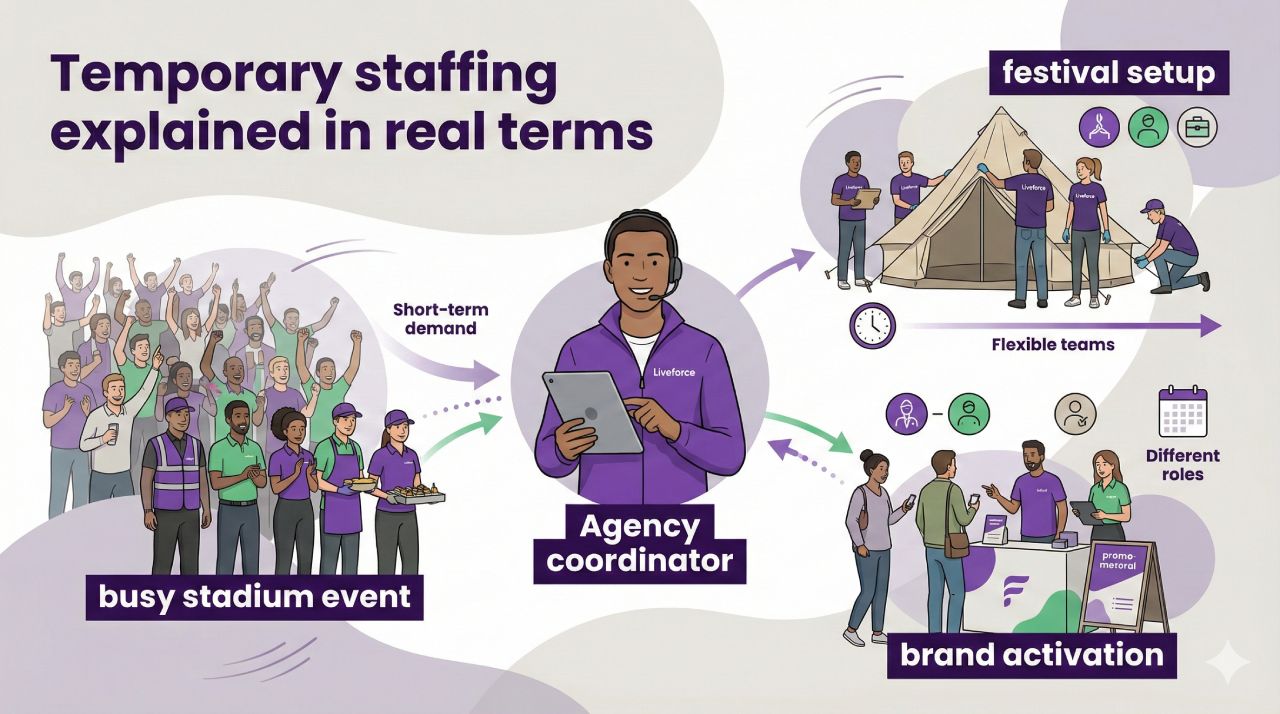
At its simplest, temporary staffing involves supplying workers to meet short term demand. Those workers are engaged for a defined period, assigned to specific roles, and released once the job is complete.
In reality, it looks less tidy.
For example, a hospitality agency supporting a football stadium may supply hundreds of staff across a single weekend. A festival supplier may build a workforce for five days, then not need the same volume again for weeks. An experiential agency may require specialist brand staff for a two day activation, then a completely different profile of people the following month.
Temporary staffing exists because:
- Demand is unpredictable
- Skills vary by event
- Volume changes rapidly
- Permanent staffing would create cost and risk
Rather than hiring for permanence, agencies hire for availability, suitability, and timing.
Where temporary staffing is most commonly used
Temporary staffing is often used in situations where work is event led, seasonal, or variable. In practice, it is most visible in environments where people, timing, and delivery must align precisely.
Common examples include:
- Festivals and outdoor events:
Stewards, bar staff, production runners, build and breakdown teams. - Sports venues and stadiums:
Matchday hospitality, ticketing, retail, and crowd-facing roles. - Hospitality and catering:
Seasonal peaks, private events, conferences, and pop-up venues. - Experiential marketing and brand activations:
Brand ambassadors, product specialists, sampling teams. - Venues and exhibitions:
Ushers, front-of-house teams, technical support, and temporary supervisors.
In each case, the work is legitimate, professional, and operationally demanding. The difference is not quality. It is duration and variability.
How temporary staffing works behind the scenes
From the outside, temporary staffing can look deceptively simple. Post roles, fill shifts, run the event. Internally, agencies manage a moving set of variables that change constantly.
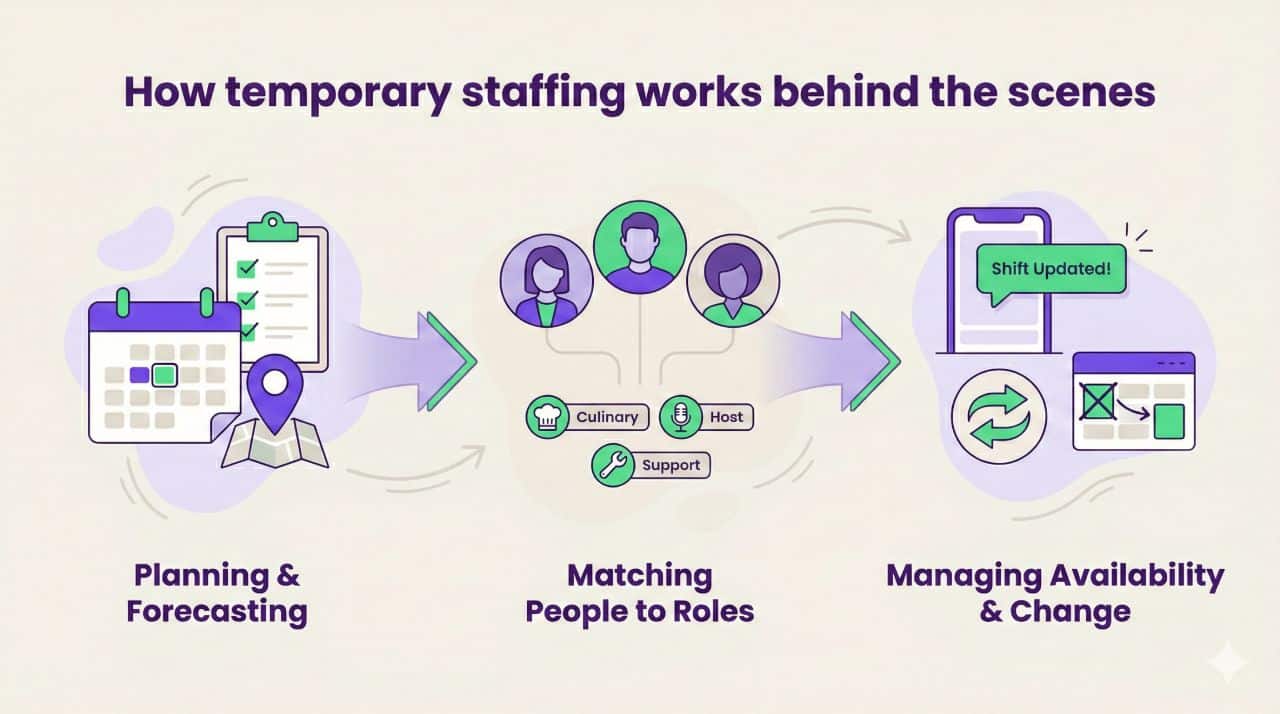
Planning and forecasting
Everything begins with demand forecasting. Agencies estimate:
- How many people are needed?
- Which roles are required?
- When are those roles live?
- Where staff need to be deployed?
Forecasts are rarely perfect. Weather changes. Ticket sales spike. Clients adjust scope. Temporary staffing works because it allows agencies to absorb these changes without rebuilding their workforce from scratch.
Matching people to roles
Availability is only part of the equation. Agencies also match:
- Skills
- Experience
- Location
- Compliance status
- Client expectations
A brand activation requires a different type of worker than a stadium shift. A production role carries a different risk than front of house support. Temporary staffing allows agencies to assemble the right mix for each project, not just fill gaps.
Managing availability and change
This is where complexity starts to build.
People cancel. Events overrun. Shifts extend. Roles change. The larger the workforce, the harder it becomes to track availability accurately using manual methods. What starts as a simple list quickly becomes a moving target.
Temporary staffing vs permanent staffing in practice
The difference between temporary and permanent staffing is not just contract length. It is operational intent.
Permanent staffing prioritises stability. Temporary staffing prioritises flexibility.
In practice, this difference shapes how agencies operate on a day-to-day basis.
With permanent staffing, the workforce size is fixed. People are hired to cover expected demand across an average year. This works well in environments where workloads are predictable and consistent. For example, an in-house catering team in a corporate office can plan staffing levels months because demand rarely fluctuates dramatically.
Temporary staffing works differently. Workforce size expands and contracts in response to real demand. A hospitality agency supporting a stadium does not need the same number of staff on a midweek afternoon as it does on a sold-out matchday. Temporary staffing allows the agency to staff for the peak without carrying the cost of those roles when the venue is quiet.
In practice, this means:
- Temporary staffing absorbs peaks without increasing fixed costs
A festival supplier can build a workforce of hundreds for a five-day event, then scale back immediately once the event closes, without ongoing payroll commitments. - Agencies can support multiple clients simultaneously
An experiential agency may run a brand activation in London, a sampling campaign in Manchester, and a product launch in Birmingham in the same week, drawing from the same temporary workforce pool. - Workforce size reflects demand, not assumption
Staffing levels are set by confirmed bookings and real-time changes, not estimates made months earlier. - Risk is distributed across projects, not locked into payroll
If one event is cancelled or reduced in scope, the impact is contained. The business is not carrying permanent wage costs for work that no longer exists.
For event businesses, relying solely on permanent staffing would limit flexibility and slow growth. Temporary staffing creates the space to scale, adapt, and respond to live demand, which is essential in environments where no two weeks look the same.
| Aspect | Temporary staffing | Permanent staffing |
|---|---|---|
| Workforce size | Scales up and down based on demand | Fixed headcount year-round |
| Cost structure | Variable, linked to active work | Ongoing payroll and overheads |
| Typical use | Events, festivals, peak periods | Consistent, predictable workloads |
| Flexibility | High, teams change frequently | Lower once roles are filled |
| Risk exposure | Spread across projects | Locked into long-term payroll |
When temporary staffing starts to feel difficult
Most agencies begin temporary staffing with simple tools. Spreadsheets. Emails. Group messages. It works when the workforce is small and projects are limited.
Problems rarely arrive all at once. They creep in.
An agency reaches a point where:
- Availability data is out of date
- Communication becomes fragmented
- Compliance checks are manual
- Payroll requires reconciliation across events
- Managers rely on memory rather than visibility
A common example is a hospitality agency supplying multiple venues across the same weekend. One cancellation creates a knock-on effect. Replacements are found, but confirmation is missed. A supervisor arrives short-staffed. The client notices.
None of this is caused by poor intent. It is caused by a scale without structure.
This is usually the point where agencies look for more structure, not more people.
In this case, Liveforce helps by bringing the moving parts of temporary staffing into one place. Availability, scheduling, communication, compliance, and timesheets are connected, so information stays current rather than being copied between tools.
How growing agencies regain control
As agencies grow, they tend to realise that temporary staffing itself is not the problem. The issue is how it is managed.
Control comes from structure, not restriction.
Agencies that stabilise operations usually focus on:
- Centralising workforce data
- Creating clear scheduling workflows
- Standardising communication
- Tracking compliance in one place
- Linking timesheets to actual shifts worked
This shift allows managers to move from firefighting to planning. Temporary staffing becomes predictable rather than reactive.
The role of workforce management software

At a certain size, manual processes stop being efficient. This is where workforce management software becomes relevant.
Before any product is mentioned, it is worth understanding the role software plays. It is not there to replace people. It exists to remove friction.
In a temporary staffing environment, software supports:
- Central staff records
- Real-time availability tracking
- Shift confirmations and updates
- Compliance visibility
- Timesheets and payments tied to actual work
Platforms such as Liveforce sit in the background, providing a single operational view across multiple events and clients. The benefit is not speed alone. It is confidence.
Managers know who is booked, who is available, and who is compliant. Decisions are made from accurate information, not assumptions.
What modern temporary staffing looks like
In a mature operation, temporary staffing does not feel chaotic. It feels controlled.
Schedules are clear. Communication is consistent. Changes are absorbed without panic. Teams trust the system because it reflects reality.
Agencies still deal with last-minute challenges. Events will always be live environments. The difference is that issues are visible early and resolved calmly.
Temporary staffing remains flexible, but it is no longer fragile.
Temporary staffing as a foundation, not a workaround
Temporary staffing is often misunderstood as a compromise. In reality, it is the foundation that allows the events and hospitality industries to function at scale.
For early stage agencies, it offers access to work without permanent risk. For growing agencies, it demands better systems and clearer processes. For established suppliers, it becomes a strategic advantage.
Understanding what temporary staffing is means understanding how people, timing, and trust intersect in live delivery. When managed well, it supports growth without sacrificing control.
For agencies reaching the point where manual methods start to strain, structured workforce management becomes the next logical step. Liveforce supports that transition by providing the operational backbone temporary staffing needs to scale with confidence.
Book your demo now with Liveforce and see how temporary staffing can work without the stress.
Frequently asked questions
What is temporary staffing and how does it differ from permanent staffing?
Temporary staffing refers to engaging workers for a defined period to meet short-term demand. Unlike permanent staffing, where staff are employed long-term with ongoing commitments, temporary staff are brought in to cover peaks, projects, or short notice needs. This means the workforce can expand or contract based on real demand without carrying long-term employment costs, making it a flexible option for event and hospitality agencies.
When should an agency consider using temporary staffing?
Agencies use temporary staffing when demand fluctuates or spikes, such as during large festivals, match days, seasonal hospitality surges, or peak weekends. It also helps cover unexpected absences or last-minute client requests without the delays and commitments of permanent recruitment.
Can temporary staff become permanent employees?
Yes. In some cases, temporary assignments can lead to long-term roles. Some organisations use temporary staffing as a trial period to assess a worker’s fit before offering a permanent position. This model, often called temp-to-perm, helps both agencies and clients reduce hiring risk
What are the typical durations of temporary staffing assignments?
Temporary assignments can vary widely. They might last a few hours for a single event shift, several days for a festival, or multiple months to cover extended seasonal demand. Duration depends on the specific operational need and the project timeline defined by the agency or client.
How does temporary staffing affect compliance and worker management?
Temporary staff still need to meet legal, training, and compliance requirements. Agencies handle much of the recruitment, vetting, and onboarding, but clients must ensure temporary workers understand site-specific rules and safety procedures. Using centralised systems helps keep documentation and compliance checks current as assignments change