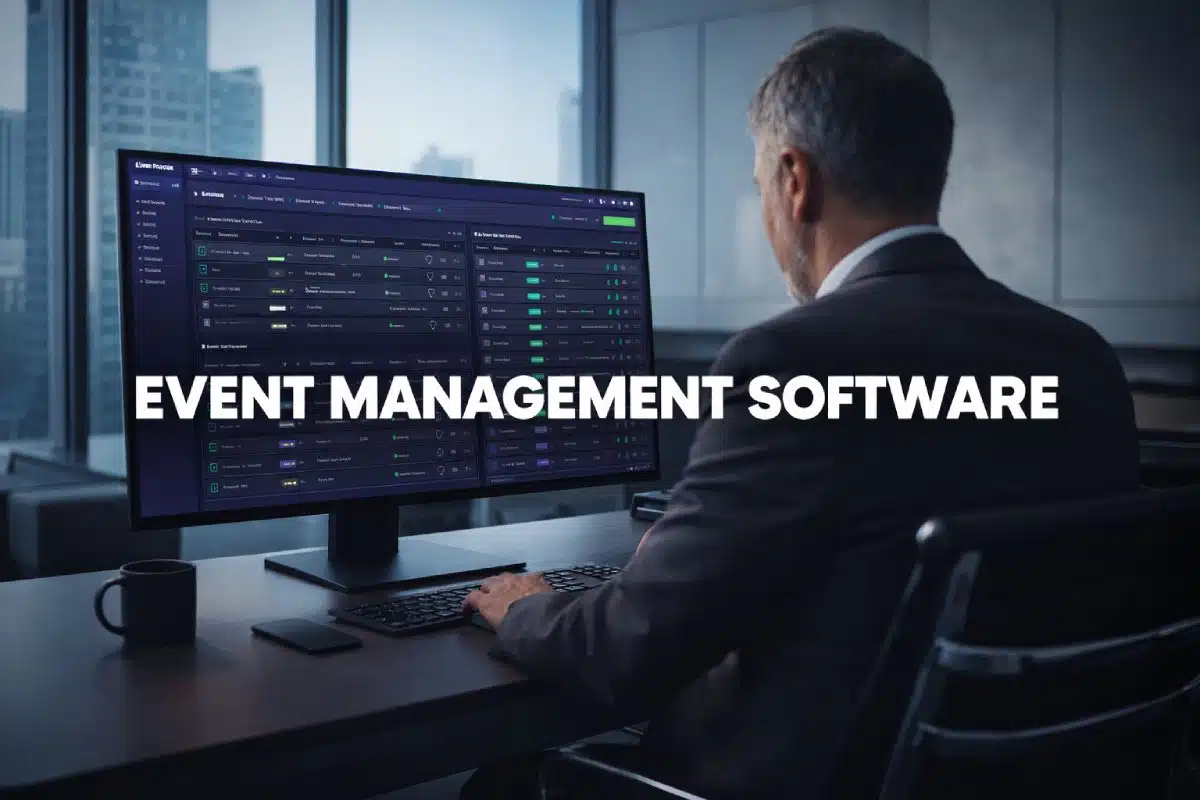

Enterprise event businesses searching for Event Management Software are often evaluating platforms designed to coordinate venues, manage attendees, and streamline logistics. Those capabilities are important. But for organisations managing large, temporary workforces across multiple clients and regions, planning functionality alone is not enough.
At scale, operational risk sits inside workforce control.
This is where the definition of Event Management Software must shift. For enterprise event-led organisations, the software layer that protects delivery capability is not the attendee workflow. It is the workforce system that governs scheduling, availability, communication, and compliance across projects.
The difference becomes material as complexity increases.
What Event Management Software Typically Prioritises
Most Event Management Software platforms are built around planning efficiency.
They optimise:
- Registration and ticketing
- Venue and supplier coordination
- Agenda management
- Guest communication
- Marketing automation
These tools support the event experience. They help organisers manage attendee journeys and streamline front-of-house logistics.
For corporate conferences or one-off internal events, this model works well. The operational focus is on the guest.
However, enterprise event agencies and staffing suppliers operate differently. Their primary risk exposure does not sit with ticketing workflows. It sits with workforce execution.
As global event revenues expand, this distinction becomes sharper. Allied Market Research projects the global events industry to exceed $2 trillion in value over the coming decade. As events scale in size and frequency, so does the operational complexity behind them.
When events become recurring, multi-location, and multi-client, workforce management becomes the structural constraint.
Planning software supports the event. Workforce systems protect their delivery.
Workforce Management vs Event Planning Software
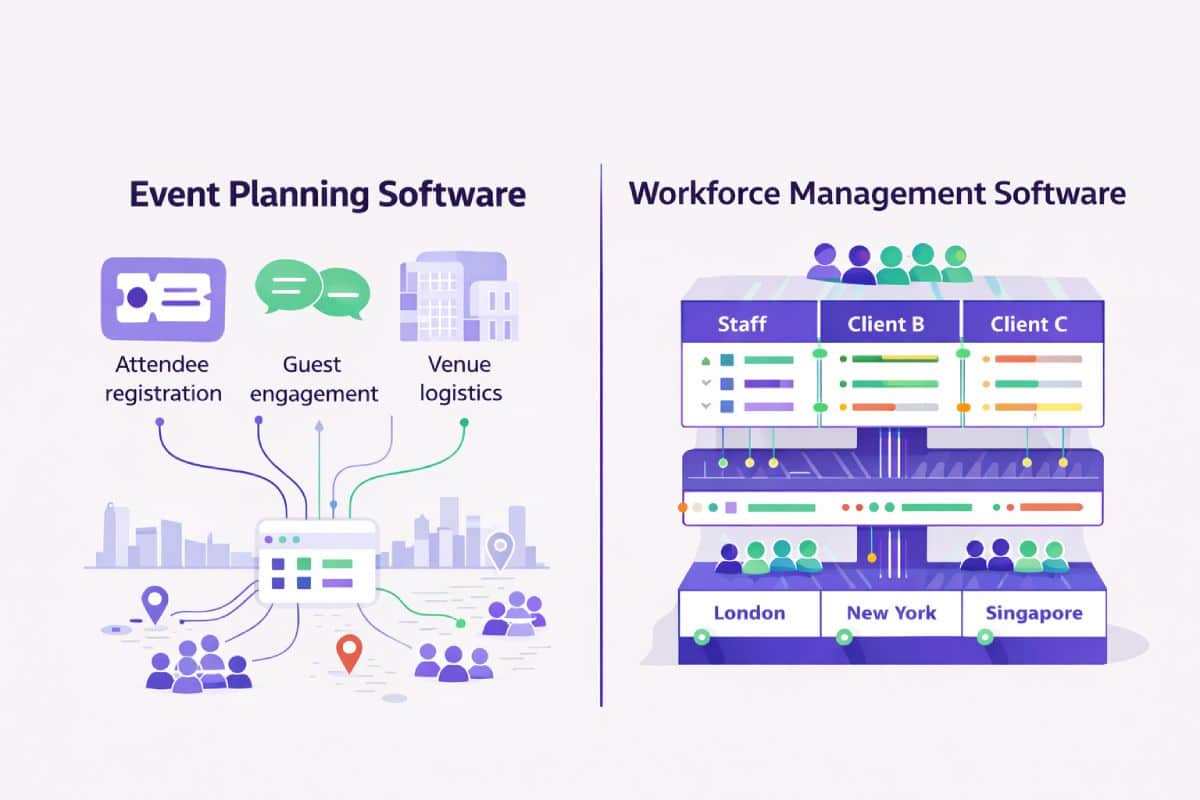
Enterprise leaders evaluating Event Management Software must distinguish between two fundamentally different system purposes.
Event planning software focuses on:
- Attendee registration
- Guest engagement
- Venue logistics
- Programme coordination
Workforce management software focuses on:
- Staff allocation
- Availability tracking
- Multi-project scheduling
- Compliance oversight
- Operational communication
Planning tools optimise the guest experience. Workforce systems safeguard operational execution.
This distinction becomes critical when managing rotating freelance teams. According to the World Employment Confederation, millions of workers globally are now engaged in temporary or contingent roles each year, with staffing markets expanding steadily across North America, Europe, and Asia-Pacific.
The growth of flexible labour models increases volatility in workforce availability. Enterprise event businesses that rely on freelance crews, technicians, brand ambassadors, or hospitality teams operate within this volatility every day.
Event Management Software that does not account for workforce variability creates blind spots.
For agencies managing dozens or hundreds of staff across concurrent projects, workforce control must sit at the centre of system architecture.
| Capability | Event Planning Software | Workforce-Focused Event Management Software |
|---|---|---|
| Primary Focus | Attendee experience and logistics | Workforce control and execution |
| Staff Allocation | Basic or limited | Multi-project conflict-aware scheduling |
| Availability Tracking | Often manual | Real-time visibility |
| Compliance Oversight | Rarely included | Embedded governance controls |
| Operational Communication | External tools required | Built-in traceable workflows |
| Work Verification | Not included | Timesheets and reconciliation |
Why Enterprise Event Businesses Outgrow General Event Management Software
As agencies expand into new regions, onboard additional clients, or increase event frequency, the limitations of generic Event Management Software begin to surface.
Three pressure points typically emerge.
Multi-Client Scheduling Complexity
Enterprise agencies rarely operate a single event at a time. They manage parallel projects for different clients, often across multiple cities or countries.
Without a centralised workforce database and conflict-aware scheduling engine, staff can be double-booked across projects. Availability records drift out of date. Spreadsheets multiply.
This fragmentation is not immediately visible at a small scale. It becomes systemic at the enterprise level.

Temporary Workforce Volatility
Temporary teams are dynamic by nature. Availability changes. Skills vary. Compliance documentation expires.
According to Staffing Industry Analysts, the global staffing industry generates hundreds of billions of dollars in annual revenue, reflecting the scale of contingent labour usage worldwide. This model introduces flexibility, but also operational unpredictability.
Event Management Software built primarily for planning rarely offers real-time visibility into workforce status across projects. Enterprise agencies require system-level visibility that spans clients, regions, and roles.
Without it, last-minute substitutions become common. Replacement decisions are made without full context. Quality control weakens.
Cross-Region Visibility and Compliance
Enterprise event organisations increasingly operate across jurisdictions. Labour regulations, certification requirements, and compliance obligations vary by country and region.
CIPD research consistently highlights compliance risk and workforce governance as top concerns for organisations relying on flexible labour models.
When compliance documentation is stored across disconnected systems or email threads, exposure increases. Enterprise decision-makers require a unified system of record.
This is where workforce-centric Event Management Software architecture becomes essential.
The Risk Exposure Created by Poor Workforce Control
Operational failures in event delivery are rarely caused by venue logistics. They are typically rooted in workforce misalignment.
Risk manifests in several ways.
Revenue Leakage
Overbooking staff, misallocating skill sets, or miscalculating hours worked directly impacts margins. Small inefficiencies compound across high-frequency event portfolios.
Disconnected systems exacerbate these errors.
Client Reputation Risk
Enterprise agencies compete on reliability. A missed shift update or under-qualified replacement can undermine long-standing client relationships.
In high-visibility environments such as global sports events or international brand activations, reputational damage can extend beyond a single project.
Governance and Compliance Exposure
Temporary labour models require structured oversight. Misclassification, missing certifications, or incomplete right-to-work documentation can lead to legal exposure.
As workforce models grow more complex, governance must become systemised.
Enterprise Event Management Software must therefore extend beyond planning workflows. It must embed workforce governance into the operational backbone.
What Enterprise Event Management Software Must Include
For workforce-heavy organisations, Event Management Software must function as infrastructure rather than convenience.
Several capabilities are non-negotiable.
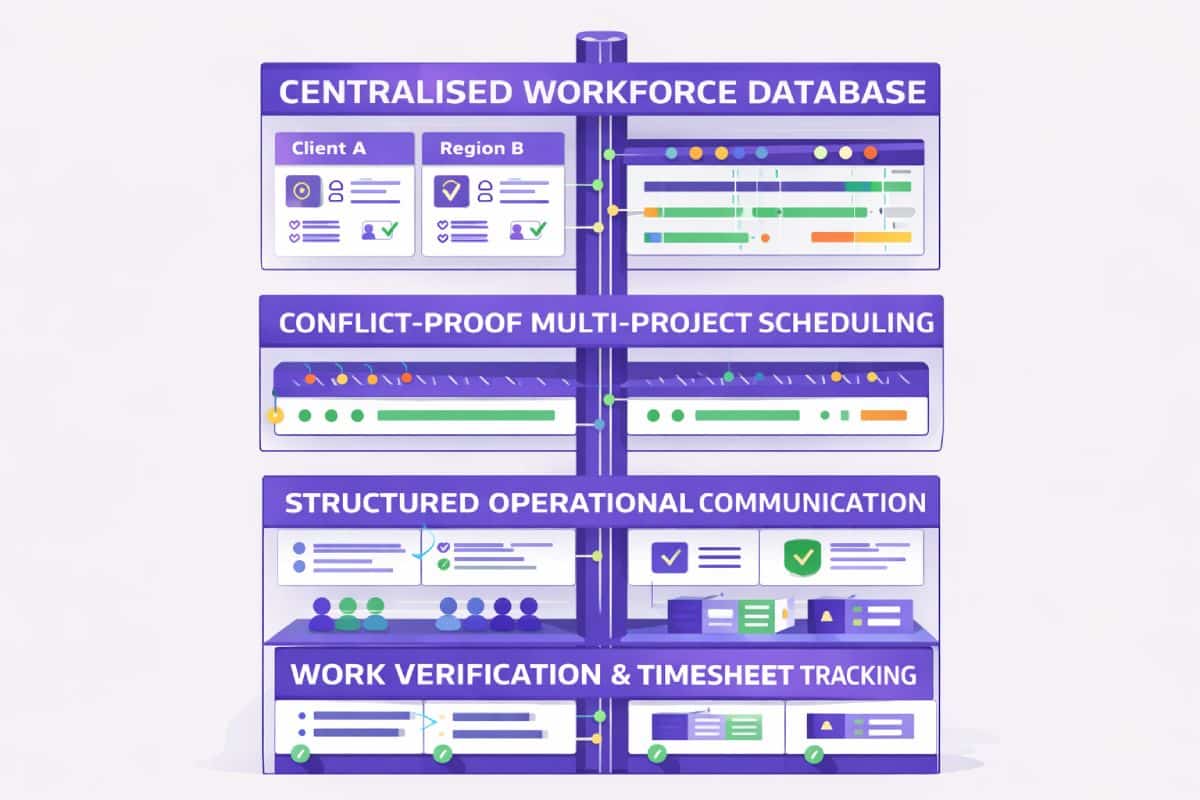
Centralised Workforce Database
All staff data, including skills, availability, certifications, and historical performance, must reside in a single system of record.
This database should segment by client, region, and role, enabling enterprise teams to maintain visibility across the entire workforce pool.
Conflict-Proof Multi-Project Scheduling
Scheduling tools must operate across concurrent events, with automatic conflict detection and real-time availability updates.
This is where event staff management software diverges from generic planning tools. Scheduling is not a side feature. It is the operational core.
Structured Operational Communication
Workforce communication must move beyond informal messaging platforms.
Shift confirmations, briefing updates, and change notifications require traceable, system-based communication to reduce ambiguity and protect accountability.
Work Verification and Timesheet Tracking
Enterprise organisations require accurate records of work completed. Clear timesheet tracking reduces disputes and improves financial forecasting.
When embedded inside Event Management Software, this capability creates a closed-loop system from planning through delivery to reconciliation.
Workforce-focused platforms such as Liveforce illustrate this architecture. Rather than positioning around ticketing or guest journeys, the system centralises workforce planning, scheduling, and communication across multiple projects and clients.
The Crew App supports operational visibility for staff, but the platform itself is designed for agencies managing complexity at scale, not for individual workers seeking employment.
This distinction matters.
How Enterprise Leaders Should Evaluate Event Management Software
When selecting Event Management Software, enterprise leaders should apply a workforce-centric evaluation framework.
Key questions include:
Does the architecture support multi-client operations?
Enterprise agencies require segmentation without fragmentation. The system must allow separate client environments while maintaining central workforce visibility.
Is workforce data unified and accessible?
A scalable platform consolidates staff profiles, availability, compliance records, and work history into one environment.
Does scheduling operate across projects in real time?
Conflict detection and live availability tracking are essential for reducing operational exposure.
Is communication embedded within the system?
Operational updates should not rely on external messaging platforms. Structured communication reduces risk.
Can the platform scale geographically?
As agencies expand into new regions, Event Management Software must support localisation without compromising governance.
Enterprise leaders should also assess vendor positioning. Platforms that primarily emphasise attendee management may lack the workforce depth required for high-frequency staffing operations.
Conversely, workforce-focused systems position planning as one layer of a broader operational framework.
Why Liveforce Is Built for Workforce Control at Scale
Enterprise organisations rarely operate with a single system. They operate with layers.
Planning tools manage venues, programmes, and attendee journeys. Financial systems manage billing and reporting. What often remains under-structured is the workforce layer that connects planning to delivery.
Liveforce is built specifically to occupy that layer.
It does not attempt to replace planning platforms. Instead, it provides structured workforce control across multiple clients, projects, and regions, ensuring that delivery capability scales alongside commercial growth.
For enterprise event businesses, workforce execution is not a feature. It is a governance requirement.
Liveforce enables:
- Clear workforce oversight across concurrent events
- Controlled allocation across clients without fragmentation
- System-level visibility into staffing capacity
- Operational continuity as organisations expand into new regions
This architecture allows enterprise leaders to maintain control without multiplying tools or reverting to manual oversight.
As event portfolios grow, operational risk does not usually increase because of attendee complexity. It increases because workforce coordination becomes harder to see and harder to govern.
Liveforce is designed around that reality.
When evaluating Event Management Software at enterprise scale, the question becomes less about who manages the event experience most elegantly and more about which system safeguards workforce execution behind it.
FAQs
What is the difference between event management software and workforce management software?
Event management software often focuses on planning elements such as registration, ticketing, and logistics. Workforce-focused platforms like Liveforce centre on staff scheduling, availability tracking, and operational control across multiple events and clients.
Can event management software manage complex staff scheduling across multiple events?
Many event management software platforms include basic scheduling tools but are not designed for multi-client, multi-project workforce control. Systems such as Liveforce provide conflict-aware scheduling and centralised workforce visibility to reduce double bookings and last-minute gaps.
What features should enterprise organisations look for in event management software?
Enterprise organisations should prioritise a central workforce database, multi-project scheduling, structured communication, and accurate work tracking. Workforce-centric platforms like Liveforce embed these controls within one system to support scalable governance.
How does workforce-focused event management software reduce operational risk?
It centralises staff data, improves scheduling accuracy, and ensures shift communication is controlled and traceable. Platforms such as Liveforce provide this structure across multiple clients and regions, reducing compliance exposure and delivery failures.
Is one event management software platform suitable for multiple clients and regions?
Enterprise-ready event management software must allow segmentation by client and region while maintaining central workforce oversight. Liveforce is designed for this model, enabling operational visibility without fragmenting control.