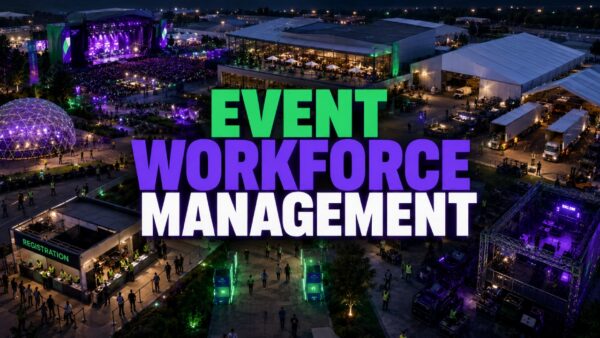


Temporary employment is a working arrangement where a person is engaged for a limited period, a defined project, or a specific event.
There is no expectation of ongoing work beyond that agreed scope. For event staffing agencies, hospitality suppliers, and experiential marketing companies, this arrangement is the foundation of how work gets done.
Generic rota tools and office-focused HR platforms treat temporary employment as an edge case. In event-led businesses, it is the default. Agencies manage hundreds of workers on short-term contracts across overlapping projects, shifting schedules, and multiple end-clients, often in the same week.
This article explains what temporary employment means in practical terms, what types exist, what rights temporary workers hold in the UK, what contracts should cover, and how agencies manage this workforce model at scale.
Liveforce is a workforce management platform built for exactly this type of operation.
Defining Temporary Employment
Temporary employment means a worker is engaged for a set duration or until a specific task is complete. The arrangement can last a single shift, a few weeks, or several months. What makes it temporary is the agreed endpoint.
In a corporate setting, this might mean covering maternity leave or filling a gap during a restructure. In the events industry, the picture is different. A hospitality agency supplying staff for a Premier League stadium needs 200 people on a matchday and none the following Tuesday. A festival supplier builds a team of 500 for a long weekend and stands them down by Monday morning.
The work is real and professional. The duration is defined by the event, not by the calendar.
Temporary employment is distinct from temporary staffing, which describes the operational model agencies use to supply workers. The former is the contractual and legal framework. The latter is how that framework gets managed day to day. The two are connected, but they answer different questions.
For agencies operating in events, hospitality, and experiential marketing, understanding both sides matters. The legal structure shapes compliance obligations. The operational model shapes how efficiently those obligations are met.
What Are the Main Types of Temporary Employment?
Temporary employment covers several distinct arrangements. Each one appears regularly in event-led businesses, and each carries different operational characteristics.
| Employment Type | How It Works in Events | What It Means for Agencies |
|---|---|---|
| Fixed-Term | Set end date or event. Example: a 12-month contract with a festival supplier covering the full season. | Clear timeline for both parties. Agencies can plan staffing volumes well in advance. |
| Seasonal | Tied to a recurring period. Example: summer festival season or a Premier League matchday hospitality rota. | Predictable peaks. Agencies build and maintain a reliable seasonal pool year on year. |
| Casual / Zero-Hours | No guaranteed hours. Work offered as needed. Common for event day roles such as front-of-house or registration. | Maximum flexibility. Workers must understand there is no guarantee of shifts. |
| Project-Based | Employment ends when the project finishes. Example: a three-day experiential campaign for a product launch. | Defined scope and deliverable. Often requires specialist skills for a short window. |
This table is a starting point. The categories overlap in practice. A hospitality agency running Wimbledon hospitality might engage some workers on seasonal contracts and others on a casual basis for individual match days. An experiential agency might use project-based contracts for a brand activation tour that runs across several months.
The type of arrangement shapes how agencies plan, communicate, and stay compliant.
Choosing the right arrangement depends on the nature of the work, the expected duration, and the level of commitment both sides need. Getting this wrong creates confusion for workers and compliance risk for the agency.
Why Do Event and Hospitality Businesses Rely on Temporary Staff?
The events industry runs on variable demand. A catering supplier might have three large weddings in one weekend and nothing booked for the next fortnight. An experiential agency could be running simultaneous brand activations in four cities, each needing a different mix of skills and headcount.
Permanent employment assumes consistent, year-round demand. That assumption does not hold in event-led work.
This model exists because the gap between peak demand and quiet periods is too wide for a fixed headcount to cover.
- Consider Glastonbury. The festival requires thousands of temporary workers across hospitality, stewarding, production, and logistics. Those roles exist for a defined window. No agency would hire permanent staff for a five-day event. The same principle applies at a smaller scale across every part of the industry.
- A hospitality agency supporting a Premier League club needs bar staff, servers, and front-of-house teams on matchdays. Outside of those fixtures, the demand drops. During international breaks, it disappears entirely. Temporary employment allows the agency to scale its workforce in line with the fixture list rather than carrying wages through idle weeks.
- Experiential marketing operates the same way. A sampling campaign might need 30 brand ambassadors for two weeks, then zero. A product launch might require specialist demonstrators for a single weekend. The work is high-skill, high-stakes, and short-lived.
Agencies rely on temporary employment because the work itself is temporary.
Multi-client agencies face an extra layer of complexity. They are not managing one event at a time. They are coordinating workers across several end-clients, each with different requirements, locations, and timelines.
The ability to engage and release people efficiently is what allows these businesses to grow without becoming unmanageable.
How Long Does Temporary Employment Last in the UK?

There is no single legal definition of how long temporary employment can last. The duration depends on the type of arrangement and the terms agreed between the worker and the employer or agency.
In practice, the duration in events can range from a single shift to several months. A matchday hospitality role might last six hours. A festival build crew might be engaged for two weeks. A seasonal contract with a venue could run for three to four months.
The defining feature is not length. It is the agreed endpoint.
- UK employment law does introduce a threshold that agencies should understand. When a worker has been continuously employed on a series of fixed-term contracts for two years, they may gain the right to be treated as a permanent employee. This means the employer must show objective justification for continuing to use fixed-term arrangements rather than offering a permanent role.
- For agencies managing event-led work, this threshold rarely becomes an issue for individual assignments. Most event roles are genuinely short-term. Where it does matter is when agencies re-engage the same workers repeatedly over long periods without reviewing the contractual basis. Tracking this requires accurate records of engagement dates, contract types, and continuity of service.
- The Agency Workers Regulations (AWR) add another time-based milestone. After 12 weeks in the same role with the same hirer, agency workers gain the right to equal treatment on pay and basic working conditions compared with directly hired staff in comparable roles. This applies regardless of whether the worker is on a fixed-term or casual arrangement.
What Rights Do Temporary Workers Have in the UK?
Temporary workers in the UK hold a clear set of rights from the first day of an assignment, with additional protections that apply after qualifying periods. Agencies operating in events and hospitality need to understand these rights because non-compliance creates financial and reputational risk.
From day one, all temporary workers are entitled to the national minimum wage, statutory holiday pay under the Working Time Regulations 1998, rest breaks, and protection from discrimination. Agency workers also have an immediate right to access shared facilities at the workplace, such as canteens or transport services, and must be told about any permanent vacancies with the hirer.
These are baseline protections. They apply from the first shift, regardless of contract type.
After 12 continuous weeks in the same role with the same hirer, the Agency Workers Regulations 2010 give temporary agency workers the right to equal treatment. This covers pay, including overtime rates and shift premiums, as well as working time conditions such as rest periods and annual leave entitlement where the hirer provides enhanced terms to comparable permanent staff.
Equal treatment does not extend to occupational pensions, redundancy pay, or company-wide bonus schemes that are linked to long-term service. It is specifically about matching the basic terms that a directly recruited worker in the same role would receive.
For agencies, the practical requirement is tracking. Each worker’s start date, assignment length, and role continuity must be recorded accurately. A central workforce database makes this manageable. Spreadsheets and email threads do not.
The Employment Rights Act 2025 introduces further changes arriving in 2027, including stronger protections for workers on zero-hours contracts and new requirements around shift notice periods and cancellation compensation. Agencies that rely on casual and zero-hours arrangements should monitor these developments closely, as the obligations on hirers and agencies are expected to increase.
Compliance is not a one-off task. It is an ongoing obligation that grows with the size of the workforce.
What Does a Temporary Employment Contract Cover?
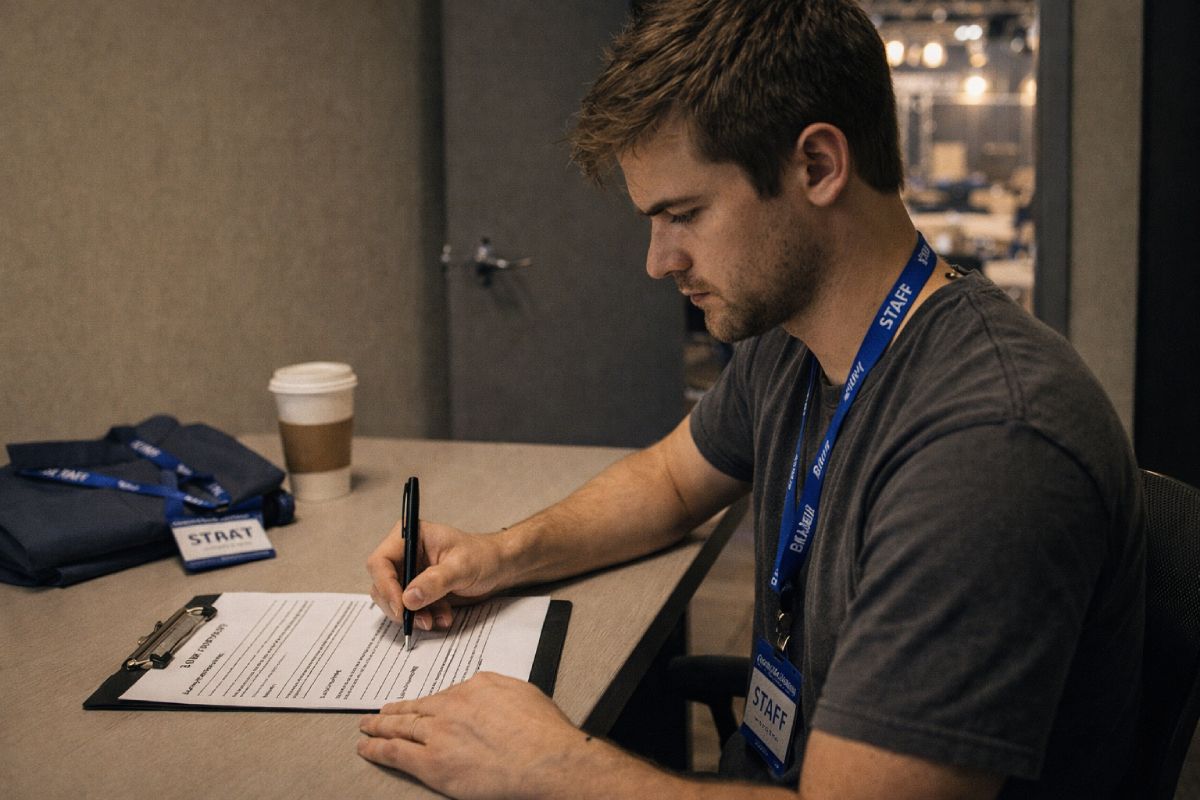
A temporary employment contract sets out the terms of the engagement between the worker and the employer or agency. It is a legal document, and both sides benefit from clarity.
At a minimum, a temporary employment contract in the UK should cover:
- start date and expected end date or trigger event,
- the role and responsibilities,
- the rate of pay and payment frequency,
- working hours and location,
- notice requirements, and
- any specific terms related to the assignment.
- For event work, this might include site-specific health and safety obligations, dress code, or client confidentiality requirements.
Vague contracts create disputes. Clear contracts protect both the agency and the worker.
Agencies working across multiple clients and events often manage dozens of contracts at any given time. Each client may have different rate structures, different compliance requirements, and different expectations around notice and cancellation terms.
This is where operational systems earn their value. Storing contract details alongside worker profiles, compliance documents, and assignment history in a single system removes the guesswork.
When a worker’s engagement terms are recorded once and linked to every assignment, the risk of inconsistency drops significantly.
Written particulars of employment must be provided on or before the first day of work. This has been a legal requirement for all workers and employees in England and Wales since April 2020. For agencies supplying temporary workers, this means having a reliable process to issue accurate documentation before each engagement begins.
How Do Agencies Manage Temporary Employment at Scale?
Managing five temporary workers for a single event is straightforward. Managing 300 across six events in the same week, for three different clients, in four different cities, is a different operation entirely.
Most agencies start with spreadsheets. Availability tracked in one file. Shift assignments in another. Compliance documents in a shared folder. Communication happening across WhatsApp, email, and phone calls. It works until it does not.
The point at which this becomes difficult to manage is the point at which the tools stop matching the complexity.
Double bookings appear because availability data lives in two places. Compliance gaps emerge because document expiry dates are not tracked centrally. Briefings go out late because there is no single communication channel. Workers arrive at the wrong site because a last-minute change was communicated to some people but not all of them.
These are not failures of effort. They are failures of structure. And they become more frequent as the volume of work increases. The operational challenge of managing temporary workers at scale, across overlapping projects and clients, is why purpose-built workforce management platforms exist. For a deeper look at the day-to-day coordination involved, see this guide on managing event staff.
Liveforce is a workforce management platform built for event-led businesses. It is designed for agencies and suppliers that manage large, temporary workforces across multiple projects, locations, and clients.
It exists for the point at which spreadsheets and basic rota tools stop scaling.
Liveforce provides:
- A central staff database that stores availability, skills, compliance status, and engagement history for every worker in one place.
- Scheduling tools that assign the right people to the right roles across concurrent events and clients, with built-in conflict checks.
- Communication features that send shift confirmations, briefings, and last-minute updates directly to staff without relying on message chains.
- Timesheet tracking that creates clear records of hours worked, reducing disputes and speeding up payment processing.
Liveforce is not a recruitment marketplace. It does not hire staff. It does not advertise jobs to the public.
It is the operational system that agencies use to manage their entire workforce, from the first shift to the last.
Book a demo with Liveforce to see how it works in practice.
Generic Tools vs Event-Built Platforms: What Matters for Temporary Employment
A quick view of what matters when agencies manage large temporary workforces across multiple events, clients, and freelance staff.
| Operational Requirement | Generic Tool | Liveforce (Event-Built) |
|---|---|---|
| Multi-project scheduling | Single-location rota. Cannot manage overlapping events. | Built for concurrent events across locations and clients. |
| Temporary workforce database | Basic contact list. No skills, compliance, or availability tracking. | Central database with availability, skills, compliance, and engagement history. |
| Agency worker compliance | No AWR tracking. Expiry dates and qualifying periods managed manually. | Tracks document status and flags compliance gaps automatically. |
| Shift communication | Email or generic messaging. No event-specific context. | Direct communication to temporary staff with shift details, briefings, and updates. |
| Timesheet accuracy | Manual sign-off. Disputes common at volume. | Digital timesheet capture linked to shift records for clear audit trails. |
| Scaling across clients | Designed for one employer. Multi-client work requires workarounds. | Designed for agencies managing workforces across multiple end-clients. |
This comparison is designed to clarify, not criticise. Generic tools work well in environments with predictable, single-location staffing. The difference becomes clear when agencies operate at scale, across variable demand, multiple clients, and large pools of workers on short-term contracts.
Temporary Employment Powers the Events Industry. Managing It Well Is the Hard Part.
Temporary employment is the operating model behind every staffed event, every hospitality shift, and every brand activation. It is how the industry meets variable demand without carrying unsustainable permanent costs.
The legal framework is clear. The types of arrangement are well established. The rights of temporary workers in the UK are defined in legislation that agencies are expected to follow.
Where agencies struggle is not the concept. It is the coordination.
Managing temporary employment across dozens of workers is manageable. Managing it across hundreds, for multiple clients, across overlapping events, with accurate compliance records and consistent communication, is where most manual systems fail.
The question for most agencies is not whether they use temporary employment. They already do. The question is whether their systems were designed for the complexity it creates at scale, or whether those systems were designed for something simpler.
Liveforce was built for that complexity.
Book a demo to see how it works.
FAQs
What is the difference between temporary and permanent employment?
Permanent employment has no defined end date and assumes an ongoing relationship between employer and worker. Temporary employment has an agreed endpoint, whether that is a specific date, the completion of a project, or the end of an event. Both types carry statutory employment rights in the UK, but the obligations around notice, redundancy, and long-term benefits differ.
How long can temporary employment last in the UK?
There is no fixed legal limit. Temporary employment can last from a single shift to several months. However, if a worker is continuously employed on fixed-term contracts for two years or more, they may gain the right to be treated as permanent. Agencies should track engagement dates and contract continuity to manage this threshold.
What rights do temporary workers have in the UK?
All temporary workers are entitled to the national minimum wage, statutory holiday pay, and protection from discrimination from day one. Agency workers gain additional equal treatment rights after 12 weeks in the same role with the same hirer, covering pay and basic working conditions under the Agency Workers Regulations 2010.
What should a temporary employment contract include?
A temporary employment contract should state the start and expected end date, the role, the rate of pay, working hours, location, and notice terms. For event work, it may also include site-specific requirements such as health and safety obligations or client confidentiality clauses. Written particulars must be provided on or before the worker’s first day.
How does Liveforce help agencies manage temporary employment?
Liveforce provides a central platform for event staff scheduling, workforce database management, shift communication, and timesheet tracking. It is built for agencies that manage large temporary workforces across multiple events and clients. It replaces fragmented spreadsheets and messaging tools with one structured system designed for the complexity of event-led operations.