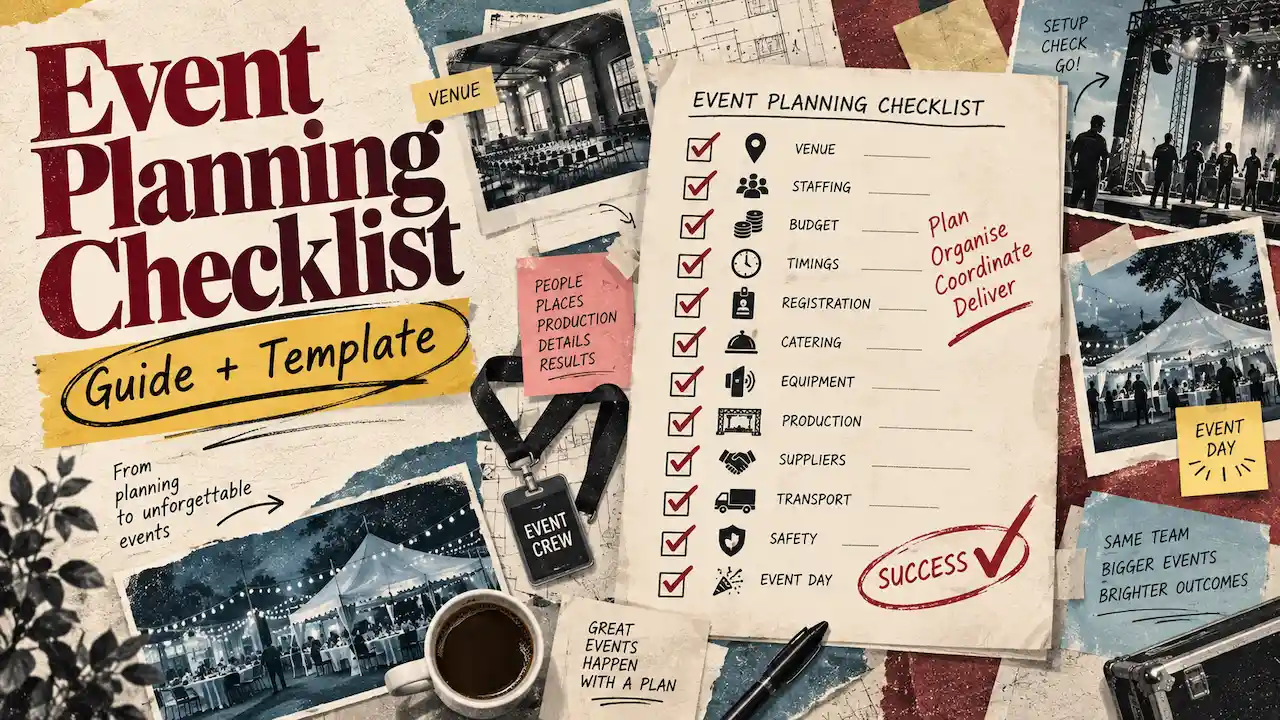
An effective event planning checklist does more than list tasks. It prevents problems that usually surface long before an event goes live.
- Missed briefings,
- Staffing gaps,
- Unclear ownership, and
- Last minute changes
This almost always results from planning gaps, not on-the-day mistakes.
Most generic event checklist content focuses on what needs doing, but ignores when it needs to happen, who is responsible, and what depends on it. Workforce planning, scheduling pressure, and compliance are often treated as side notes. In real operations, those are the areas where events fail.
This guide is built around how events are actually planned when reliability matters. It prioritises control, ownership, and readiness, helping teams reduce risk long before the event begins.
Why Most Event Checklists Fail in Real Operations
Most event checklists fail because they are built as task lists, not control systems. They record what needs doing, but not how actions connect, who owns them, or what breaks if they are missed. That works on small, one-off events. It breaks quickly at scale.
A typical event management checklist treats every task as equal:
- Book the venue.
- Confirm staff.
- Send briefs.
None of these steps exists in isolation.
Staffing depends on confirmed roles ➡️Briefings depend on final schedules ➡️ Schedules depend on availability and compliance.
When those dependencies are not made explicit, teams complete tasks in the wrong order or too late to fix the damage.
Ownership is the next point of failure
Many event organisation checklist templates assume someone will “pick it up”. In practice, that means no one is fully accountable. Tasks drift. Assumptions are made. Critical actions are missed because responsibility was implied rather than assigned.
Another common issue is version control
Planning teams update documents weeks out. Delivery teams make changes closer to the event. Different versions circulate across email threads, shared drives, and spreadsheets.
By the time the event arrives, teams are working from different sources of truth, and small discrepancies turn into on-the-day problems.
Workforce and compliance are also treated as secondary. Staff are often added late, briefings are rushed, and checks are handled manually or spread across systems. This creates avoidable risk, especially when teams are managing multiple events, clients, and locations at the same time.
When checklists fail, it is rarely because teams did not care. It is because the checklist was never designed to reflect how events are actually delivered under pressure.
What a Real Event Planning Checklist Needs to Control
A real event planning checklist is not there to remind teams what to do. It exists to control the conditions that make delivery reliable. When those conditions are managed early, events run smoothly. When they are not, teams end up firefighting.
It is simple like that!
The first control point is time
Certain decisions must be made early for everything else to work:
- Roles need to be defined before staff can be scheduled.
- Briefings need final schedules.
- Compliance checks must be complete before anyone steps on site.
A checklist that does not make timing explicit allows critical steps to drift until they are too late to fix properly.
The second control point is ownership
Every step needs a named owner. Not a team. Not a department. One person who is accountable for making sure it is done. Without clear ownership, tasks are assumed to be in hand, and gaps only appear when pressure is already high.
Next are dependencies
Many planning steps only work if another step has already been completed. Staffing depends on confirmed roles and volumes. Briefings depend on final locations and timings.
Health and safety planning depends on how the event will actually be delivered, not how it was first imagined. A checklist must make these relationships clear, or it creates a false sense of progress.
Workforce readiness
Another critical area of control. This goes beyond having enough people on a list. It includes availability, skills, compliance, and whether staff have the right information at the right time. When workforce planning is treated as a late-stage task, teams lose the ability to correct issues without disruption.
Finally, a checklist must control information flow
- Plans change.
- Schedules move.
- Access details are updated.
A working checklist ensures that the latest information reaches the right people and that outdated versions do not stay in circulation. Without this, even well-made plans fall apart during delivery.
These control points are why an effective checklist is broken into clear phases. Events do not fail all at once. They fail gradually, as small issues compound over time. Structuring the checklist around each phase makes it easier to spot problems early and deal with them while there is still room to act.
1. Planning Phase Checklist (Before Anything Is Booked)
The planning phase is where most event problems are either prevented or quietly created. A strong checklist for event planning starts before venues are confirmed or staff are contacted. This is the point where assumptions are tested and constraints are made explicit.
Teams that skip this phase often rely on experience and instinct. That works until complexity increases. Once multiple suppliers, locations, and workforces are involved, unclear foundations lead to costly changes later.
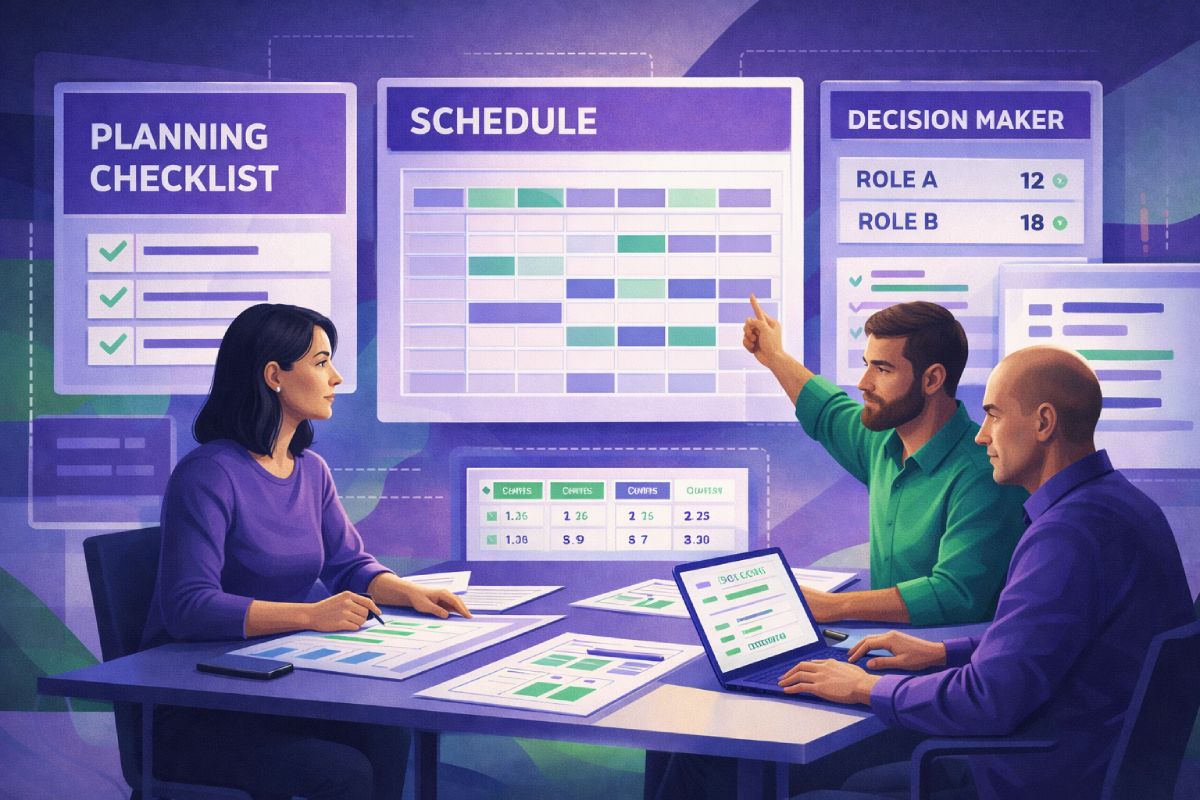
Event Scope and Constraints
Every plan needs clear boundaries. Without them, decisions drift and responsibilities blur.
At this stage, teams should be aligned on:
- Event objectives
What the event is expected to deliver, both for the client and for attendees. - Client requirements
Brand standards, service levels, reporting needs, and any non-negotiables. - Budget boundaries
Where spend is fixed, where it is flexible, and what trade-offs are acceptable. - Location constraints
Access times, load-in rules, site restrictions, and local regulations. - Capacity limits
Maximum attendance, staff-to-guest ratios, and space limitations.
A clear scope prevents later conflicts between what was promised and what is possible.
Workforce Planning Assumptions
Workforce planning starts with assumptions. If those assumptions are wrong, everything built on top of them becomes fragile.
Before moving forward, teams should define:
- Roles required
What roles are needed and what each role is responsible for. - Skill levels
Which roles require trained or certified staff and which do not. - Expected volumes
How many people are needed per role and per shift. - Shift patterns
Start times, end times, overlaps, and handovers. - Peak pressure points
Times when volume, complexity, or risk is highest.
This clarity makes it possible to plan staffing realistically instead of reactively.
Early Risk Identification
Risk is easiest to manage before commitments are locked in. A plan an event checklist should surface risks early, not record them after the fact.
Key areas to review include:
- Single points of failure
One person, one supplier, or one process on which everything depends. - Supplier dependencies
Where delays or changes upstream would affect delivery. - Weather or access risks
Outdoor exposure, transport limits, or restricted entry times. - Compliance exposure
Licensing, health and safety requirements, and workforce checks.
Identifying these risks early gives teams options. Leaving them until later removes choice and increases pressure.
Example: Event Scope and Constraints
Large outdoor festival delivery
At Glastonbury Festival, early planning decisions around site access and capacity shape everything that follows. Load-in schedules are locked weeks in advance. Certain areas of the site are restricted once the gates open. If scope and access constraints are not agreed early, suppliers cannot move equipment or staff when needed.
This is why scope and location constraints must be defined before bookings are confirmed. Once those limits are missed, no amount of on-the-day coordination can fix them.
What this reinforces
- Location constraints are not admin details
- They directly affect workforce timing and logistics
2. Scheduling Phase Checklist (Where Most Problems Start)
Most delivery issues can be traced back to this phase. Once schedules are shared, assumptions harden into commitments. If errors exist here, they are difficult and expensive to correct later. This is why the scheduling phase sits at the centre of any effective event coordinator checklist.
Scheduling is not just about filling shifts. It reflects whether planning assumptions were realistic and whether teams still have room to adapt.
Role-Based Scheduling
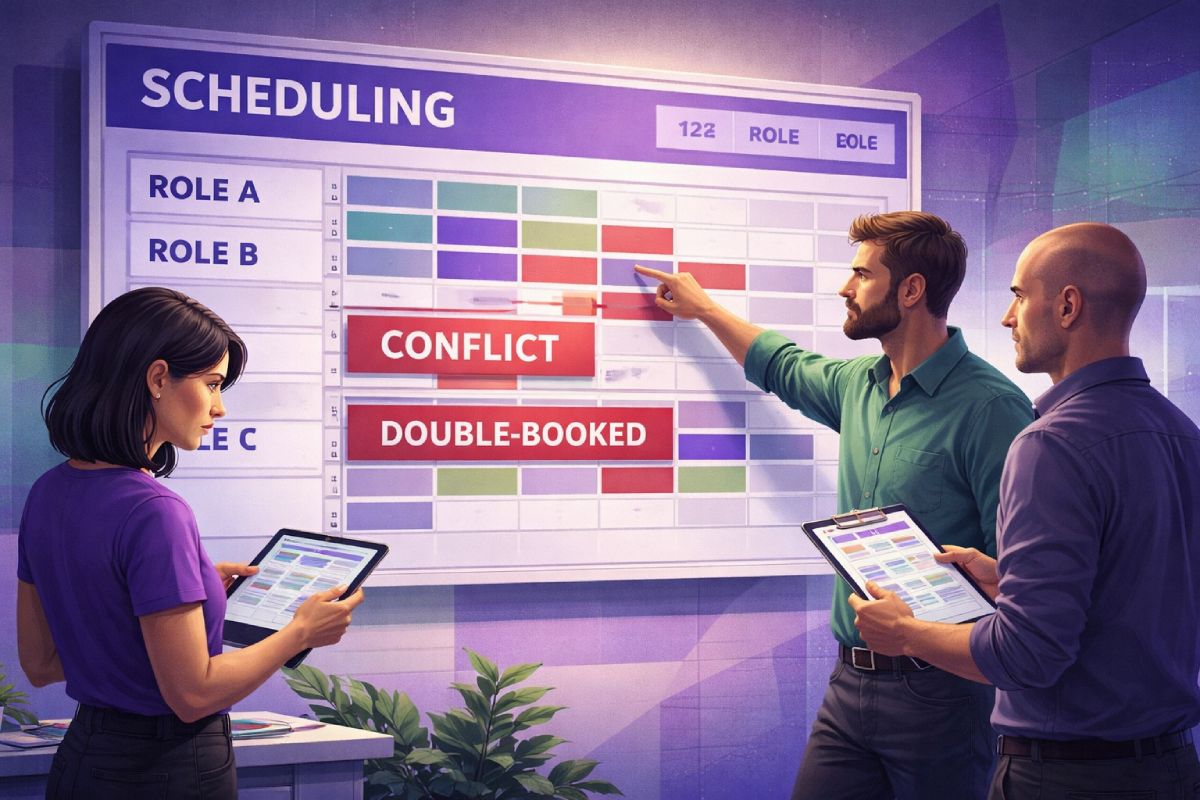
Scheduling works when roles are defined clearly and matched properly. It breaks down when speed takes priority over fit.
At this stage, teams need to ensure:
- Skills match roles
Staff are assigned based on what the role actually requires, not just availability. - Double bookings are avoided
People working across multiple events or clients are checked properly before confirmation. - Availability conflicts are resolved early
Conflicts are addressed while alternatives still exist, not on the day.
When role based scheduling is rushed, teams end up reshuffling at the last minute, increasing stress and reducing reliability.
Communication and Briefings
Scheduling decisions only work if the right information reaches the right people at the right time. A strong event preparation checklist treats communication as part of scheduling, not a separate task.
Teams should be clear on:
- What information do staff need
Role details, timings, location, dress code, and expectations. - When they need it
Early enough to prepare, but close enough to remain accurate. - How updates are confirmed
Not just sent, but acknowledged, so changes do not go unnoticed.
Poor communication creates confusion, even when schedules are technically correct.
Compliance and Documentation
Compliance checks often happen alongside scheduling, which makes this a high-risk area when teams are under time pressure.
Before schedules are finalised, teams should confirm:
- Right-to-work checks
Completed and valid for the duration of the event. - Certifications
In-date and appropriate for the role being assigned. - Health and safety acknowledgements
Delivered, understood, and recorded.
When compliance is left until later, teams lose flexibility. Issues that could have been resolved quietly become urgent problems.
Example: Role-Based Scheduling and Availability Conflicts
Major public street event
At the Notting Hill Carnival, stewarding and crowd management roles require specific experience and accreditation. In past editions, organisers and suppliers have publicly acknowledged challenges around steward availability and late confirmations, particularly where individuals were working across multiple events during the same summer period.
When role requirements and availability conflicts are not resolved early, teams are forced to reshuffle assignments close to delivery. This increases pressure on experienced staff and reduces overall coverage in high-risk areas.
What this reinforces
- Availability conflicts often exist weeks in advance
- Late scheduling changes are usually the result of early assumptions
- Role-based scheduling needs to happen before confirmations go out
3. Event Logistics Checklist (Making the Plan Executable)
A plan only becomes real when it can be executed on site. This is where many events lose control, even when earlier planning was solid. An effective event logistics checklist ensures that people, equipment, and information move as expected once delivery begins.
Logistics is not about reacting quickly. It is about removing uncertainty before teams arrive on site.

Location and Access
Access rules shape everything that happens on the day. When they are unclear or poorly communicated, delays cascade quickly.
Teams need confirmed details on:
- Load-in times
Exact windows for staff, vehicles, and equipment, including cut-off points. - Accreditation
Who needs access, which zones they can enter, and how passes are issued. - Site access rules
Restrictions on movement, security procedures, and local regulations. - Equipment movement
Routes, handling requirements, and storage locations.
Without this clarity, staff arrive too early, too late, or are unable to access the areas they are assigned to support.
On-Site Coordination
Once delivery starts, responsibility must be obvious. Confusion over who is in charge creates delays and inconsistent decisions.
An effective logistics checklist makes clear:
- Who is in charge on-site
One named lead responsible for operational decisions. - Escalation paths
What happens when issues arise, and who makes the final call. - Contact lists
Up-to-date details for key staff, suppliers, and venue contacts. - Real-time updates
How changes are shared and how receipt is confirmed.
Strong coordination reduces the need for reactive problem solving and keeps teams aligned under pressure.
Contingency Planning
Contingencies are not signs of pessimism. They are signs of experience. Events rarely fail because of one large issue. They fail because small issues stack up with no buffer.
Logistics planning should account for:
- No-shows
Cover options and decision thresholds. - Delays
Transport, access, or supplier timing issues. - Supplier failure
What happens if a critical service is late or unavailable. - Weather disruption
Changes to access, schedules, or staffing needs.
When contingencies are agreed in advance, teams act with confidence instead of hesitation.
Example: Location, Access, and Equipment Movement
Large-scale urban music festival
At BST Hyde Park, access windows and load-in schedules are tightly controlled due to the park’s location and local authority restrictions. Suppliers and staffing teams must work within fixed delivery times, specific vehicle routes, and strict equipment movement rules to minimise disruption to the surrounding area.
When access rules are not clearly communicated or understood by all teams, delays during load-in quickly affect setup schedules, staffing deployment, and safety checks. These issues are rarely solvable on site, because access permissions and vehicle movements are locked in advance.
What this reinforces
- Location constraints directly affect workforce timing
- Access rules are operational dependencies, not background details
- Logistics planning must happen before teams arrive on site
4. Event Health and Safety Checklist (Non-Negotiable)
Health and safety is not a box to tick at the end of planning. It is a live operational requirement that affects how an event is staffed, scheduled, and delivered. A proper event health and safety checklist exists to protect people and keep control when conditions change.
When safety planning is rushed or treated as static, teams lose the ability to respond calmly under pressure.
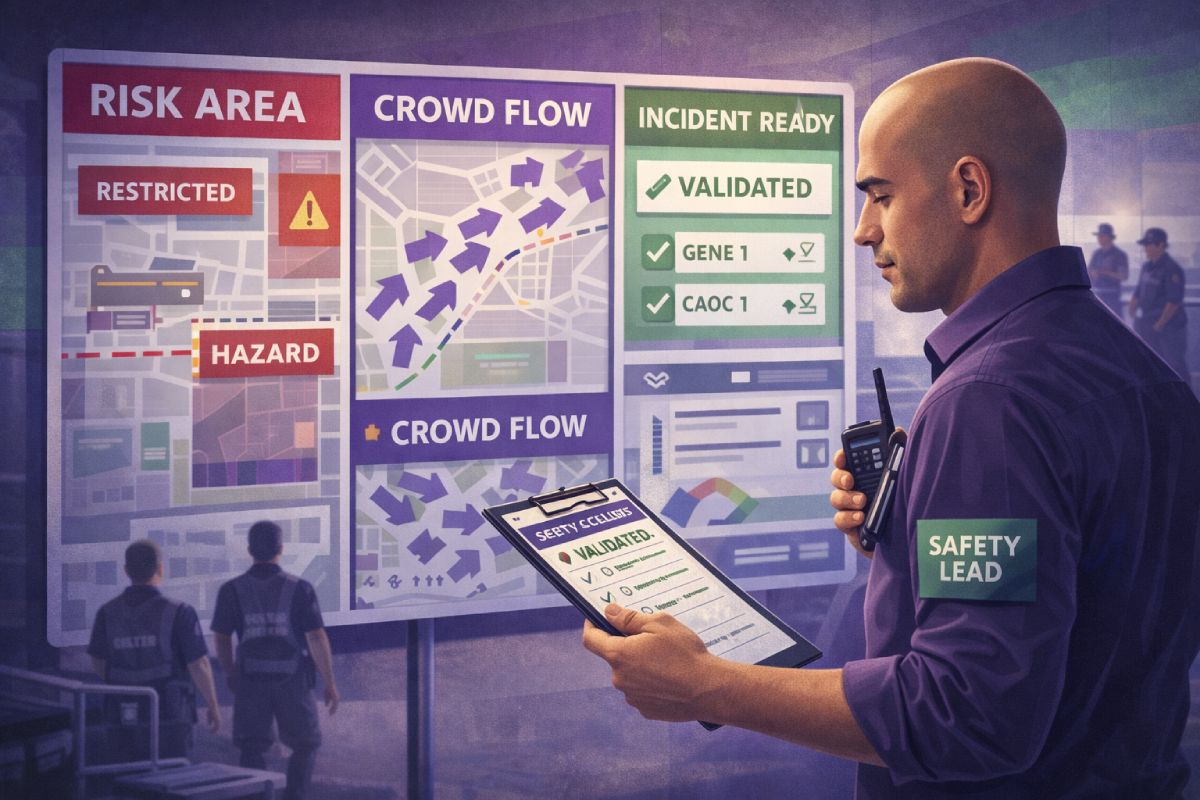
Risk Assessments
Effective risk assessments are specific to the event being delivered. Generic documents see hazards in theory, but miss how they appear in practice.
At this stage, teams need to identify:
- Event-specific hazards
Site layout, temporary structures, equipment, lighting, noise, or environmental factors. - Workforce exposure
Where staff are most at risk due to role, timing, fatigue, or crowd density. - Public interaction risks
Points where staff and attendees mix, queue, or move through shared spaces.
Risk assessments should reflect how the event will actually run, not how it was first imagined.
Briefings and Acknowledgement
Safety information only works if it is understood. Sending a document is not the same as briefing a workforce.
Teams should be clear on:
- How safety information is delivered
Briefings, written instructions, or on-site inductions, depending on the role. - How understanding is confirmed
Acknowledgements, confirmations, or checks that staff know what to do. - What happens when plans change
How updates are shared if layouts, timings, or conditions shift.
When safety briefings are unclear or outdated, staff are forced to make decisions without guidance.
Incident Readiness
Incidents are rare, but readiness must be constant. Teams need to know what happens before something goes wrong.
A strong checklist defines:
- Reporting processes
How incidents are logged and escalated. - On-site responsibility
Who takes control when an issue occurs. - Post-incident follow-up
What happens after the event is to review, record, and improve future planning.
Clear incident readiness reduces hesitation and ensures issues are handled consistently.
Example: Event-Specific Risk and Crowd Interaction
Music and arts festival
At the Love Parade in 2010, poor crowd flow planning and insufficient risk assessment around access routes led to fatal crowd compression. Subsequent investigations highlighted failures in understanding how people would move through constrained spaces and how staff should intervene when conditions changed.
While this was an extreme case, it is widely cited in UK event safety guidance as an example of why generic risk assessments are not enough. Crowd behaviour, site layout, and staff positioning must be assessed together, and plans must reflect real movement patterns, not theoretical ones.
What this reinforces
- Risk assessments must reflect actual site conditions
- Public interaction risks cannot be treated as secondary
- Safety planning must consider how people really behave
5. Delivery Phase Checklist (On-the-Day Control)
By the time the event day arrives, most decisions should already be made. The delivery phase is not the moment to rethink the plan. It is the moment to confirm, monitor, and respond with discipline. Calm delivery is the result of earlier control.
This phase is about visibility and restraint. Teams that try to “fix” the plan on the day usually introduce more risk than they remove.
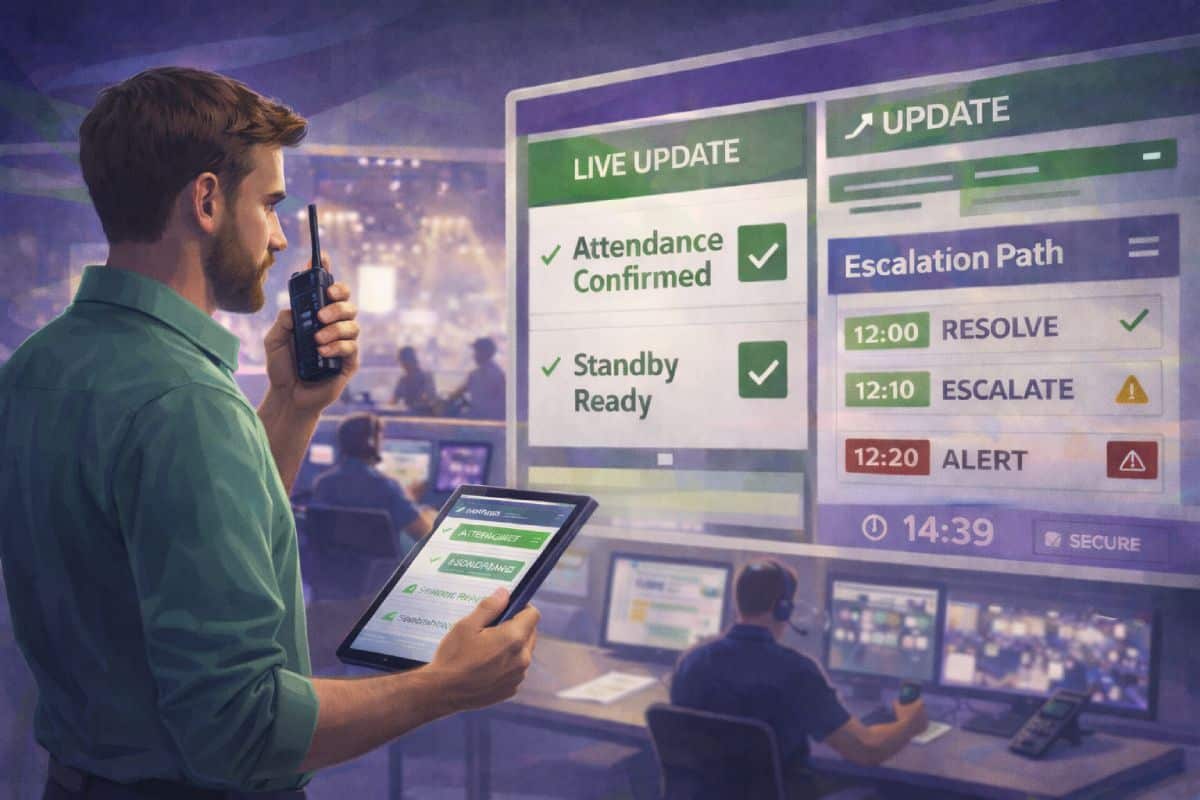
Workforce Check-In
The first priority on the day is knowing who is actually on site and ready to work. Assumptions made during planning must now be confirmed.
Teams need clear processes for:
- Attendance confirmation
Knowing exactly who has arrived, who is en route, and who is missing. - Late arrivals
Agreed thresholds for action and clear decisions on when to escalate. - Standby coverage
Pre-approved options for covering gaps without disrupting the wider plan.
When attendance is unclear, everything downstream becomes reactive.
Live Communication
On the day, communication must be controlled and purposeful. Too much information creates noise. Too little creates uncertainty.
Teams should manage:
- Shift changes
Confirmed, authorised, and clearly communicated. - Updates
Shared in a consistent way so everyone receives the same message. - Issue escalation
Clear rules for what gets escalated and who makes the call.
Effective communication keeps small issues from becoming visible problems.
Maintaining Oversight
Strong delivery teams know what still needs attention and what should already be locked down.
On the day, focus should be on:
- What needs monitoring
Attendance, access flow, safety conditions, and timing. - What should already be locked down
Roles, responsibilities, schedules, and access permissions. - What should not be changing now
Core staffing plans, safety procedures, and command structure.
Resisting unnecessary changes is often the hardest discipline on the day. It is also one of the most important.
Example: Workforce Check-In and Live Communication
Large national sporting event
At events such as the FA Cup Final, delivery relies on thousands of temporary staff across stewarding, hospitality, and operations. Public reporting around major fixtures has consistently highlighted that late arrivals or last-minute role changes are not unusual, especially where transport disruption or security delays occur.
Events that run smoothly are those where attendance is confirmed early, escalation thresholds are clear, and standby plans are already agreed. Where this control is missing, teams spend the opening hours chasing information instead of managing delivery.
What this reinforces
- On-the-day issues are expected, not exceptional
- Early attendance confirmation reduces panic
- Clear escalation keeps small gaps from spreading
6. Post Event Checklist (Where Teams Win or Lose Time)
What happens after the event matters more than most teams realise. This is where good operations compound and poor ones repeat the same mistakes. A strong checklist for an event does not stop at delivery. It closes the loop.
When post-event steps are rushed or skipped, teams carry unresolved issues straight into the next project.

Timesheets and Validation
Accurate records protect both the business and the workforce. The longer validation is delayed, the harder it becomes to resolve issues cleanly.
Post-event checks should confirm:
- Hours worked
Actual time worked versus planned schedules. - Disputes
Any discrepancies flagged early, while details are still fresh. - Approval flows
Clear sign-off so records are final, not provisional.
Delays here create avoidable friction and increase admin effort later.
Debriefs and Learnings
Every event produces insight. The difference is whether it is captured or forgotten.
Teams should review:
- What went wrong
Issues that caused disruption, delay, or unnecessary pressure. - What worked
Decisions or processes that improved delivery. - What needs fixing next time
Gaps that can be addressed through better planning or clearer control.
This does not need to be long or complex. It needs to be honest and specific.
Updating the Checklist
A checklist only improves if it evolves. Post-event learning should feed directly back into the process.
This means:
- Turning experience into process
Updating steps, timing, or ownership based on what actually happened. - Improving future delivery
Reducing reliance on memory and individual judgment.
Teams that update their checklist after every event reduce risk over time. Teams that do not are forced to relearn the same lessons under pressure.
Example: Timesheets, Validation, and Scale
Global multi-venue sporting event
Following the London 2012 Olympic Games, post-event reporting highlighted the scale of workforce coordination required across venues, suppliers, and contractors. With tens of thousands of temporary staff involved, accurate validation of hours and roles was essential to closing out operations and contracts.
Where records were reconciled quickly, teams avoided prolonged disputes and administrative backlog. Where validation was delayed, resolving discrepancies became more time-consuming and costly due to the volume of people involved and the time elapsed since delivery.
What this reinforces
- Post-event validation protects time and trust
- Delays increase admin effort exponentially at scale
- Clean close-out enables faster readiness for the next project
How to Use This Event Planning Checklist at Scale
A checklist that works for one event can quickly fall apart when teams are running several at the same time. Scale introduces more clients, more locations, more staff, and more change. This is where structure matters most.
Using this event planning checklist at scale is not about adding more steps. It is about applying the same controls consistently, even as complexity increases.
One-Off Events vs Repeat Operations
One-off events often rely on experience and improvisation. Repeat operations cannot. When events are delivered regularly, small inefficiencies turn into ongoing pressure.
For repeat work, the checklist should be treated as a baseline. Core steps stay the same. Only event-specific details change. This allows teams to move faster without skipping critical controls.
For one-off events, the checklist provides discipline. It prevents important steps from being missed simply because the event feels unfamiliar or different.
Adapting Without Losing Control
No two events are identical. The risk comes from adapting too freely.
Effective teams adapt the inputs, not the structure. Roles, timings, locations, and volumes change. Ownership, dependencies, and checkpoints do not. This keeps planning flexible without becoming inconsistent.
When teams change the structure of the checklist for every event, knowledge is lost and mistakes are repeated. Consistency is what allows adaptation to work.
Keeping a Single Source of Truth
Scale breaks down when information is spread across documents, inboxes, and messaging apps. Different teams start working from different versions, and confidence disappears.
A single source of truth keeps everyone aligned. Planning, scheduling, updates, and confirmations live in one place. Changes are visible. Ownership is clear. Outdated information is removed rather than forwarded.
This reduces noise, shortens decision time, and lowers the risk of last-minute surprises.
Why This Matters Operationally
At scale, control comes from clarity, not effort. Centralised planning makes it easier to see what is happening across events. Clear ownership prevents assumptions. Fewer disconnected tools reduce handovers and errors.
Teams that apply these principles spend less time chasing information and more time delivering reliably, even under pressure.
Download the Event Planning Checklist PDF
This guide is designed to be read. The checklist is designed to be used.
The downloadable event planning checklist PDF turns the guidance above into a practical working tool that can be applied to live projects. It is built for agencies and suppliers managing real delivery pressure, not theoretical planning.
The PDF includes:
- All checklist phases
Planning, scheduling, logistics, health and safety, delivery, and post-event. - Ownership fields
Clear space to assign responsibility for each step. - Timing markers
Prompts for when actions must be completed to avoid knock-on issues. - Notes and sign-off sections
Room to capture decisions, changes, and confirmations as the event progresses.
Used properly, the checklist helps teams spot risks early, stay aligned as plans change, and avoid last-minute confusion.
- Download the checklist.
- Use it at your next event.
- Reduce last-minute chaos.
Frequently asked questions
1. What should an event planning checklist include?
An effective event planning checklist should cover planning, scheduling, logistics, health and safety, delivery, and post-event close-out. It must define timing, ownership, and dependencies, not just list tasks, to prevent last-minute issues.
2. Why do most event checklists fail during live delivery?
Most event checklists fail because they focus on tasks instead of control. They often ignore workforce readiness, version control, and ownership, which leads to gaps that only appear once the event is already underway.
3. How early should an event planning checklist be used?
An event planning checklist should be used before anything is booked. Starting early allows teams to define scope, roles, risks, and constraints while there is still time to adjust plans without disruption.
4. How is an event planning checklist different from an event management checklist?
An event planning checklist focuses on controlling decisions before delivery, while an event management checklist often documents activity during delivery. The most effective approach combines both into a phased checklist that runs from planning through post-event review.
5. Can an event planning checklist be used across multiple events?
Yes. A well-structured event planning checklist is designed to scale across multiple events and clients. Using a centralised system like Liveforce helps teams keep a single source of truth, assign ownership clearly, and reduce reliance on disconnected tools.