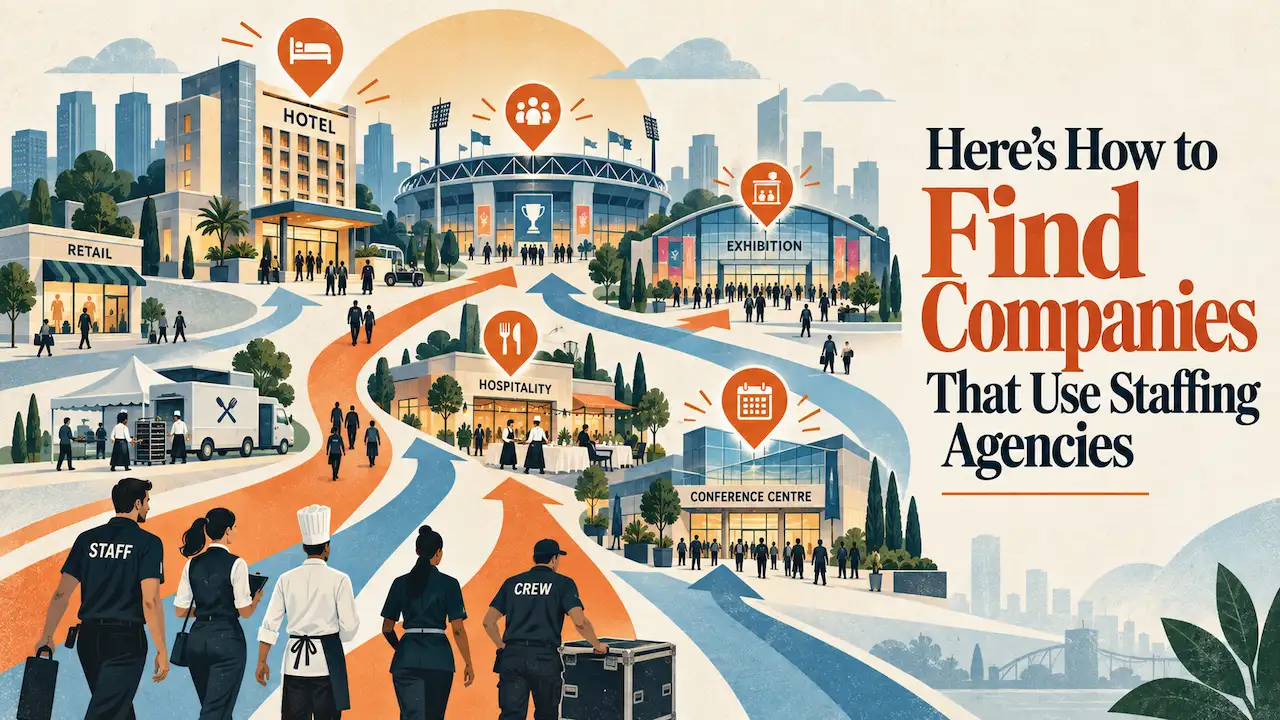
Finding companies that use staffing agencies is not about luck, cold guessing, or scraping endless lists.
It is about recognising patterns.
Businesses that rely on staffing agencies leave clear signals in how they hire, how they communicate roles, and how they structure their operations. These signals are public. The challenge is knowing where to look and how to interpret what you see.
This guide explains how to find companies that use staffing agencies by breaking down the most reliable signals, one method at a time. Each section focuses on a single approach and goes deep, so you understand not just what to do, but why it works.
Why does this question keep coming up
Many companies do not openly say, “We use staffing agencies.”
Some do not want to discourage direct applicants. Others want flexibility. Some operate under procurement frameworks that limit public disclosure. As a result, people researching agency usage often get vague advice that sounds helpful but leads nowhere.
In practice, companies that outsource hiring tend to behave in consistent ways. Once you understand those behaviours, the research becomes much easier and far more accurate.
How job boards reveal agency hiring activity
Job boards are one of the strongest indicators of agency usage, but only if you know how to read them properly.
Many companies that use staffing agencies do not post roles themselves. Instead, agencies post on their behalf. This creates identifiable signals in job listings.
What to look for:
Agency-managed job posts often include language such as:
- “Our client is looking for…”
- “We are recruiting on behalf of…”
- “A leading company in the sector requires…”
The hiring company name may be missing, partially obscured, or replaced with a generic description like “a global manufacturer” or “a fast-growing logistics business”.
This is not accidental. Agencies do this to protect their client relationships and prevent direct approaches.
How to research this properly:
Start by searching job boards for roles in a specific industry or location. Then:
- Open multiple listings with similar job titles.
- Compare the wording and structure.
- Look for repeated agency branding across different companies or locations.
If the same recruitment firm is advertising many similar roles across multiple sites, that is a strong signal of ongoing agency reliance rather than one-off hiring.
Why this works:
Companies that hire directly tend to:
- Use consistent branding.
- Link back to their own careers page.
- Provide clear internal job references.
Agency-led hiring looks different. It prioritises speed and volume over brand voice. Once you see the difference, it becomes obvious.
Real Examples:
“Our client is looking for a hands-on Operations Coordinator to support a fast-growing business during a period of expansion.”
“We are recruiting on behalf of a well-established professional services organisation seeking an experienced Sales Director.”
What company career pages quietly disclose
Company career pages often reveal more than people expect.
Even businesses that prefer agency hiring usually keep a careers page for branding, compliance, or investor reasons. The key information is often not on the job listings themselves, but in the fine print.
What to look for:
Scroll beyond the open roles and check:
- The footer.
- The “Recruitment” or “Hiring process” section.
- Equal opportunities or data protection statements.
Phrases such as:
- “We work with a preferred set of recruitment partners”
- “Unsolicited CVs from agencies will not be accepted”
- “All recruitment is managed through approved suppliers”
These are strong signals that the company uses staffing agencies, often through a preferred supplier list.
How to interpret this correctly:
A company that explicitly mentions recruitment partners is not experimenting with agencies. It has already made a structural decision to outsource part or all of its hiring.
This is common in:
- Large corporates.
- Regulated industries.
- Businesses with high turnover or seasonal demand.
The absence of this language does not mean agencies are not used. But its presence is a clear confirmation.
Real Example:
“Please note unsolicited CVs from agencies will not be accepted.”
How recruitment agency websites expose their client base
Recruitment agencies often reveal more about their clients than the clients themselves do.
Agency websites are designed to attract both candidates and new business. Client logos, case studies, and sector pages are all valuable research tools.
What to analyse:
Look at:
- “Our clients” pages.
- Case studies.
- Testimonials.
- Sector-specific landing pages.
Pay attention to patterns rather than individual logos. If an agency specialises in warehousing, hospitality, or healthcare and showcases long-term client relationships, those clients almost certainly rely on agency staffing regularly.
Reading between the lines
Agencies rarely publish full client lists. However, repeated references to:
- Ongoing volume hiring.
- Multi-site delivery.
- Seasonal scaling.
These descriptions indicate embedded agency relationships rather than ad-hoc support.
If a company appears across multiple agency sites within the same sector, that is an even stronger signal.
Real Example:
“Supporting high-volume hiring across multiple sites with a scalable workforce solution.”
What LinkedIn activity shows about outsourced hiring
LinkedIn is often used incorrectly for this type of research. The key is not job ads, but people and behaviour.
Start with job titles
Search for employees at a company with titles such as:
- Talent Partner
- Resourcing Manager
- Recruitment Business Partner
Then review their activity. Posts thanking recruitment partners, sharing agency vacancies, or promoting external hiring campaigns all suggest agency involvement.
Look at company posts and comments
Companies that work closely with staffing agencies often:
- Share agency job posts.
- Comment on agency updates.
- Announce partnerships or supplier awards.
This is especially common during:
- Rapid growth phases.
- New site launches.
- Seasonal demand spikes.
Why LinkedIn is reliable
LinkedIn reflects operational reality more than polished corporate messaging. People post what is happening now. When agencies are involved, they tend to show up in conversations, comments, and shared content.
How procurement frameworks confirm agency reliance
In the UK and many global markets, larger organisations must use approved procurement frameworks to hire staffing agencies.
These frameworks are public.
Where to look:
UK examples include:
- Government procurement portals. (Contracts Finder, Find a Tender)
- Public sector framework agreements. (Crown Commercial Service frameworks, NHS Workforce Alliance)
- Crown Commercial Service listings. (Crown Commercial Service supplier frameworks)
Internationally, similar systems exist across Europe, Australia, and parts of North America.
If a company appears as a participant or buyer within a staffing or recruitment framework, it is actively using agencies or has committed to doing so.
Why this matters:
Framework participation requires:
- Budget approval.
- Legal review.
- Ongoing usage to justify inclusion.
This is not speculative hiring. It confirms structured, repeat agency engagement.
When hiring volume becomes the signal
Sometimes the clearest indicator is scale.
High-volume hiring is difficult to manage internally. When roles are repeated, time-sensitive, or geographically spread, companies tend to outsource.
Patterns to watch for:
Look for:
- Dozens of similar roles are posted at once.
- Constant re-advertising of the same positions.
- Rapid hiring across multiple locations.
Industries where this is common include:
- Logistics and warehousing.
- Hospitality and events.
- Manufacturing.
- Healthcare.
- Customer service and contact centres.
Interpreting this correctly
High volume alone does not guarantee agency usage. Some companies build large internal teams.
However, when high volume is combined with:
- Generic job descriptions.
- Agency-style language.
- Multiple third-party postings.
The likelihood of agency involvement is high.
What most people get wrong
The biggest mistake is relying on one signal.
No single method is definitive on its own. Job boards, LinkedIn, career pages, and agency sites each show part of the picture. Experienced researchers combine them.
Another common error is assuming silence means no agency usage. Many companies deliberately keep agency relationships low-profile.
Finally, people often confuse one-off agency use with structural reliance. The difference matters. Long-term agency users behave consistently over time.
How experienced teams apply this thinking
Teams that do this well follow a simple approach:
- Start with one method.
- Look for confirmation elsewhere.
- Build confidence through repetition, not assumptions.
They track patterns over weeks, not minutes. They focus on behaviour, not claims. Over time, the signals become clear.
Bringing it all together
Learning how to find companies that use staffing agencies is about understanding how modern hiring works in practice.
Companies reveal their hiring models through:
- How roles are advertised.
- How careers pages are written.
- How agencies present their work.
- How people talk about recruitment publicly.
- How procurement is structured.
When you combine these signals, agency usage stops being a mystery. It becomes observable, predictable, and verifiable.
The most reliable insights come from patience and pattern recognition, not shortcuts. That is what separates surface-level research from work that actually leads somewhere.
Agency-led hiring examples
Examples are illustrative, not exhaustive. Companies may use staffing agencies for specific roles, locations, or periods.
| Sector | Example company | Typical agency use case | Public signal to look for |
|---|---|---|---|
| Retail | Tesco | Seasonal store and warehouse staff | High-volume agency job ads during peak periods |
| E-commerce & logistics | Amazon | Fulfilment centre operatives | Repeated third-party listings across multiple locations |
| Hospitality | Marriott International | Event and temporary hospitality staff | Agency case studies and sector-specific agency pages |
| Manufacturing | Unilever | Production and packaging cover | Supplier policies and framework participation signals |
| Logistics | DPD | Drivers and depot staff | Agency-posted roles across multiple regions |
| Healthcare | NHS | Clinical and non-clinical bank staff | Public procurement and workforce frameworks |
| Facilities management | ISS | Cleaning and support staff | Ongoing agency recruitment campaigns |
| Food production | Greencore | Temporary production line workers | Seasonal scaling language in agency job ads |
| Construction | Balfour Beatty | Project-based site labour | Agency involvement tied to specific projects |
| Customer service | Teleperformance | Contact centre agents | Repeated outsourced hiring campaigns |
Frequently asked questions
How can you tell if a company uses a staffing agency?
Companies that use staffing agencies often show patterns such as agency-written job ads, repeated third-party postings, recruitment partner disclosures, or public interaction with recruiters.
Do all large companies use staffing agencies?
No. Some large organisations hire entirely in-house, but many use agencies for high-volume, specialist, seasonal, or location-based roles.
Are companies required to disclose their staffing agencies?
In most cases, no. However, public sector organisations and regulated industries often disclose agency use through procurement frameworks or supplier policies.
Can job boards reliably show agency hiring?
Yes, when patterns are tracked over time. Single job posts are unreliable, but repeated agency listings for similar roles are a strong signal.
Is there one definitive way to confirm agency use?
No. Reliable confirmation comes from combining multiple signals rather than relying on one source alone.
Resources:
The following resources are useful for researching whether companies use staffing agencies. All are publicly available and widely used by recruitment, sales, and operations teams.
Job boards and hiring platforms
- LinkedIn Jobs – Useful for spotting agency-posted roles, hiring volume patterns, and recruiter activity.
- Indeed – Strong signal source for high-volume and repeat agency hiring.
- Glassdoor – Job listings and reviews sometimes reference agency-led hiring processes.
- Google Jobs – Aggregates postings from agencies and employers, helpful for pattern comparison.
Company and employer research
- Company career pages and recruitment policy statements.
- “Work with us” and “Recruitment partners” sections, often found in site footers.
Recruitment agency research
- Recruitment agency websites and case study pages.
- “Clients we work with” and sector-specific landing pages.
- Industry-focused agencies in logistics, hospitality, healthcare, manufacturing, and events.
Professional and social platforms
- LinkedIn company pages – Posts, comments, and shared vacancies often reveal agency involvement.
- Employee profiles with titles such as Talent Partner or Recruitment Business Partner.
Procurement and public sector data (UK-focused)
- GOV.UK procurement notices – Confirms approved staffing suppliers and framework usage.
- Crown Commercial Service frameworks – Lists organisations authorised to use staffing agencies at scale.
Labour market and industry context
- Office for National Statistics (ONS) – Employment trends and workforce data.
- CIPD – Research on hiring practices and workforce strategy.
- Staffing Industry Analysts (SIA) – Global insights into agency usage and staffing models.