Most temp staffing agency software was built for recruitment firms. It tracks candidates, manages placement pipelines, and handles client billing cycles.
For agencies that place permanent or long-term contract workers, these tools work well. But event staffing agencies operate in a different world. Their problem is not sourcing people. It is managing hundreds of temporary workers across live events, multiple clients, and shifting schedules, often in the same week.
The gap between what recruitment-focused platforms offer and what event staffing agencies need is wider than most buyers expect. An agency running 15 events across three clients this weekend does not need a better applicant tracking system.
It needs real-time scheduling, instant communication with large freelance pools, and compliance tracking across varied client requirements. It also needs timesheet processing for variable-hour workers.
Choosing the wrong temp staffing agency software is one of the most costly decisions an agency can make. The consequences rarely show up on day one.
Why choosing the wrong software for staffing agencies costs more than it saves
The decision looks simple. An agency outgrows spreadsheets. They search for temp staffing agency software. They find dozens of platforms. Most are built for general recruitment. They pick one, import their data, and start using it.
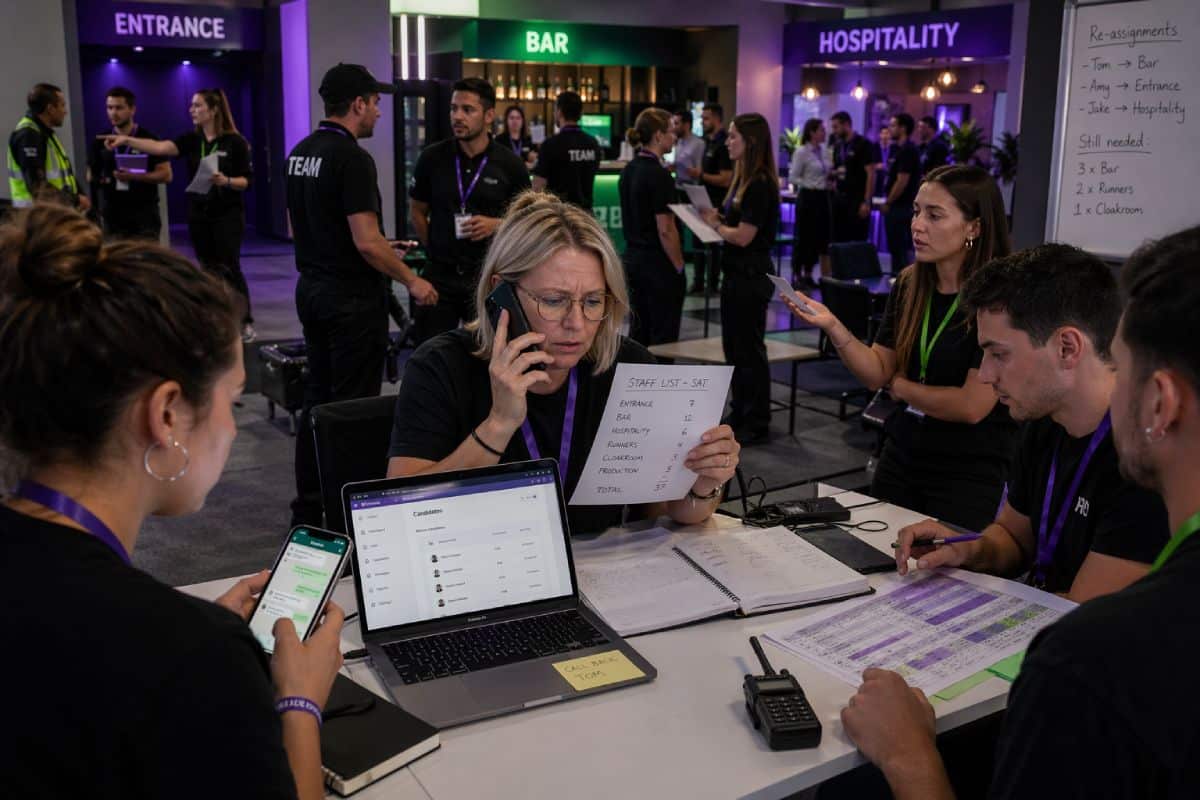
For the first few weeks, things seem fine. The system handles candidate records and basic scheduling. But then event season arrives. The agency is running multiple live events per week. Different clients have different briefing documents. Staff need shift changes communicated at short notice. Compliance requirements vary between sites.
The recruitment platform was never built for this. It tracks placements. It does not manage the operational chaos of a live event pipeline.
Agencies that choose the wrong platform do not realise it immediately. They realise it six months later when they are still running events from a WhatsApp group.
The result is a two-system problem. The agency pays for software that handles placement admin. Then it uses WhatsApp, spreadsheets, and phone calls for everything else: confirming shifts, chasing availability, sending briefing documents, collecting timesheets.
The software was supposed to replace those tools. Instead, it sits alongside them.
Why software built for recruitment does not solve temporary workforce management
Recruitment software solves a linear problem. A role opens. Candidates are sourced. Interviews happen. Someone is placed. The process has a clear beginning and end.
Temporary workforce management at scale is not linear. Shifts change daily. Workers are booked across multiple events in the same week. Availability updates constantly. An agency with 300 freelancers needs to know who is free on Saturday. They need to check who has the right compliance documents.
They need to confirm who can reach a specific venue. Recruitment platforms store this information badly, if at all. They were designed around candidate pipelines, not live operational scheduling.
What temp staffing agency software actually needs to do for event operations
Once an agency moves past the recruitment stage, the operational requirements change completely. The day-to-day work is scheduling, communication, compliance tracking, and timesheet processing, repeated across dozens of events per month.
The right platform must handle all of this from one system. Otherwise, agencies end up bolting tools together and losing visibility in the gaps between them.
Event staffing software features that matter for multi-client agencies
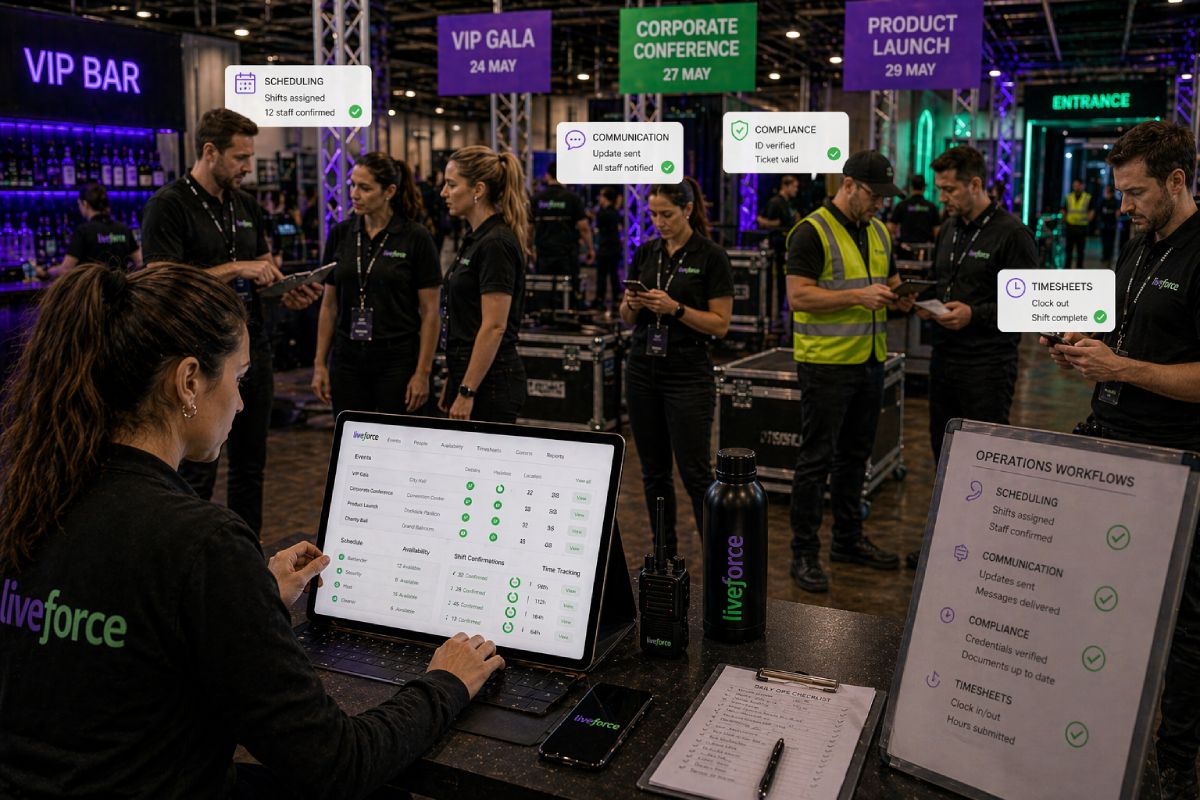
The core capabilities event staffing agencies should expect from their platform:
- Multi-event scheduling that prevents double bookings and shows real-time availability across the entire workforce, even when staff are shared between clients.
- Mass communication tools that send shift confirmations, briefing updates, and last-minute changes to specific groups of staff without relying on personal messaging apps.
- Compliance tracking that stores right-to-work documents, certifications, and client-specific requirements in one searchable system, flagging gaps before event day.
- Integrated timesheets that capture hours worked per event, per role, per client, and feed into payment processing without manual data entry or chasing paper records.
These are not advanced features. They are baseline requirements for any agency managing temporary workers across live events. The problem is that most platforms in the market treat them as add-ons or do not offer them at all.
A platform that handles recruitment well but scheduling badly is not a staffing solution. It is half of one.
Event agencies also need their platform to handle the speed of their work. A festival supplier confirming 40 staff for a weekend site needs to do that in minutes, not hours. A hospitality agency replacing a no-show at 6am needs to see who is available, qualified, and nearby. Generic recruitment tools are not built for that pace.
How to evaluate staffing agency scheduling software before committing
Most agencies evaluate temp staffing agency software by looking at feature lists. Feature lists tell a buyer what a platform can do in theory. They do not reveal what it was designed to do well.
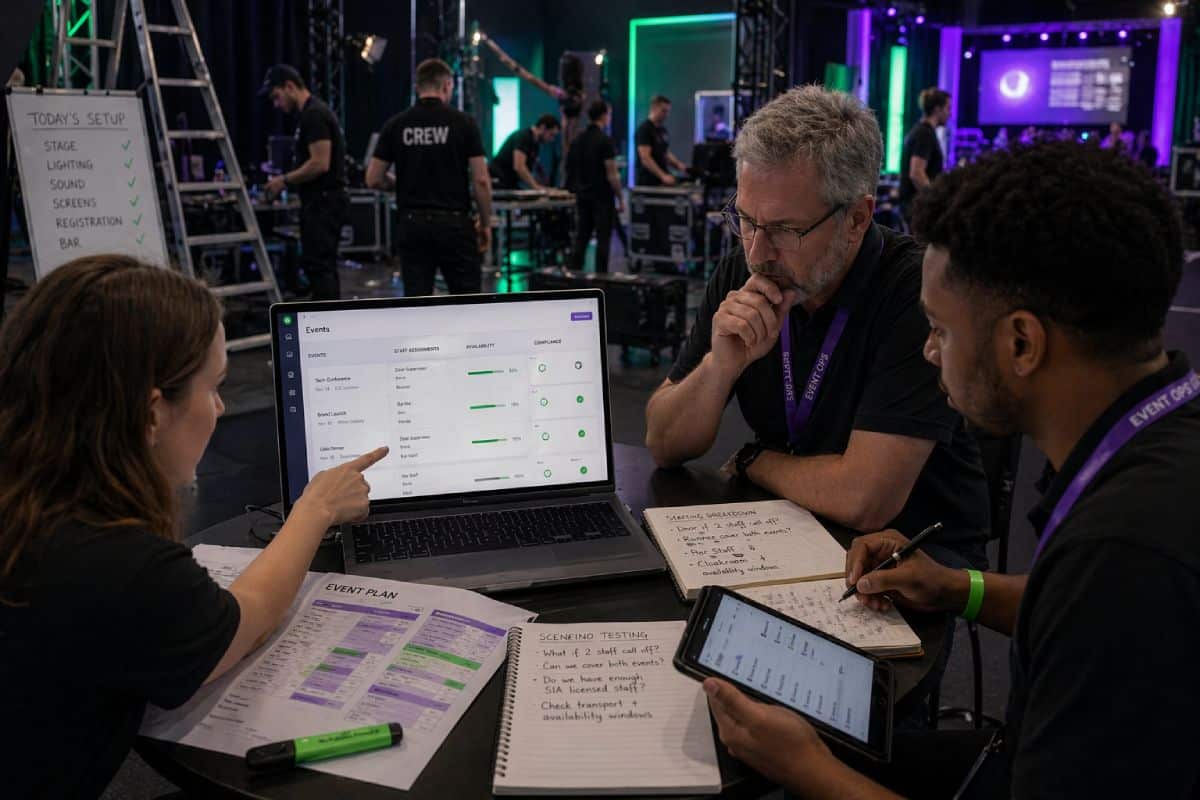
The better approach is to test the platform against real operational scenarios. Not demo data. Real events. Real staff numbers. Real client requirements.
Questions to ask when comparing a temporary workforce management platform
During any evaluation, agencies should test the platform against practical questions. These questions expose whether it was built for event operations or recruitment workflows.
First: Can the platform schedule the same worker across different events for different clients in the same week? Does it flag conflicts automatically? If the scheduling engine only handles one-to-one placements, it will not cope with multi-event agency work.
Second: Does the communication system send targeted messages to specific groups? An agency running a hospitality shift and a festival build on the same day needs to send different briefings to different teams. A single broadcast tool is not enough.
The demo is where recruitment software reveals its limits. Ask for a scenario that mirrors a busy week, not a clean setup with five staff and one event.
Third: How does the platform handle compliance? Event staffing agencies need to store and verify different documents for different clients. Some clients require DBS checks. Others need specific certifications. The system must filter staff by compliance status when building a schedule.
Fourth: Can timesheets be processed per event and per client from the same platform? Agencies billing multiple clients in a single week cannot afford to export data into a separate system for every invoice.
If the answer to any of these questions involves workarounds, the platform was not built for event staffing operations.
How recruitment software compares to event-specific workforce management
What a workforce management platform built for events looks like in practice
When the right platform is in place, the daily routine of an event staffing agency changes. The shift from fragmented tools to one operational system removes layers of manual work and guesswork.
How the right software for staffing agencies changes day-to-day operations
On a Monday morning, the operations team opens one platform. They can see every event for the week. They can see which staff are confirmed, which shifts still need filling, and which workers have compliance gaps that need resolving before Friday.
By Tuesday, shift updates have gone out to all confirmed staff via the platform. Briefing documents are attached. The hospitality team working a corporate dinner in Manchester receives different instructions to the promo team working a brand activation in London. Both messages sent from the same system. No WhatsApp groups. No lost emails.
When the platform replaces the spreadsheet, the coordinator stops being a message relay and starts being an operations manager.
On Thursday, a client calls with a last-minute change. Two extra bar staff needed for Saturday. The coordinator searches by role, availability, location, and compliance status. They find four suitable candidates and send availability requests. Three confirm within the hour through the platform. The schedule updates automatically.
After the weekend, timesheets are submitted digitally. Hours are logged per event. The finance team processes payments for three different clients from one dashboard. No chasing paper. No disputed hours.
This is what the right temp staffing agency software looks like in practice. Not a single dramatic moment. A series of small, reliable processes that compound across every event the agency runs.
How Liveforce supports event staffing agencies
Liveforce is a workforce management platform built for event-led businesses. It was designed for the exact operational challenge most platforms in this category ignore: managing what happens after workers are booked.
For agencies running multiple events across multiple clients, Liveforce replaces the combination of a recruitment platform, spreadsheets, WhatsApp, and paper timesheets with one operational system.
The scheduling engine handles multi-event, multi-client, multi-role work from a single view. When an agency is running a festival build, a corporate dinner, and a product launch in the same week, all three events sit in the same schedule. Availability conflicts are flagged automatically. This replaces the spreadsheet-and-phone-call approach that most agencies fall into when their recruitment platform cannot handle parallel scheduling.
The workforce database tracks every worker’s availability, skills, certifications, and compliance status in real time. When a coordinator needs to fill a last-minute gap, they search by criteria that matter: role, location, compliance, availability. This replaces disconnected contact lists and outdated spreadsheets that make accurate scheduling impossible at scale.
Communication runs through the platform. Shift confirmations, briefing documents, and last-minute changes reach the right staff groups directly. This replaces WhatsApp chains where critical information gets buried between unrelated messages.
Timesheet processing happens per event and per client. Workers log hours digitally. The finance workflow removes the manual reconciliation that slows down payment runs and causes disputes. This replaces the email-and-spreadsheet approach that adds hours of admin to every payroll cycle.
Liveforce does not replace the agency’s recruitment process. It replaces everything that comes after it.
Red flags to watch for when evaluating any staffing platform:
- The demo only shows recruitment workflows. If the sales team leads with candidate sourcing and ATS features, the platform was not built for operational delivery.
- Scheduling cannot handle parallel events. If the platform schedules one job at a time, it will not cope with a busy agency’s weekly workload.
- Communication relies on email only. Event staffing moves too fast for email. The platform needs instant, targeted messaging.
- Compliance is a single checkbox. Event agencies need document-level compliance tracking that varies by client and role.
- Timesheets require manual export. If hours worked cannot be processed per event and per client inside the same system, the agency will spend hours reconciling data externally.
The one question that separates the right platform from the wrong one
Every agency evaluating temp staffing agency software should ask one question during the demo:
Show me how this platform handles a week where I am running five events for three different clients with 80 staff across all of them?
If the platform handles that scenario cleanly, with scheduling, communication, compliance, and timesheets all working from one system, it was built for event staffing. If the answer involves workarounds, exports, or separate tools, it was not.
That single question saves months of frustration. The agencies that ask it early choose platforms built for their reality. The agencies that skip it spend their first year working around limitations the demo never revealed.
See how Liveforce handles a real event staffing workload
Liveforce was built for agencies that manage temporary workforces across multiple clients and events. If the platform described in this article sounds like the one the agency has been looking for, a 30-minute demo will confirm it.
Book a demo with Liveforce and see how scheduling, communication, compliance, and timesheets work from one system.
Frequently asked questions
What is temp staffing agency software?
Temp staffing agency software is a platform agencies use to schedule, manage, and communicate with temporary or freelance workers across multiple jobs and clients. It centralises operations that would otherwise rely on spreadsheets, messaging apps, and manual processes.
How is temp staffing agency software different from recruitment software?
Recruitment software focuses on sourcing candidates, managing applicant pipelines, and placing workers into roles. Temp staffing agency software focuses on what happens after placement: scheduling shifts, tracking availability, communicating changes, and processing timesheets across a live operational pipeline.
What event staffing software features should agencies prioritise?
Multi-event scheduling with conflict detection, targeted mass communication, client-specific compliance tracking, and integrated timesheet processing. These features address the operational complexity that generic recruitment tools do not handle.
Can temp staffing agency software manage multiple clients and events at the same time?
The right platform can. Event-specific workforce management software is built to schedule staff across parallel events for different clients. It prevents double bookings and gives agencies a single view of their entire operation. Recruitment-focused platforms typically handle placements one at a time.
How does Liveforce compare to other temp staffing agency software?
Liveforce is a workforce management platform built specifically for event-led businesses. Unlike recruitment-focused alternatives, it handles multi-client scheduling, targeted communication, compliance tracking, and timesheet processing from one system. It replaces the fragmented combination of a recruitment platform, spreadsheets, and messaging apps that most event agencies rely on.