Forecasting staffing needs is where most event staffing agencies lose control of their pipeline. The problem is rarely a shortage of workers. It is a shortage of visibility.
Agencies managing multiple clients and event types cannot wait until the week before a busy period to check staffing. By that point, the best people on their books are already committed elsewhere.
The agencies most likely to struggle with last-minute gaps are not the ones with the smallest rosters. They are the ones without a centralised view of upcoming demand.
When each event lives in its own spreadsheet or thread, nobody can see the full picture. Cross-event clashes go unnoticed. Availability is assumed rather than confirmed. And gaps only become visible when there is no time left to fill them.
The rest of this piece covers why forecasting staffing needs is harder for agencies than it looks. It explains where most teams go wrong and what structured forecasting looks like in practice.

Why Forecasting Staffing Needs Is Harder for Agencies Than It Looks
Single-event organisers can estimate headcount from a guest list, a floor plan, and a rough ratio. That process is straightforward because it is one event, one date, one set of requirements.
Forecasting staffing needs for an agency is a different problem entirely.
An agency running 15 events over six weeks for four clients has overlapping dates and competing requirements. The same bartender might be suitable for three of those events. The question is not whether she is qualified. It is whether she is available, confirmed, and not already booked.
The difficulty is not headcount. It is the overlap between events that share the same staff pool.
Most agencies do not set out to forecast reactively. They simply lack the tools to do it any other way. When availability lives in a WhatsApp thread and bookings sit in separate spreadsheets, forecasting staffing needs becomes guesswork. Each event gets planned in isolation. Patterns across the pipeline stay hidden.
What an Event Staffing Forecast Actually Needs to Cover
An event staffing forecast is not a headcount estimate. It is a cross-referenced view of three things: confirmed bookings, staff availability, and outstanding gaps. All three need to be visible in one place. If even one of them lives in a different system, forecasting staffing needs accurately becomes impossible.
Hospitality agencies managing festival season or experiential teams running brand activations across multiple cities face the same risk. When two events on the same date pull from the same staff pool, a gap will appear.
The only question is whether that gap is spotted three weeks in advance or three days.
What Most Agencies Get Wrong When Predicting Staffing Requirements
The most common mistake is treating each event as a standalone project. A coordinator confirms a team for Friday’s corporate dinner. Separately, another coordinator starts building a crew for Saturday’s festival shift. Nobody checks whether the same people appear on both lists.
This event-by-event approach works at small scale. Once an agency runs more than a handful of events per week, it breaks. The cracks show up as double bookings, last-minute cancellations, and panicked WhatsApp messages at 7am on event day.

How to Predict Staffing Requirements Before Gaps Appear
The fix sounds simple: check availability before confirming anyone.
In practice, most agencies skip this step because it takes too long. Forecasting staffing needs manually means calling or messaging each person individually, then cross-referencing their responses against every upcoming event.
When availability checking takes hours, it gets skipped. When it gets skipped, gaps appear.
Another common error is relying on last year’s numbers without updating for roster changes. Staff move on. New crew join the pool. Compliance documents expire. An agency that ran a 40-person team at Ascot last year might assume the same team is available this year. That assumption is often wrong.
The third failure pattern is late communication. Agencies that wait until two weeks before an event to contact staff are already behind. The most reliable workers confirm early. By the time a late request goes out, the people left are often the least experienced. They may not know the client’s requirements or the venue’s layout.
The patterns that cause forecasting to fail tend to repeat across agencies of all sizes:
- Isolated event planning. Each event is staffed in its own spreadsheet with no view across the full pipeline.
- Manual availability checks. Coordinators message staff one by one and wait for responses that may never come.
- Outdated roster assumptions. Agencies assume last season’s team is still available without confirming current availability or compliance.
- Late outreach. Staff contact happens too close to the event date, leaving no buffer for gaps or no-shows.
No cross-event visibility. Coordinators cannot see where the same staff member has been booked across overlapping events.
How Experienced Agencies Approach Staffing Levels for Events in Advance
Agencies that rarely get caught out by last-minute gaps share one thing in common. They forecast from a centralised view of everything coming up, not from individual event files.
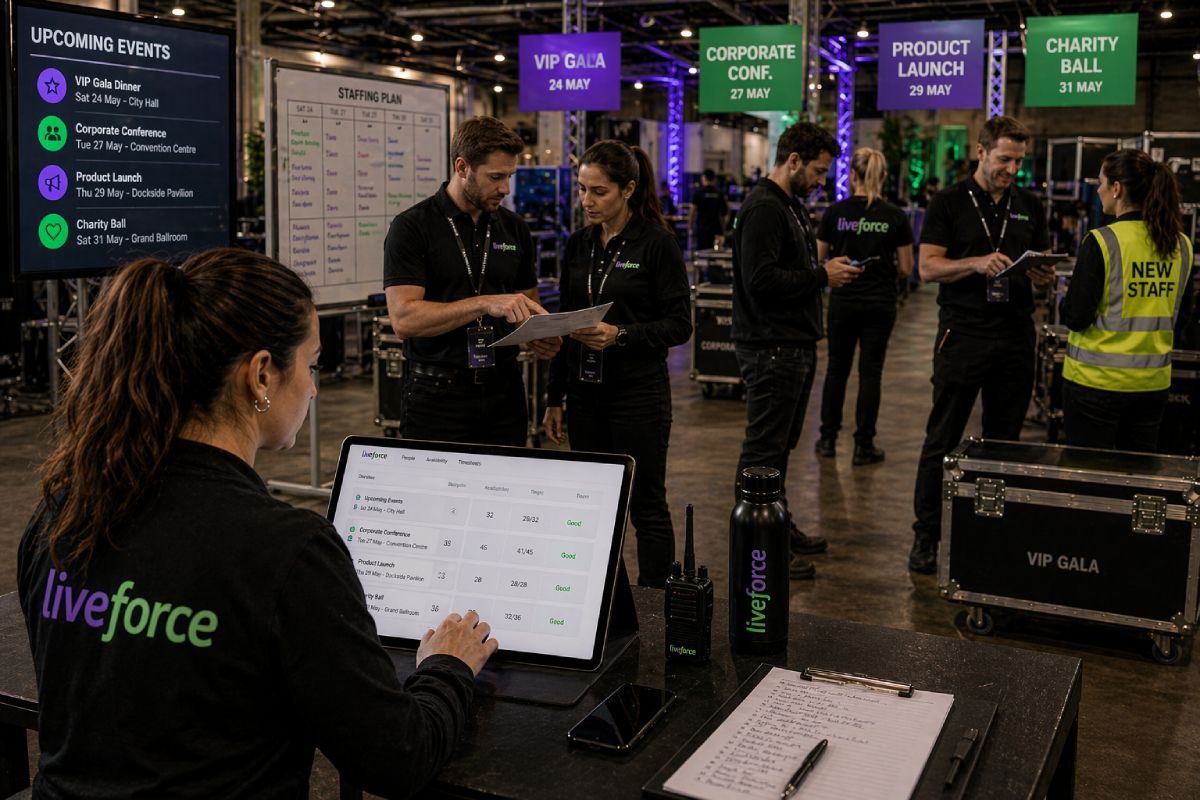
Structured forecasting starts with a rolling review of the event pipeline. Forecasting staffing needs in this way means every confirmed or likely booking is logged with its requirements. Roles, numbers, dates, locations, and compliance needs all go into the same view. This creates a forward-looking picture of demand.
Using Workforce Demand Planning to Get Ahead of Busy Periods
The value of workforce demand planning shows up most clearly during peak periods. Festival season, the Christmas corporate calendar, the summer wedding surge. These periods are predictable. The pressure they create should be too.
Agencies that forecast well do not have more staff. They have more time to find and confirm the right staff.
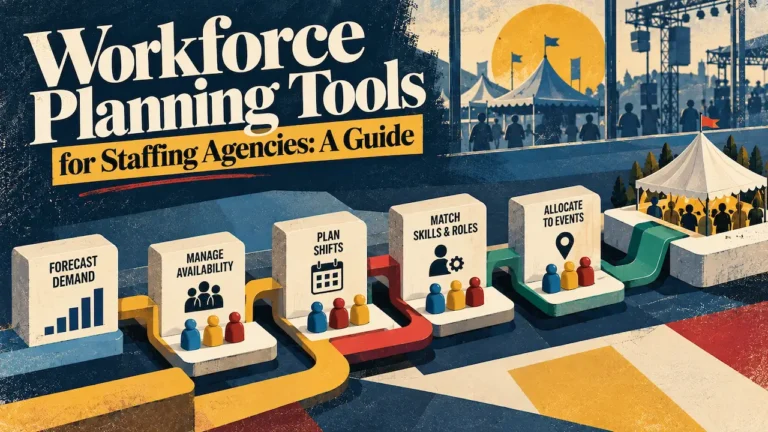
Experienced operators start by mapping confirmed and likely events for the next four to eight weeks. They then cross-reference each event’s requirements against confirmed availability in their workforce database.
Where gaps appear, they act early: reaching out to available staff, flagging shortfalls to clients, or activating backup pools.
This process works because it is repeatable. Forecasting staffing needs does not depend on one person remembering everything. It depends on having the right information visible in the right place at the right time. That is the difference between forecasting and guessing.
Agencies in the hospitality sector often run repeat shifts for the same venues each week.
Forecasting here means tracking which staff are available for recurring patterns, not just one-off events. A gap in a repeat shift creates a ripple: filling it last-minute often pulls someone from another commitment.
How to Apply Event Workforce Planning Across a Full Pipeline
Moving from reactive to structured forecasting is not a technology decision. It is an operational one. Forecasting staffing needs effectively requires a consistent process, though the right tool makes that process sustainable.
Start four to six weeks out. Log every event that is confirmed, likely, or under discussion. Include the basics: date, location, client, roles required, headcount per role, and any compliance requirements. This does not need to be perfect. It needs to exist.
Next, cross-reference those requirements against your available workforce. For each event, check how many roles can be filled by staff who are available and compliant. The gap between required and confirmed is your exposure.
The agencies that avoid last-minute staffing crises are not the ones with the most staff. They are the ones with the clearest view of what is coming.
Once gaps are visible, the response can be planned. Some gaps close naturally as staff confirm availability. Others need proactive outreach. The earlier that outreach happens, the better the response rate.
A weekly pipeline review covers five areas that keep forecasting on track:
- Confirmed demand. Which events are locked in, and how many staff does each one require?
- Availability status. How many staff in the pool are available for each date and location?
- Gap exposure. Where does confirmed demand exceed available, confirmed staff?
- Compliance readiness. Are all confirmed staff up to date on right-to-work documents and any client-specific requirements?
- Outreach priority. Which gaps need immediate action, and which can wait another week?
Agencies that build workforce planning into their weekly rhythm catch problems before they become emergencies. The review does not need to be long. Thirty minutes each week, looking at the next four to six weeks of events, is enough to stay ahead.
For agencies running seasonal demand patterns, the forecasting process should extend further out. Festival suppliers, for example, need a three-month forward view during peak season. Hospitality agencies supplying corporate events around Christmas should begin forecasting staffing needs in September, not November.
Reactive vs. Structured Staffing Forecasting
How Liveforce Supports Forecasting Staffing Needs for Agencies
Forecasting staffing needs at scale depends on one thing: having the right information in one place. That is what Liveforce provides.
When an agency needs to cross-reference upcoming requirements against real availability, they use the workforce database. Every worker’s availability, skills, and compliance status is stored centrally. This replaces phoning or messaging each person individually, a process that takes hours and still misses people.
When coordinators map confirmed staff against upcoming events, staff scheduling shows where coverage is complete and where gaps remain. Each event’s status is visible in one view. This replaces separate spreadsheets that cannot be compared side by side.
When agencies need to reach available staff ahead of peak periods, the communication tools send targeted messages. This replaces last-minute WhatsApp broadcasts sent when options are already limited.
The centralised view across all events, confirmed staff, and gaps is what makes forecasting sustainable. Agencies that use Liveforce for seasonal workforce planning build this review into their weekly workflow. They see the full pipeline in one place and act on gaps before they become crises.
Liveforce does not replace the forecasting process. It makes the process possible at scale.
Frequently asked questions
What does forecasting staffing needs mean for event agencies?
Forecasting staffing needs means building a forward view of how many staff an agency requires across all upcoming events. It involves cross-referencing that demand against confirmed availability to spot gaps early. For agencies, this covers the full pipeline across multiple clients.
How far in advance should an event agency start forecasting staffing requirements?
Most agencies benefit from forecasting four to six weeks ahead for regular schedules. During peak seasons like festival periods or Christmas, extending to eight or twelve weeks helps secure the right staff.
What information does an agency need to forecast staffing levels accurately?
Accurate forecasting requires confirmed event dates, role requirements, headcount per role, and real-time availability from the workforce pool. Compliance data matters too. Without centralised tracking, forecasts rely on assumptions.
How do agencies spot staffing gaps before they become a problem on event day?
The most reliable method is a weekly pipeline review that compares upcoming event requirements against confirmed, available staff. Gaps are flagged when the number of confirmed staff falls short of the requirement. Early visibility gives coordinators time to reach out to additional staff or adjust plans.
How does workforce management software support staffing forecasting?
Workforce management software centralises event schedules, staff availability, and compliance data. This gives agencies a single view of upcoming demand and available supply. It replaces the manual cross-referencing that makes forecasting slow.