

Managing event staff is one of the most complex operational challenges in the events industry. Agencies and suppliers are often responsible for large temporary workforces, spread across multiple locations, roles, and clients, all operating to tight deadlines.
Without clear systems in place, even experienced teams can find themselves firefighting rather than delivering smooth events.
This guide explains how to manage event staff effectively, focusing on real operational practices that work both on the ground and at scale. It is written for event staffing agencies, hospitality and experiential marketing companies, venues, festival suppliers, and any organisation responsible for managing temporary event staff across live environments.
Why managing event staff is so challenging
Event staff management is fundamentally different from permanent workforce management.
Event teams are:
- Temporary and fluid
- Often working across multiple events at the same time
- Made up of people with varying skills and experience
- Dependent on last-minute availability and changes
Add to this the pressure of live delivery, client expectations, compliance requirements, and payment accuracy, and it becomes clear why many agencies struggle to maintain control.
Understanding how to manage event staff properly starts with recognising that this is an operational systems challenge, not a people problem.
How to manage event staff effectively: 10 tips
Below are 10 practical tips that reflect how successful agencies manage event staff day to day while also supporting long-term growth.
Each tip addresses a real operational issue faced by event businesses and explains how to approach it in a structured, scalable way:
1. Centralise your event staff data
One of the biggest barriers to effective event staff management is fragmented data.
When staff details are spread across spreadsheets, emails, messaging apps, and paper forms, it becomes almost impossible to maintain accuracy. This leads to:
- Outdated contact information
- Missing compliance documents
- Poor visibility of skills and experience
To manage event staff properly, agencies need a single, central source of truth for all workforce data. This includes:
- Personal details
- Roles and skills
- Availability
- Compliance and right to work
- Event history
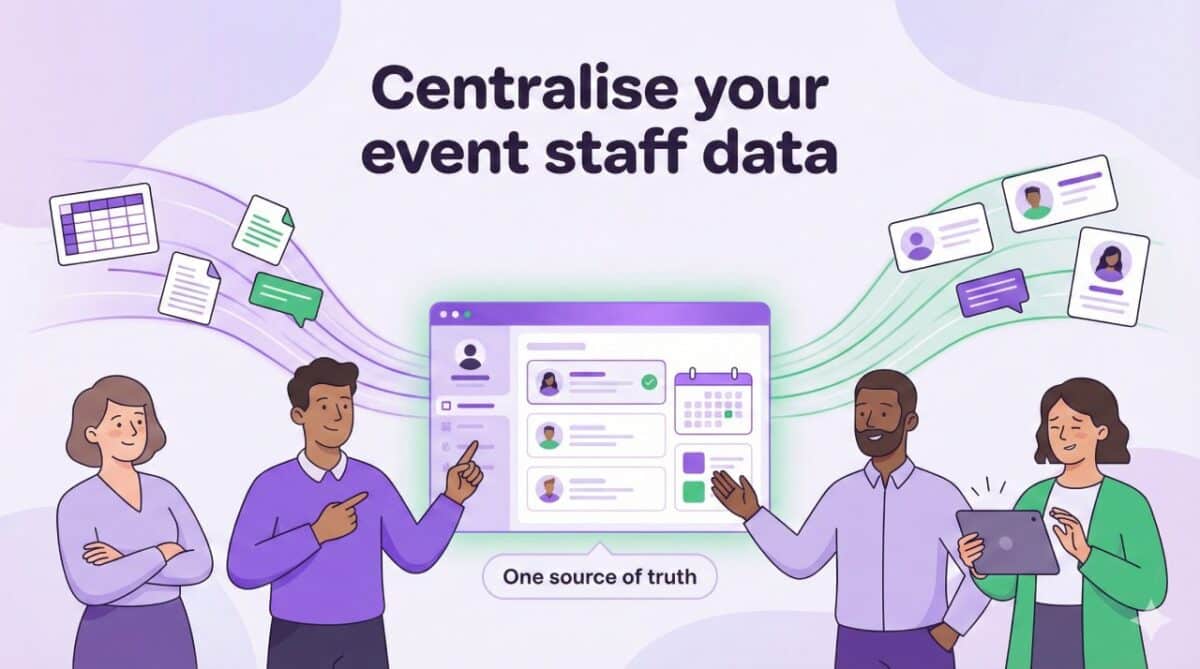
Centralising staff data reduces admin time and gives managers confidence that decisions are based on accurate information.
Example:
An event staffing agency works across hospitality, festivals, and corporate events. Instead of keeping staff details in multiple spreadsheets, they store contact information, roles, certifications, and previous event history in one central place.
When a new event comes in, the team can immediately see which staff have the right experience, who has worked similar events before, and whether any compliance documents are missing. This removes guesswork and saves hours of admin before scheduling even begins.
2. Track availability in real time
Knowing who is available, and when, is critical to managing event staff efficiently.
Many agencies still rely on manual methods such as group messages or email replies to confirm availability. This creates delays, misunderstandings, and double bookings.
A structured approach to availability management allows agencies to:
- See who is available at a glance
- Avoid scheduling clashes
- Respond quickly to client changes
When availability is visible in real time, teams spend less time chasing responses and more time focusing on delivery.

Example:
A hospitality supplier regularly manages last-minute bookings for pop-up events. Rather than sending group messages asking who is free, staff update their availability in advance.
When a new shift is added, managers can instantly see who is available and avoid double-booking someone already working another event. This reduces back-and-forth messages and allows the team to confirm staff faster, even under time pressure.
3. Schedule by role and skill, not just by name
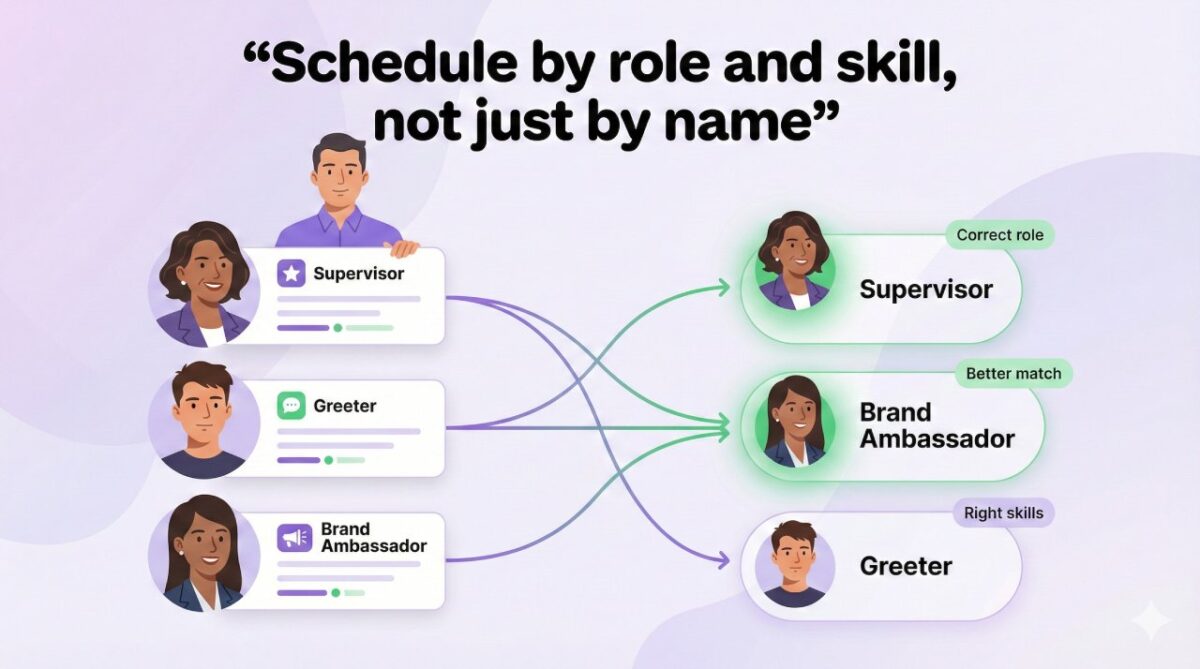
Effective event staff management is not about filling slots. It is about matching the right people to the right roles.
Scheduling staff purely by name increases the risk of:
- Skill mismatches
- Poor on-site performance
- Increased supervision requirements
Instead, agencies should structure schedules around:
- Role requirements
- Skill levels
- Experience
- Certifications where required
This approach improves event quality and reduces last-minute changes caused by unsuitable assignments.
Example:
For a large corporate event, an agency needs greeters, supervisors, and experienced brand ambassadors. Instead of assigning staff purely based on who is free, the scheduler filters by role and experience.
Senior staff are assigned to client-facing positions, while newer team members support lower-risk roles. This results in smoother delivery on the day and less need for on-site intervention.
4. Plan staffing across multiple events, not in isolation
One of the most overlooked aspects of how to manage event staff is multi-event visibility.
Agencies rarely manage one event at a time. Teams are often scheduled across overlapping dates, locations, and clients. Without a clear overview, it becomes easy to:
- Overbook staff
- Miss conflicts
- Create burnout within the workforce
Managing event staff effectively requires a holistic view of all active and upcoming events. This allows teams to:
- Balance workloads
- Spot clashes early
- Allocate resources more strategically
Multi-event planning is essential for agencies looking to scale without increasing operational stress.
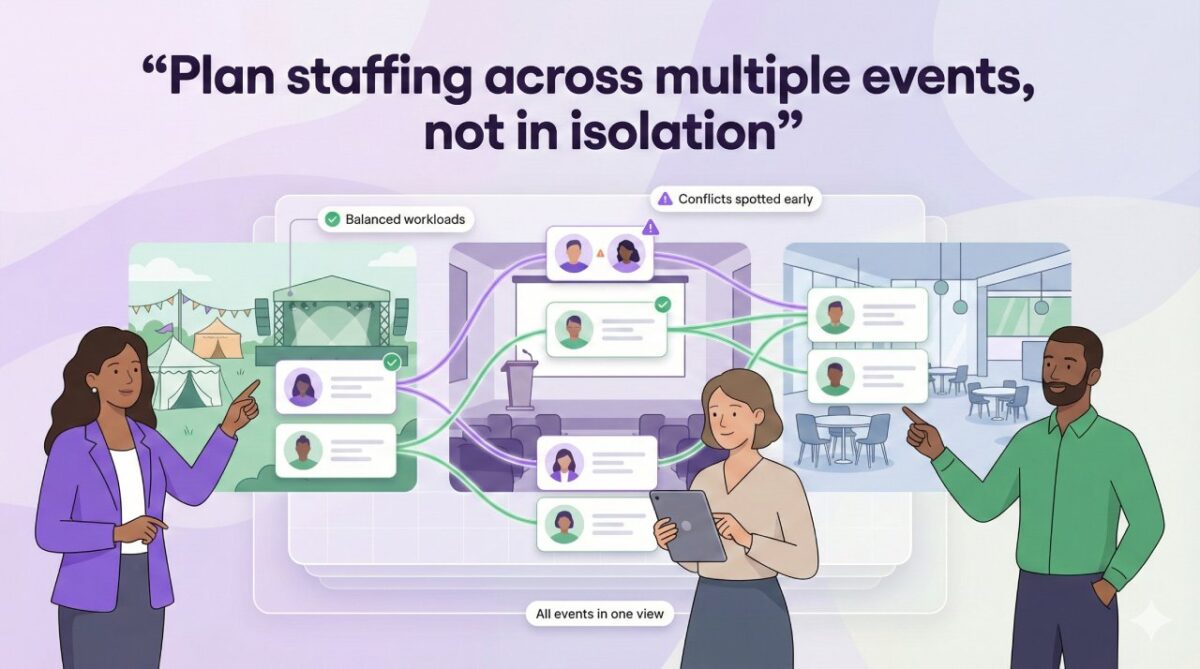
Example:
An agency is delivering three events in different locations over the same weekend. By looking at all events together, they notice that several experienced staff members were initially scheduled for overlapping shifts.
Adjusting the plan early prevents last-minute cancellations and avoids staff fatigue. The team can balance workloads across the weekend instead of fixing clashes at the last minute.
5. Centralise communication with event staff
Communication breakdowns are one of the most common causes of event delivery issues.
When information is shared across multiple channels, staff may miss:
- Shift changes
- Location updates
- Client requirements
- Arrival instructions
A centralised communication approach ensures that all staff receive consistent, up-to-date information in one place. This reduces confusion and improves accountability.
Clear communication is a core pillar of effective event staff management and directly impacts on-site performance.
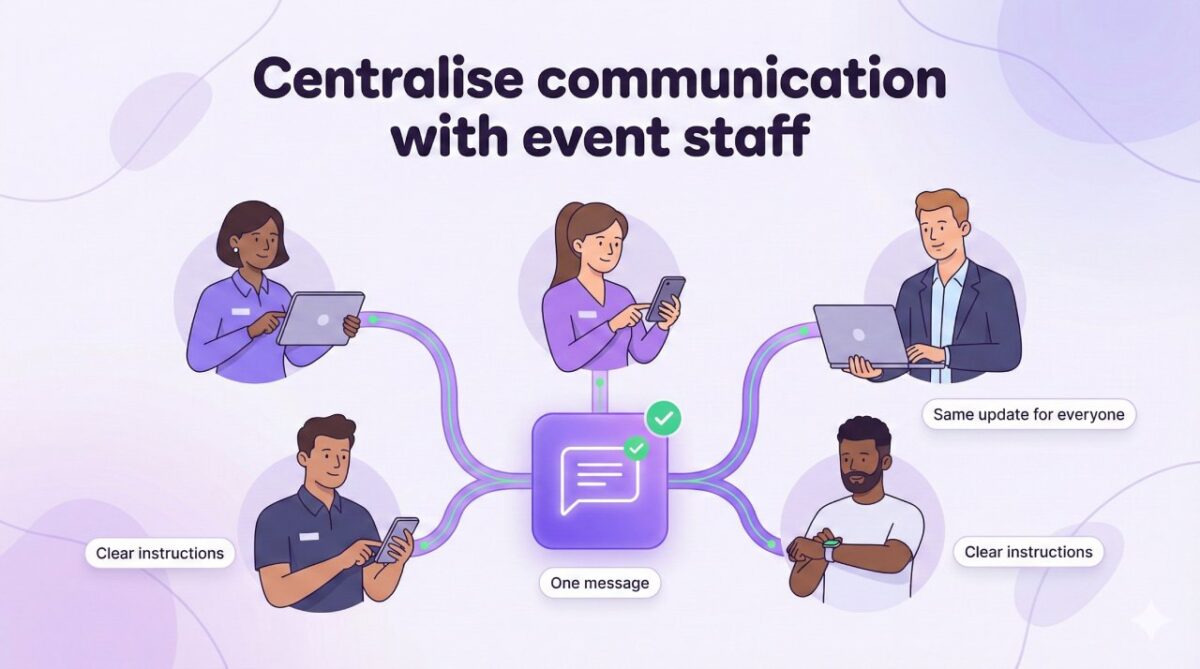
Example:
Before a festival, all shift details, arrival times, location notes, and updates are shared in one place.
When the client changes the load-in time the night before, staff receive the update immediately without having to check emails, texts, and WhatsApp groups. Everyone arrives informed and prepared, reducing confusion and delays on the day.
6. Prepare staff properly before the event
Strong event staff management starts well before the first shift begins.
Many operational issues on event days stem from poor preparation, such as:
- Unclear role expectations
- Missing documentation
- Inadequate briefings
To manage event staff successfully, agencies should ensure that:
- Roles and responsibilities are clearly defined
- Event details are shared in advance
- Compliance requirements are completed before arrival
Pre-event preparation reduces on-site supervision needs and creates a more confident, reliable workforce.

Example:
A promotional staffing agency sends role details, dress code requirements, and event schedules to staff several days before the event. Compliance documents are checked in advance, not on-site.
When staff arrive, they already know what is expected, where to go, and who to report to. This reduces first-day questions and allows supervisors to focus on delivery rather than onboarding.
7. Maintain visibility during live events
Live events are dynamic environments. Schedules change, staff run late, and client demands evolve.
Managing event staff during live delivery requires real-time visibility. Without it, managers are forced to rely on guesswork or constant manual check-ins.
Maintaining oversight allows teams to:
- Respond quickly to issues
- Adjust staffing levels as needed
- Support staff on the ground
Visibility during live events is essential for maintaining control and delivering a consistent client experience.

Example:
During a multi-day sporting event, a manager monitors attendance and shift coverage throughout the day.
When one staff member is delayed, the team can quickly reassign cover from another nearby area without disrupting the schedule. Having real-time visibility helps the team stay in control, even when plans change during live delivery.
8. Standardise post-event processes
Event staff management does not end when the event finishes.
Post-event processes such as timesheets, approvals, and payments are often time-consuming and error-prone. Inconsistent approaches can lead to:
- Delayed payments
- Staff dissatisfaction
- Increased admin workload
Standardising post-event workflows ensures that:
- Hours are recorded accurately
- Approvals are completed promptly
- Payments are processed efficiently
Reliable post-event processes are key to building trust with temporary staff and retaining reliable workers.

Example:
After each event, supervisors confirm hours worked the same day using a standard process. Timesheets are approved quickly and passed on for payment without chasing emails or correcting errors later.
Staff are paid on time, and the office team avoids spending days resolving payment queries after every event.
9. Review performance and build stronger teams
Managing event staff effectively also means learning from each event.
Agencies that review performance gain valuable insights into:
- Staff reliability
- Role suitability
- Training needs
This information helps teams make better staffing decisions in the future and strengthens the overall workforce.
Over time, performance data supports a more reliable and engaged staff pool, reducing recruitment pressure and improving delivery consistency.

Example:
After a series of events, an agency reviews attendance, punctuality, and role feedback. Staff who consistently perform well are prioritised for future bookings, while training needs are identified for others.
Over time, this creates a more reliable core team and reduces the need to recruit new staff for every event.
10. Use systems that support both delivery and scale
The final, and most important, aspect of how to manage event staff is recognising when manual processes no longer work.
As agencies grow, spreadsheets and disconnected tools create bottlenecks rather than flexibility. Scaling requires systems that support:
- Centralised data
- Real-time scheduling
- Clear communication
- Compliance tracking
- Multi-event visibility
Event staff management systems are not about replacing people. They exist to give teams the structure they need to operate efficiently at scale.

Example:
As an agency grows from managing a handful of events per month to dozens, spreadsheets become harder to maintain.
By using a single system to manage scheduling, communication, compliance, and payments, the team can take on more work without increasing admin headcount. Operations remain structured, even as event volume increases.
Liveforce supports agencies by providing one central platform to manage scheduling, communication, compliance, and payments across multiple events, allowing teams to focus on delivery rather than admin.
Common mistakes when managing event staff
Even experienced agencies and suppliers can fall into common operational traps when managing event staff, especially as event volumes increase and teams scale quickly.
These mistakes are rarely caused by poor intent. They usually stem from relying on processes that no longer match the complexity of the operation.
Common mistakes include:
- Relying on manual tools for complex operations
Spreadsheets, emails, and messaging apps may work for small teams, but they struggle to support multi-event scheduling, real-time changes, and compliance tracking. As complexity grows, manual tools increase the risk of errors and missed information. - Managing events in isolation rather than as part of a wider schedule
Planning each event separately makes it harder to spot staffing clashes, balance workloads, and avoid burnout. Without a clear view across all active and upcoming events, teams are more likely to overbook staff or react too late to conflicts. - Over-communicating across too many channels
Sharing updates via emails, texts, WhatsApp groups, and calls can lead to important information being missed or misunderstood. When messages are scattered, staff may arrive with outdated instructions or incomplete details. - Reacting to issues rather than planning for them
Constant firefighting often indicates a lack of visibility or preparation. When teams do not have clear data, structured workflows, or real-time oversight, they are forced to respond to problems as they arise instead of preventing them in advance.
Avoiding these mistakes is essential for improving control, reducing operational stress, and delivering consistent event experiences. Strong event staff management is built on clear systems, shared visibility, and proactive planning, not last-minute fixes.
How these tips support growth
Understanding how to manage event staff properly is not just about smoother events. It directly impacts an agency’s ability to grow.
When operations are under control:
- Teams spend less time firefighting
- Clients receive a more consistent service
- Staff are more likely to return for future work
- Businesses can confidently take on more events
Operational clarity creates capacity for growth without sacrificing quality.
Managing event staff is one of the most demanding aspects of running an event-focused business. It requires clear systems, structured processes, and consistent oversight across every stage of delivery.
By following these 10 practical tips, agencies can improve how they manage event staff on the ground while also building an operational foundation that supports long-term scale.
For organisations managing large temporary workforces, having the right systems in place makes the difference between constant firefighting and confident delivery. Liveforce provides the operational backbone that helps agencies manage event staff with clarity, control, and consistency across every event.
If your team is managing multiple events, large temporary workforces, or frequent last-minute changes, having a single operational system makes a measurable difference.
FAQs
What is the best way to manage event staff across multiple events?
The best way to manage event staff across multiple events is to use a central system that shows availability, roles, and schedules in one place. This prevents double-booking, improves visibility, and allows agencies to balance workloads across events without last-minute changes.
How do event staffing agencies manage temporary staff effectively?
Event staffing agencies manage temporary staff effectively by centralising staff data, tracking availability in real time, and standardising communication, onboarding, and payments. Clear processes reduce admin time and help teams stay in control during live events.
What are the biggest challenges when managing event staff?
The biggest challenges when managing event staff include last-minute availability changes, poor communication, manual scheduling, compliance tracking, and limited visibility across multiple events. These issues often arise when teams rely on disconnected tools instead of structured systems.
How can technology help improve event staff management?
Technology improves event staff management by providing real-time scheduling, centralised communication, compliance tracking, and multi-event visibility. Using a single platform helps agencies reduce errors, respond faster to changes, and scale operations without increasing admin workload.
How do you manage event staff more efficiently as your business grows?
As an event business grows, managing event staff efficiently requires moving away from spreadsheets and manual processes. Using an operational workforce management system allows agencies to handle more events, larger teams, and complex schedules while maintaining control and consistency.