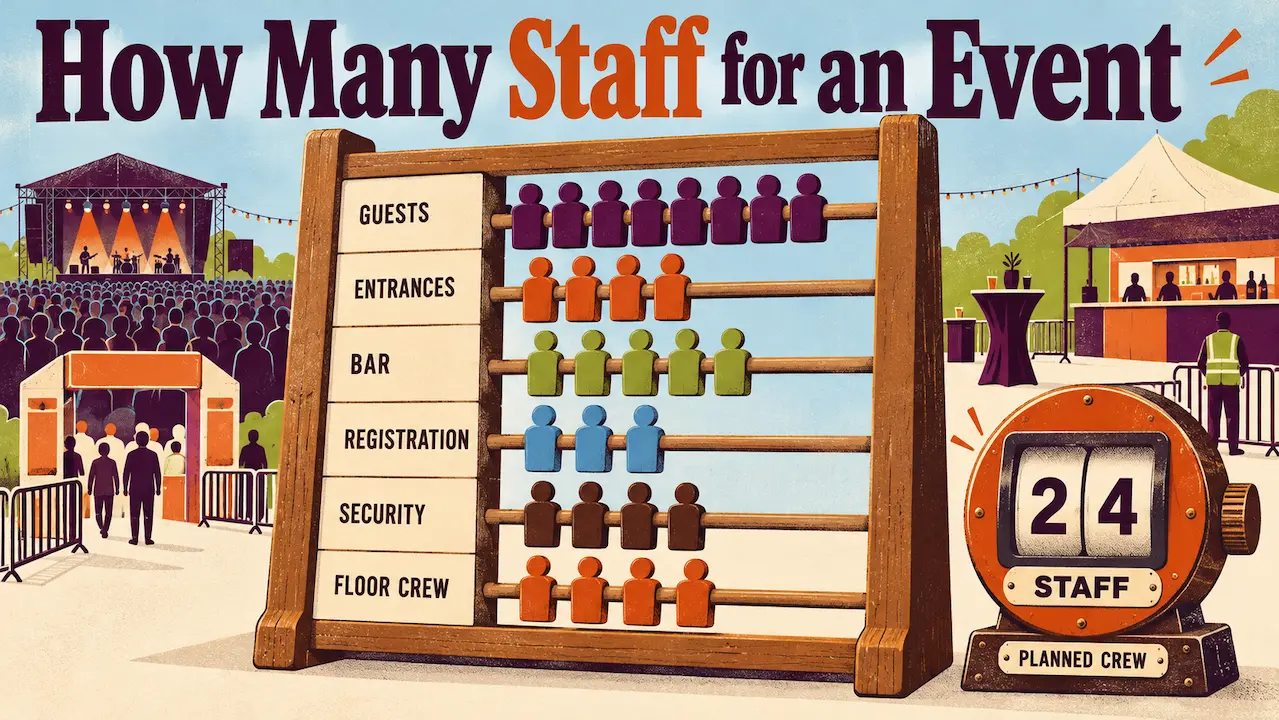
How many staff for an event depends on its format.
- A seated dinner needs about one person per 5 to 7 guests when the venue runs the kitchen.
- A conference with refreshments needs about one per 14 to 19 attendees, and a festival about one per 20.
- Add a standby buffer of around 10% on top.
Event organisers, venues and suppliers use these numbers to size their own teams. Agencies use them to check a client brief before quoting. The calculator below builds the full plan role by role, with staff-hours and standby included.
With the number set, the next job is to turn the headcount into a rota. In-house teams reuse each plan when staffing a venue’s events calendar across the season.
Use the Event Staffing Calculator
The Liveforce Event Staffing Calculator sizes a team role by role in about two minutes. Pick one of six event types, then set guest numbers, event hours and setup time. Switch off anything the venue or another supplier covers. It gives a first answer to how many staff for an event before any rota exists.
The plan shows headcount, staff-hours, a standby buffer and an estimated cost. Every ratio and hourly rate can be edited, and alerts flag gaps such as alcohol with no security.
There is no sign-up, and nothing entered is stored. Rates default to pounds, and the calculator also works in dollars and euros. You can print the plan or copy a summary to share with a client or venue.
Loading the event staffing calculator...
The figures are planning estimates. Licence conditions and your risk assessment always take precedence over any ratio.
How Many Staff Do You Need for an Event?
Most catered events and festivals need between one staff member per 4 guests and one per 20.
Food and drink drive most of that range. A plated dinner puts waiting staff on every table at the same moment. A conference with coffee breaks needs a much smaller floor team. Entry, bars, cleaning and security then add their own roles on top.
No single ratio answers how many staff for an event, because each format loads different roles. Event length matters too. Stretch a 300-person conference from 8 to 12 hours, and the team stays at 17. Its staff-hours rise from 170 to 238.
The quick-reference table below comes from the calculator at its default settings. Each shift includes two hours of setup and pack-down. Conferences assume refreshments only and QR check-in. Dinners assume a full bar and plated service at a standard level.
Swipe sideways to see every column
| Event format (calculator defaults) | Guests | Core team | Standby | Staff-hours |
|---|---|---|---|---|
| Conference, refreshments only, QR check-in, 8 hrs | 100 | 7 | +1 | 70 |
| Conference, refreshments only, QR check-in, 8 hrs | 300 | 17 | +2 | 170 |
| Conference, refreshments only, QR check-in, 8 hrs | 1,000 | 54 | +5 | 540 |
| Seated dinner, venue runs kitchen, full bar, 8 hrs | 50 | 9 | +1 | 90 |
| Seated dinner, venue runs kitchen, full bar, 8 hrs | 100 | 17 | +2 | 170 |
| Seated dinner, venue runs kitchen, full bar, 8 hrs | 200 | 31 | +3 | 310 |
| Seated dinner, you staff the kitchen, full bar, 8 hrs | 100 | 24 | +3 | 240 |
| Buffet, full bar, venue runs kitchen, 8 hrs | 200 | 18 | +2 | 180 |
| Drinks and canapés, beer and wine bar, 8 hrs | 200 | 16 | +2 | 160 |
| Festival, standing, bars, scan entry, 10 hrs | 1,000 | 52 | +7 | 624 |
| Festival, standing, bars, scan entry, 10 hrs | 5,000 | 250 | +33 | 3,000 |
| Stadium, seated, turnstiles, 6 hrs (excl. concessions) | 20,000 | 276 | +22 | 2,208 |
Conference and dinner rows leave out licensed security. That number depends on your licence and risk assessment, covered further down. The festival rows already include stewards, gate security and first aid.
A 200-guest seated dinner needs nearly twice the team of a 300-person conference.
The table gives the shape of a team. Multi-day events with several shift patterns need more detailed maths. For that, follow the full shift-by-shift method and run each day as its own plan.
Staff to Guest Ratios by Service Style and Standard
Service style sets the staff to guest ratio, and service standard moves it by roughly 20 to 25% either way.
Plated service needs the most people, because every course reaches every seat at once. Buffets and drinks receptions need fewer, and refreshment breaks fewer still. The calculator starts from these defaults, and every one can be changed in its Fine-tune step:
- Waiting staff: one per 14 guests for standard plated service, and one per 25 for buffets and receptions. Refreshment-only events need one per 40. Plated service adds one busser for every three waiting staff.
- Bar: one bartender per 50 guests for a full bar, or 75 for beer and wine. A cocktail-led bar needs one per 40, plus one bar back for every three bartenders.
- Kitchen: one chef per 25 covers for plated food when you staff the kitchen yourself. Add one kitchen porter for every three chefs.
- Entry: one staffed position clears about 150 guests an hour with QR scanning, or about 75 from a manual list.
- Team leaders: one per 10 staff on the floor, from four staff upwards.
Service standard changes the waiting-staff number most. Premium plated service runs at about one waiter per 11 guests. Casual plated service runs at about one per 18. A buffet moves from one per 25 at standard to one per 20 at premium.
Premium plated service needs about a quarter more waiting staff than standard service.
Caterers running several dinners a week rely on these defaults when scheduling seated-dinner teams across different venues. The defaults are a starting point. A tight room, a long wine list or a complex menu all justify more waiting staff. For bars, stewarding and medical cover by sector, see the separate guide to sector ratio benchmarks and sources.
How Many Staff for 100 Guests?
A 100-guest event needs about 7 staff for a conference with refreshments and about 17 for a seated dinner.
For 100 guests, how many staff for an event depends almost entirely on the menu. The conference team has three waiting staff for the breaks and one person on QR check-in. One host, one cleaner and one team leader complete it, with one more on standby.
The seated dinner assumes the venue runs the kitchen. It needs eight waiting staff and three bussers to clear between courses. Two bartenders and a bar back run a full bar. One cleaner and two team leaders complete the team, with two more on standby. That plan adds up to 170 staff-hours on a 10-hour shift.
A 100-guest drinks reception with canapés and a beer and wine bar needs only nine. Four waiting staff, two bartenders, a bar back, a cleaner and a team leader cover it.
Staffing the kitchen yourself takes a 100-guest dinner team from 17 to 24.
That adds four chefs, two kitchen porters and a third team leader. Licensed security adds at least two more, because the calculator never plans fewer than two.
CASE STUDY EXAMPLE:
Bespoke caterers see this range every week. Indulge Catering builds each event’s team from scratch because each event is designed for one client. Its team of more than sixty chefs, front-of-house managers and service staff is scheduled event by event. The numbers change with every menu and venue, so the plan has to change with them.
How Many Security Staff for an Event in the UK?
In the UK, licence conditions and the event’s risk assessment set the number of security staff. For larger events, the local Safety Advisory Group reviews the plan as well.
The Security Industry Authority does not publish a standard ratio. In a 2023 Freedom of Information response, the SIA said the premises licence sets the number where one applies. The same applies to any conditions attached to a Temporary Event Notice.
The calculator uses common planning starting points. Low-risk events start at one licensed officer per 150 attendees. Standard risk starts at one per 100, and high risk at one per 75. The minimum is two officers, and serving alcohol raises the risk level by one step.
Stewards and licensed security do different jobs. Stewards guide crowds and manage queues. Licensed door supervisors handle searches, refusals and incidents, and they need an SIA licence. It helps to keep your team’s licence records in one place. Gate shifts then go only to people with a current licence on file.
A 600-guest dinner at standard risk with a full bar starts at eight licensed officers.
How Many Staff Do You Need at the Gate?
Entry staffing follows how fast guests arrive. One staffed position clears about 75 guests an hour from a manual list.
With QR scanning, it clears about 150, at kiosks, about 200, and at turnstiles, about 600. If 1,000 guests arrive within an hour via QR scanning, plan about seven entry positions. A manual list would need fourteen for the same arrival window.
Shifts, Staff-Hours and Standby: The Hidden Headcount
A headcount becomes a working plan once it includes the hours and the cover. Two plans with the same number of people can differ by hundreds of staff-hours. A plan for how many staff are needed for an event should state both numbers: the people and the hours.
Check these four items before the rota goes out:
- Setup and pack-down: the calculator adds two hours to every shift by default. An 8-hour event becomes a 10-hour shift for each person.
- The 4-hour minimum: many staffing suppliers book at least four hours. The calculator never plans a shift shorter than that.
- Double-crewing: events of 10 hours or more should run two crews for continuous roles. That covers security, stewarding, cleaning and first aid.
- Standby buffer: plan about 10% on standby, or 15% for festivals. Operators running large temporary teams usually allow for 5 to 10% dropout.
A 300-person conference team of 17 works 170 staff-hours on a 10-hour shift.
Standby only works if those people are confirmed in advance and know where to go. When someone drops out on the morning, the standby list is how you fill gaps from your own pool. It replaces a round of early phone calls. Give standby staff the same brief as the main team, so they can step into any post.
How Much Does It Cost to Staff an Event?
To work out the cost to staff an event, multiply each role’s staff-hours by its hourly rate. Then add the role totals together. The calculator does this for you, and every rate can be set to match your own.
In 2026, the UK floor is the National Living Wage of £12.71 an hour for workers aged 21 and over. Irregular-hours workers also accrue holiday at 12.07% of hours worked. That takes one crew hour to £14.24.
Employer National Insurance adds 15% on earnings above £5,000 a year, under HMRC’s rates for 2026 to 2027. A workplace pension adds more where the worker is eligible.
Once employer National Insurance applies, one crew hour costs up to £16.38 before pension, overheads or margin.
Agency charge rates sit above that floor, because they also cover overheads and margin. The calculator’s pound defaults start at £18 an hour for entry roles such as stewards, cleaners and hosts. They are indicative, so replace them with your own rates or a supplier’s quote. Skilled roles such as chefs, licensed security and team leaders carry higher defaults.
Costs only stay accurate if the hours do. Teams that approve hours after each shift can compare worked hours with the plan before payroll and invoicing. Holiday pay on zero-hours contracts has its own detailed guide on the Liveforce blog.
Staffing Festivals, Stadiums and Large Venues
At scale, each zone is staffed by its own flow of people. Gates, bars, stewarding and first aid grow at different rates, so a single total hides the detail. For a festival or stadium, how many staff for an event becomes a question for each zone.
A 1,000-capacity festival with bars and scan entry needs about 52 staff, plus seven on standby.
At 5,000 capacity, the festival team reaches about 250 staff, 33 on standby and 3,000 staff-hours.
Bars are the largest block in that plan, with 67 bartenders and 23 bar backs. Gates and the box office take 34, and stewards another 50.
A seated stadium of 20,000 needs about 276 staff for entry, stewarding, cleaning, first aid and supervision. Stadium stewarding follows crowd type. The calculator starts at one steward per 250 for seated crowds, 150 for mixed and 100 for standing.
Concessions and hospitality are sized separately, often by their own suppliers. Above 20,000, the calculator flags that zoned operations and phased shifts take over. Treat its result as the starting point for the operations plan.
First aid figures in the calculator are indicative. A medical needs assessment sets the real cover, and the Purple Guide is the UK reference for outdoor event safety. Major venues and large events follow the same logic, one zone at a time. Festival suppliers plan festival crews by zone and shift so each gate, bar and arena has its own team.
How Liveforce Turns the Number into a Working Rota
A plan that says 17 staff is still a number on a page. The risk sits between that number and 17 confirmed people at the right door at 5 pm. For many teams, that gap lives in a spreadsheet and a busy WhatsApp group. Changes arrive by phone, and nobody is sure which version of the rota is current.
- Shifts are built role by role from the plan, across setup, service and pack-down.
- The staff database shows who in your own team has the skills or licence records each role needs. It also shows who is free on the day.
- Coordinators use the platform to brief the team before doors open and push late changes to everyone at once.
- On the day, check-in shows who has arrived and which posts are still empty.
- Timesheets then turn worked shifts into approved hours for payroll and client invoices.
- Payroll itself stays in the payroll system you already use.
Liveforce runs the team you already have and does not hire, source or supply staff.
It is built for event organisers, venues, caterers, festival suppliers and staffing agencies that run large temporary teams. Crew confirm shifts and read their briefs in the Crew App
Start with the Number, Then Plan the Team
Once you know how many staff for an event you need, the risk moves to the people. The questions become who works, when, and whether each person is confirmed. Size the plan role by role, then add the hours, the standby and the security your licence requires. Check the gate against your arrival window, and the cost against real rates.
A sized plan only protects the event once every shift in it is confirmed and briefed.
Put the plan into shifts early enough to brief everyone before doors open. Recheck it whenever the guest list, menu or bar changes.
Seated dinners, conference days and festival weekends each need their own staffing plan. Bring one of your plans to a Liveforce demo and see it turned into confirmed, briefed shifts. Book a demo.
How Many Staff for an Event: FAQs
How many staff do I need for an event?
The answer to how many staff for an event depends mostly on food and drink. Seated dinners need about one per 5 to 7 guests, and buffets and receptions one per 11 to 13. Conferences with refreshments need one per 14 to 19, festivals one per 20, plus about 10% standby.
How many staff do I need for an event with 100 guests?
A 100-person conference with refreshments needs about 7 staff. A 100-guest seated dinner needs about 17 when the venue runs the kitchen, or 24 if you staff it. Plan one to three people on standby on top.
How many security staff does a UK event need?
Your licence conditions and risk assessment set the number, and the Safety Advisory Group reviews larger events. A common starting point is one licensed officer per 150 attendees at low risk. That tightens to one per 75 at high risk, with a minimum of two.
When should an event staffing plan be finalised?
Lock the headcount once guest numbers, service style and bar plans are confirmed. Then leave enough time to confirm every shift and brief the team before doors open. Recheck the plan whenever the guest list or menu changes.
How much does it cost to staff an event in the UK?
Multiply each role’s staff-hours by its hourly rate. In 2026 the floor is the £12.71 National Living Wage plus holiday and employer costs. The calculator’s pound defaults start at £18 an hour, and you can set your own.